Thinking about a career change to healthcare often brings to mind images of endless schooling and grueling shifts. The good news? That’s not the whole story. This stable, rewarding field is far more accessible than most people realize. A successful switch is all about finding where your unique skills and passions align with a role that makes a real difference.
Is a Career Change to Healthcare Right for You?
The thought of starting over can be intimidating, but healthcare is actively looking for people with diverse backgrounds. Your experience in business, tech, or customer service brings a fresh perspective that’s incredibly valuable in both patient care and the operations that support it. This isn’t just about finding a new job; it’s about finding genuinely meaningful work.
For many, this pull comes from a deep desire for purpose. After years in another industry, the need to do something that truly matters can become overwhelming. Healthcare delivers that opportunity in countless ways, whether you’re interacting directly with patients or making sure the systems behind the scenes run like clockwork.
This isn’t just a feeling, either—the numbers back it up. The U.S. healthcare sector is projected to add about 2 million new jobs between 2021 and 2031, a growth rate that outpaces most other industries. This boom creates a huge window of opportunity for anyone ready to make a change. If you want to see the hard numbers, you can explore the data on the global healthcare workforce gap for a deeper dive into these trends.
Honestly Assessing Your Motivation and Skills
Before you start filling out applications, it’s time for some candid self-assessment. A career change to healthcare is more than just a professional move; it’s a lifestyle shift. It demands emotional resilience, deep empathy, and the ability to stay calm in high-stress situations.
Start by taking inventory of the skills you already have. Don’t sell yourself short.
- Communication Skills: Ever managed a difficult client or trained a new team member? That’s patient education and clinical team collaboration right there.
- Problem-Solving: Did your old job involve troubleshooting tricky issues or navigating tight deadlines? Healthcare is all about thinking on your feet under pressure.
- Teamwork: Almost every role in healthcare is a team sport. Your experience on group projects or coordinating between departments is a massive advantage.
Think of your previous career as a training ground. A retail manager already knows how to handle an upset customer with grace—a skill that translates perfectly to managing an anxious patient. An administrative assistant’s knack for organization is exactly what’s needed for a role in medical billing or coding.
Key Takeaway: Your professional history isn’t something to forget. It’s a toolbox of transferable skills that makes you a stronger, more adaptable candidate for a role in healthcare. Learn to frame that experience as the asset it is.
Gauging Your Emotional and Financial Readiness
Beyond your professional skills, you need to think about the emotional demands. Are you comfortable with the inherent unpredictability of health? Can you stay compassionate yet professional when things get tough? Shadowing a professional or volunteering at a local clinic for a few shifts can be an invaluable reality check.
Finally, let’s get practical and talk about money. Your transition will almost certainly involve some training, whether it’s a quick certification course or a two-year degree. You need a realistic budget that covers tuition, supplies, and potentially a temporary dip in your income while you study.
Look into all your funding options:
- Scholarships and Grants: Many organizations offer financial aid specifically for people entering the healthcare field.
- Employer Tuition Reimbursement: If you’re still working, see if your current company has a program to help pay for education.
- Federal and Private Loans: Explore the options available for career-changers going back to school.
It’s crucial to have a solid financial plan. Researching the potential return on your investment is also a smart move. Understanding the typical salary for the role you’re aiming for can give you a clear picture of the long-term benefits. For example, you can learn more about how much CNAs make to get a sense of what you might earn in an entry-level position. Building this honest foundation allows you to move forward with confidence.
Pros and Cons of a Healthcare Career Change
Every major life decision comes with its own set of highs and lows. Shifting into healthcare is no different. It’s essential to look at the full picture—the rewarding aspects and the undeniable challenges—before you commit. This table breaks down what you can realistically expect.
| Key Considerations | Potential Rewards (Pros) | Potential Challenges (Cons) |
|---|---|---|
| Job Security & Demand | The field is growing rapidly, offering high stability and abundant opportunities. | Some regions or specialties can be highly competitive. |
| Personal Fulfillment | You’ll find deep meaning in directly helping people and making a tangible impact on lives. | The work can be emotionally draining; dealing with illness and loss takes a toll. |
| Career Advancement | There are numerous pathways for growth, from specialization to leadership roles. | Advancement often requires additional education, time, and financial investment. |
| Work Environment | You’ll be part of a collaborative, team-oriented environment focused on a common goal. | The work can be physically demanding, with long hours and irregular shifts (nights/weekends). |
| Financial Outlook | Salaries can be competitive, especially with experience and specialization. | Entry-level positions may start with modest pay, and education costs can be significant. |
Ultimately, weighing these factors against your personal goals and circumstances is the key. While the challenges are real, for many, the profound sense of purpose and stability makes the transition a life-changing and worthwhile journey.
Finding Your Niche in the Healthcare Field
The word “healthcare” is huge, but your starting point doesn’t have to be overwhelming. Let go of the idea that you need a decade of school before you can start making a real impact. A smart career change to healthcare usually starts with finding an accessible role that fits your existing skills and gets you in the door quickly.
The trick is to focus on roles with a clear and efficient certification path—ones that don’t demand a four-year degree right off the bat. This approach minimizes your time on the sidelines and gets you into a rewarding job much faster. From there, you can build your career, gain invaluable experience, and decide if more education makes sense down the road.
High-Impact Entry-Level Roles to Consider
Let’s talk about some of the most practical entry points I’ve seen career changers succeed in. These jobs are always in demand and serve as a fantastic launchpad into the wider world of medicine.
- Certified Nursing Assistant (CNA): As a CNA, you’re right on the front lines, helping patients with the essential activities of daily life—bathing, dressing, moving around. The training is incredibly fast, often just 4-12 weeks, making it one of the quickest routes to direct patient care.
- Medical Coder: If you’re a stickler for details and prefer working behind the scenes, medical coding is a perfect fit. You’ll be the one translating diagnoses and procedures into the universal codes used for billing. Certification programs usually take less than a year.
- Phlebotomy Technician: Phlebotomists are the specialists who draw blood for tests, and they are absolutely vital to the diagnostic process. Training is short—often just a few months—and the job demands a steady hand and a calm, reassuring demeanor with patients.
Each of these paths provides a solid foundation. If you want to see what else is out there, check out our guide to the best entry-level healthcare jobs.
Here’s a real-world example: I once worked with a former retail manager, Sarah, who was completely burned out. She channeled her amazing customer service skills into becoming a CNA. Her knack for calming anxious people and showing genuine empathy made her a natural with patients, proving that her “soft skills” were just as critical as any clinical training.
Clinical vs. Non-Clinical: Where Do You Fit?
It’s crucial to understand the two main branches of healthcare work: clinical and non-clinical. Clinical roles mean you’re hands-on with patients. Non-clinical roles are all about supporting the system from an administrative or operational angle.
A Clinical Role Might Be Your Calling If:
- You thrive on personal interaction and want to be directly involved in a patient’s well-being.
- You’re empathetic by nature and can keep a cool head when things get stressful.
- You enjoy hands-on tasks and are comfortable with the physical side of caregiving.
A Non-Clinical Role Could Be a Better Match If:
- You’re a master of organization, data, and detail-oriented work.
- You prefer a more structured, office-based environment.
- You want to be part of the healthcare solution without the direct patient-facing responsibilities.
Think about it: an administrative assistant’s talent for organization is a perfect match for medical billing, where one tiny error can cause huge problems. There’s no “right” path—it’s all about matching what you’re naturally good at with the day-to-day reality of the job.
Weighing the Investment and the Return
When you’re planning a career pivot, you have to be practical about the time and money involved. The beauty of entry-level certifications is that they offer a fantastic return on your investment by getting you into the workforce fast.
Here’s a quick look at what to expect for a few popular roles:
| Role | Typical Training Time | Average Cost Range | What a Day Feels Like… |
|---|---|---|---|
| CNA | 4-12 weeks | $800 – $2,000 | Fast-paced, physically active, and highly interactive with patients. |
| Medical Biller/Coder | 4-9 months | $3,000 – $10,000 | Detail-focused, analytical, and computer-based, requiring intense concentration. |
| Phlebotomist | 1-4 months | $700 – $3,000 | Precise, methodical, and involves brief but crucial patient interactions. |
The demand for skilled healthcare workers is absolutely skyrocketing. Some positions, like nurse practitioners, are projected to grow by a staggering 46% by 2030. This boom is largely driven by an aging population; the Congressional Budget Office expects the number of Americans over 65 to grow by 8 million in the next five years alone. This isn’t a temporary trend—it’s a fundamental shift that ensures long-term job security across the entire healthcare sector. Finding your place now is a strategic move for a stable and meaningful future.
Figuring Out Your Education and Certification Plan
So, you have a role in mind. Awesome. Now comes the part that can feel a little daunting: getting the right qualifications to actually land the job. When you start looking, you’ll see dozens of different paths, programs, and certifications. It’s easy to get overwhelmed.
The secret is to focus on what makes sense for you. Think about your specific career goal, how much time you can realistically commit, and what your budget looks like. For most people switching careers, a short-term certificate is the quickest, most direct route into the healthcare field. These programs are designed to get you job-ready for a specific role—like a phlebotomist or medical assistant—without the time and expense of a full degree.
This infographic breaks down the typical time and cost you can expect for different healthcare education pathways.
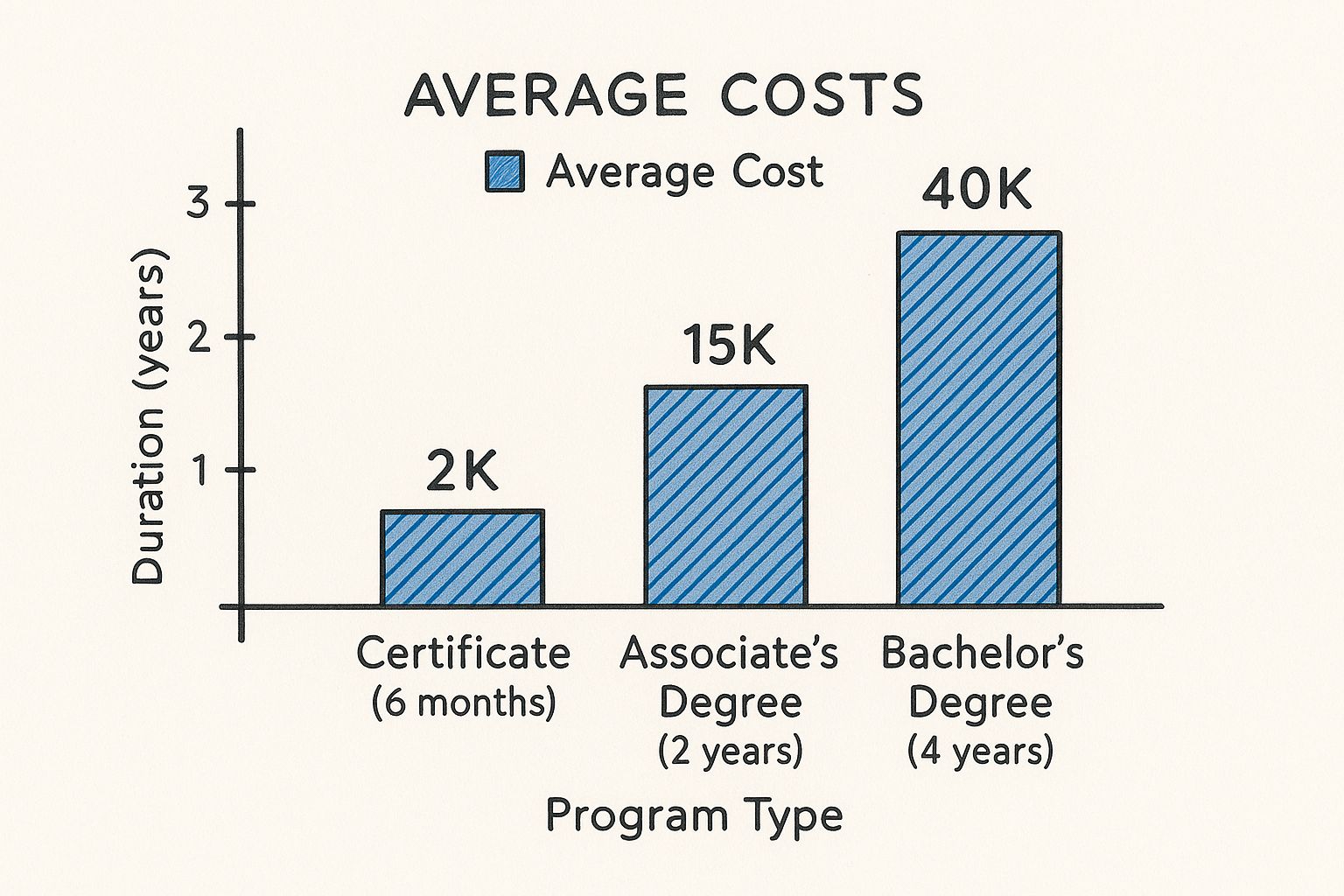
As you can see, certificate programs are the clear winner for speed and affordability, which is why they’re such a popular choice for career changers who want to start working and earning sooner.
To give you a better idea of what’s out there, here’s a quick look at some of the most common entry-level certifications.
Entry-Level Healthcare Certification Comparison
| Certification | Typical Training Time | Average Cost | Common Job Titles |
|---|---|---|---|
| Certified Nursing Assistant (CNA) | 4-12 weeks | $800 – $2,000 | Nursing Assistant, Patient Care Technician |
| Certified Medical Assistant (CMA) | 9-12 months | $2,500 – $5,000 | Medical Assistant, Clinical Assistant |
| Certified Phlebotomy Technician (CPT) | 2-4 months | $700 – $1,500 | Phlebotomist, Lab Assistant |
| Certified Billing & Coding Specialist (CBCS) | 4-9 months | $2,000 – $7,000 | Medical Coder, Billing Specialist |
This table is just a starting point, but it shows how different roles require different levels of investment in both time and money. Weighing these factors will help you narrow down the best fit for your personal roadmap.
Choosing the Right Program for You
Listen, not all training programs are created equal. The absolute last thing you want is to pour your time and money into a certificate that employers won’t recognize.
That’s why accreditation is non-negotiable. It’s the seal of approval that tells you—and future employers—that a program meets rigorous quality standards. When you’re researching schools, look for accreditation from respected organizations. For nursing, that would be the ACEN or CCNE. For other allied health fields, you’ll want to see names like CAAHEP.
Beyond that, you need to think about the practical stuff:
- How it fits your life: Can you really make it to in-person classes every day? Or would a part-time or online program work better with your current job and family commitments?
- Hands-on experience: Does the program have a clinical or externship component? This is where the learning really clicks. It’s one thing to read about drawing blood; it’s another to actually do it with a real patient.
- Help finding a job: Good programs don’t just teach you and send you on your way. They often have career services that help you polish your resume, practice for interviews, and connect you with local hospitals and clinics.
Insider Tip: Ask programs for two specific numbers: their recent graduate employment rate and their first-time certification exam pass rate. Honest, successful programs will be proud to share these with you. If they’re hesitant, that’s a red flag.
Tackling Your Certification Exam
Once you’ve finished your training, there’s usually one final hurdle: the certification exam. This is the standardized test that proves you officially know your stuff. Whether you’re sitting for a medical assisting exam through the NHA or the CPC exam for medical coding, your preparation will make all the difference.
Treat studying like a part-time job. Block out time on your calendar and be consistent. I’ve seen so many students succeed by teaming up with classmates. A study group is perfect for quizzing each other and staying motivated when the material gets tough.
Practice tests are your best friend here. They get you comfortable with the question formats and the pressure of the clock. If you’re aiming to become a CNA, for instance, drilling practice questions is one of the most powerful study techniques out there. For a deeper dive, you can learn more about how to master the CNA written exam and ace it with field-tested strategies.
Funding Your New Career Path
Let’s talk about the money. The cost of changing careers can be stressful, but don’t assume you have to pay for it all yourself. You have options.
Your very first step should be filling out the Free Application for Federal Student Aid (FAFSA). This will tell you if you’re eligible for federal grants, which is free money you don’t have to pay back.
Dig a little deeper, and you’ll find that many professional organizations offer scholarships just for healthcare students. And here’s another great tip: some hospitals and large healthcare systems have tuition reimbursement programs for their employees. This means you could land a great entry-level job and have them help pay for your next certification. Planning how you’ll pay for school is just as important as planning what you’ll study.
Your Past Experience is Your Greatest Asset
So many people making a career change into healthcare make the same mistake: they try to pretend their old career never happened. But your past work isn’t something to hide—it’s your secret weapon. You’ve spent years honing valuable skills that healthcare employers are desperate for. You just need to learn how to speak their language.
Don’t fall into the trap of thinking your background is irrelevant. A project manager who has juggled impossible deadlines and demanding stakeholders already gets the fundamentals of coordinating a patient’s care plan. A customer service rep who has calmed down angry customers is perfectly primed for patient advocacy.
The trick is to reframe what you’ve already accomplished. You’re not starting from zero; you’re simply pointing your expertise in a new, more meaningful direction. That diverse background is exactly what will make you stand out.
From Corporate Skills to Clinical Strengths
First things first: do a “skills audit” of your own resume. Go through your past jobs line by line and pinpoint the core competency behind each task. Forget the industry jargon for a minute and focus on the universal ability you were using.
You’ll be surprised how quickly skills from seemingly unrelated fields connect directly to healthcare needs.
- Retail Management: You weren’t just managing inventory; you were practicing resource allocation under pressure and using conflict resolution skills daily. That’s life on a busy clinic floor.
- Administrative Assistant: You didn’t just schedule meetings; you were running complex logistical coordination and information management. That’s the backbone of any well-run medical office.
- Sales or Marketing: It wasn’t just about hitting quotas. It was about building rapport, educating consumers, and using persuasive communication—all vital skills for patient education and building trust.
My Takeaway: At its core, healthcare is about people and the complex systems that support them. If your background involves managing people, data, or processes, you already have a head start. Your job is to connect those dots for the hiring manager.
Rewriting Your Resume for Healthcare Recruiters
Once you’ve identified your transferable skills, it’s time to translate them on your resume. This means swapping out your old corporate buzzwords for language that resonates in a healthcare setting. You have to show, not just tell, how your past prepares you for your future.
Let’s look at a few real-world examples of how to rephrase your resume bullet points to catch a recruiter’s eye.
Scenario 1: From Project Manager to Clinic Coordinator Applicant
- Before: “Led a cross-functional team to deliver a software project on time and 15% under budget.”
- After: “Coordinated multi-departmental teams to achieve project goals, demonstrating strong resource management and timeline adherence skills essential for patient care coordination.”
Scenario 2: From Customer Service Rep to Medical Assistant Applicant
- Before: “Handled an average of 50+ customer inquiries per day, resolving issues with a 95% satisfaction rate.”
- After: “Managed high-volume client communications using active listening and empathetic problem-solving to ensure positive outcomes—skills directly transferable to effective patient interaction.”
See the difference? The “after” versions spotlight the underlying abilities—like resource management and empathetic communication—that are universally critical in any clinical environment.
Telling a Story That Makes Sense
Your resume gets you in the door, but your story gets you the job. When you’re making a career change to healthcare, you absolutely need a clear, compelling narrative that answers the big question: “Why?” Why this change? And why now?
You want to frame this move not as an escape from your old job, but as a deliberate step toward something that aligns with your personal values.
Here’s a simple but effective framework for your story:
- Anchor in Your Past: Start by acknowledging your previous field and one key skill you mastered. “In my decade in logistics, I became an expert at streamlining incredibly complex processes.”
- State Your Motivation: Connect that skill to your new passion. “I realized I wanted to apply that skill to a system that directly helps people, which is what pulled me toward healthcare operations.”
- Show Your Commitment: Mention your recent training or certification to prove you’re serious. “That’s why I pursued my Medical Billing and Coding certification—to build on my organizational skills with the specific knowledge this industry requires.”
This kind of narrative shows you’re a thoughtful, motivated professional who has strategically planned this move. And that makes you exactly the kind of candidate they want to hire.
How Technology Is Reshaping Healthcare Careers

If you’re considering a career change to healthcare, you need to think about technology. The old world of overflowing file cabinets and scribbled paper charts is disappearing. Today’s healthcare system is built on a digital framework, creating a ton of new opportunities for people who are comfortable in a tech-driven world.
This isn’t just about futuristic research labs. It’s about the everyday software and hardware that make a modern clinic or hospital function. From patient scheduling systems to the diagnostic equipment in an exam room, technology is deeply embedded in almost every role, whether you’re working with patients or behind the scenes.
For anyone looking to make a career switch, this is great news. Your ability to pick up new software isn’t just a nice-to-have skill—it’s a critical asset that can make your transition into healthcare much smoother.
The New Must-Have Skills: Tech Literacy in Healthcare
At the center of it all are Electronic Health Records (EHR). An EHR is essentially a patient’s entire medical story in a digital file—lab results, medications, allergies, treatment plans, everything. Everyone from a Certified Nursing Assistant (CNA) to a top surgeon relies on these systems to log updates, communicate with other providers, and ensure seamless patient care.
Then there’s telehealth. Virtual visits exploded during the pandemic, but they’ve stuck around for a good reason: they make healthcare more accessible. This shift demands staff who can not only manage a video call but also navigate the platforms for secure messaging and virtual appointment scheduling.
Simply put, being comfortable with these tools is a baseline expectation now. If you’re coming from another field, make sure your resume highlights any experience with databases, scheduling software, or digital communication tools. It’s a clear signal to hiring managers that you’re ready for a modern healthcare setting.
Key Insight: Don’t underestimate your existing tech skills. Your experience in a completely different industry is more relevant than you think. Frame your ability to learn new software or manage digital records as a core strength, and you’ll immediately stand out.
Beyond the Bedside: Emerging Tech-Focused Roles
The digital shift has also opened up a whole new category of non-clinical jobs, perfect for people with backgrounds in IT, data analytics, or project management. These roles are essential for keeping the healthcare system running efficiently and securely.
Here are a few high-growth areas to keep an eye on:
- Health IT Support: These are the people who keep a hospital’s digital heart beating. They troubleshoot EHR glitches, manage network security, and make sure clinical staff have reliable access to the tech they need.
- Healthcare Data Analyst: Hospitals produce a staggering amount of data. Analysts dive into this information to spot trends, help improve patient outcomes, and find ways to make operations more efficient.
- Patient Engagement Specialist: This role bridges technology and patient care. These specialists often manage patient portals and mobile apps, helping people stay on top of their appointments, access their records, and become more involved in their own health.
The sheer volume of healthcare data is fueling this trend, creating a huge demand for professionals who can make sense of it all. As you can explore more insights about the future of healthcare data, you’ll see how this creates a clear path for career changers with skills in data and digital systems.
Your tech background isn’t just transferable; it’s one of your most valuable assets. It could be your express ticket to a stable and fulfilling career in healthcare.
Got Questions About Switching to a Healthcare Career? We’ve Got Answers.
Making a huge career leap is bound to stir up a lot of questions. That’s a good thing. Facing those uncertainties head-on is how you find the clarity to move forward with real confidence. Let’s tackle some of the most common concerns people have when thinking about a career change to healthcare.
We’ll cut through the noise with direct, practical answers to help you get unstuck and start planning your next move.
Can I Get a Job in Healthcare Without a Medical Degree?
Yes, absolutely. This is probably the single biggest myth about working in healthcare. We all think of doctors and surgeons, but they’re just one piece of a massive, complex puzzle. The truth is, the industry is desperate for talent in countless roles that don’t require an M.D.
Many fantastic, in-demand jobs only require a certificate or an associate’s degree. You can often get certified and start working in under two years, which is a game-changer for anyone looking to make a switch without going back to school for a decade.
Think about jumping into powerful roles like these:
- Medical Assistant: You’re the engine of the clinic, handling everything from patient scheduling to taking vitals.
- Phlebotomy Technician: Your specialized skill in drawing blood is absolutely essential for diagnosing and treating patients.
- Health Information Technician: You’re the guardian of patient data, managing sensitive records and ensuring everything is accurate and secure.
These aren’t just “foot-in-the-door” jobs. They are meaningful careers that provide a solid foundation for whatever you want to do next.
How Do I Figure Out Which Healthcare Role Is Right for Me?
Forget job titles for a minute and start with a little honest self-reflection. The key to finding the right fit is understanding your own strengths and what you genuinely enjoy doing day-to-day.
Are you a people person? If you feel energized after connecting with others and have a knack for making people feel comfortable, you’ll probably thrive in a patient-facing role. That natural empathy is a clinical skill.
On the other hand, maybe you’re the one who loves digging into details and solving complex puzzles. If you’re analytical and methodical, you could be a perfect fit for an administrative or tech-focused position in medical billing, coding, or health IT. These fields reward precision and a sharp eye.
The best way to know for sure? Go see it for yourself. Ask to shadow a professional for a day or even just set up a few informational interviews. Talking to people who actually do the job gives you a real-world perspective that you’ll never find in a job description.
Is It Too Late to Start a Healthcare Career Over 40?
Not a chance. In fact, your age and experience are often seen as a huge plus. Healthcare organizations value the maturity, reliability, and real-world wisdom that professionals over 40 bring to the team. Your past career isn’t a liability—it’s your secret weapon.
All those years in another field gave you a ton of transferable skills that are highly valued in healthcare:
- Communication: You know how to handle tough conversations and explain complex information clearly.
- Problem-Solving: You’ve dealt with unexpected crises and know how to think on your feet.
- Professionalism: You show up on time, know how to work on a team, and have a proven history of being dependable.
These aren’t just soft skills; they’re the foundation of great patient care. Many people discover that a second career in healthcare, started later in life, is more fulfilling than they ever imagined. Your experience is your advantage.
At The CNA Guide, we help people find their way into one of the most accessible and rewarding roles in healthcare. We offer free, state-specific resources to help you locate the right training program, navigate certification, and launch your new career. Find all the tools you need at The CNA Guide.