Feeling stuck? Wondering if agency work could give you the freedom and pay you're looking for? It absolutely can. But it all starts with one crucial decision: choosing the right staffing agency. Think of a good agency as a true career partner—someone in your corner, fighting for your needs and connecting you with assignments that actually fit your life and goals.
Your First Steps in Choosing a Staffing Agency
As a CNA, you are in a fantastic position. You're in high demand, and agencies are out there specifically to connect skilled professionals like you with facilities that desperately need you. This isn't a small corner of the healthcare world, either. The global staffing market is expected to hit a staggering $650 billion in 2025, which just shows how essential agency staff have become.
This guide will be your roadmap. We're going to cut through the noise and show you exactly how to find an agency that has your back, whether you're chasing higher pay, a super-flexible schedule, or the chance to try out different work environments.
Why Your Choice Matters
Picking an agency isn't just about finding another job; it's about forming a partnership. The best agencies offer so much more than a weekly paycheck.
- Real Career Support: A great recruiter gets to know you. They understand your skills and what you want to achieve, then find roles that help you grow your experience and confidence.
- Logistical Backup: If you're looking at travel assignments, a top-tier agency handles the headaches. They'll help with housing, credentialing, and all the little details of working in a new place.
- Someone in Your Corner: When things go wrong at a facility—and sometimes they do—your agency should be the first one you call. They're there to make sure you're treated fairly and professionally.
On the flip side, a bad agency choice can be a nightmare. We're talking about ghosting recruiters, late paychecks, and assignments that look nothing like what you were promised. A little bit of research upfront will save you a world of frustration later.
Your recruiter is everything. They are your lifeline and your biggest advocate. A transparent, supportive recruiter can single-handedly make or break your entire agency experience.
Laying the Groundwork for Your Search
Before you even think about hopping on the phone with a recruiter, take a minute to get clear on what you want. Knowing your non-negotiables makes the whole process a thousand times easier.
Ask yourself these simple questions:
- What's my number? Figure out the hourly rate or weekly take-home pay you need to make it all worthwhile.
- Flexibility or commitment? Are you looking for local per-diem shifts you can pick up whenever? Or are you ready for a 13-week travel contract in a new state?
- Where do I want to work? Do you prefer the pace of a hospital, or are you more comfortable in long-term care or a rehab center?
Answering these questions turns your search from a vague "I wonder what's out there" into a focused mission. You'll be able to walk into conversations with agencies, ask the right questions, and know immediately if they're a good fit. Our list of top CNA agencies is a perfect starting point. From there, this guide will give you the tools to vet any agency like you've been doing this for years.
Finding Your Fit: The Different Kinds of Staffing Agencies
When you first dip your toes into the world of agency work, it's easy to assume all staffing agencies are the same. They're not. Far from it, actually. The first and most important step is figuring out which type of agency aligns with what you want out of your CNA career.
You’ll generally run into three main flavors: local, regional, and national. Each one offers a completely different experience. Understanding how they work helps you cut through the noise and find a partner that can actually deliver, whether you need to work around your kid’s soccer practice or you’re ready for an adventure across the country.
This infographic breaks down how your goals, pay expectations, and schedule can point you toward the right kind of agency partner.
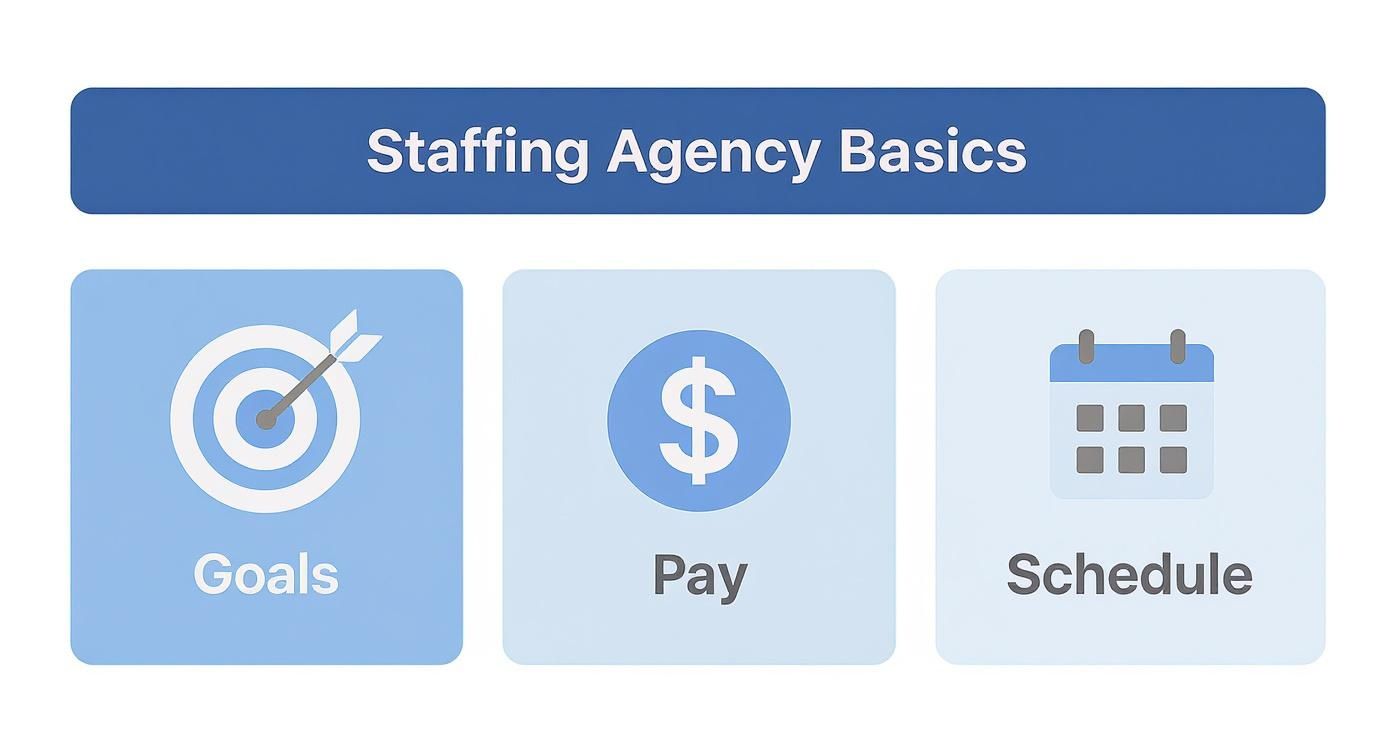
As you can see, what you want to achieve is directly tied to the agency model that will get you there. It makes the decision a lot simpler.
To make it even clearer, let's explore the different agency models.
Local Per-Diem Agencies
Think of local agencies as your secret weapon for total flexibility. They specialize in per-diem—or day-to-day—shifts right in your backyard.
- Best For: CNAs needing maximum flexibility and local shifts.
- Typical Assignment Length: Day-to-day (single shifts).
- Key Benefit: Ultimate control over your schedule.
Let's say you're a CNA who needs to build a schedule around family commitments. With a local agency, you can just pop open an app, browse open shifts at nearby nursing homes or hospitals, and book what works for you. You might grab two shifts one week and five the next. It’s all up to you.
The trade-off for that level of control? Benefits are usually minimal. Don’t expect health insurance or a 401(k) from most per-diem gigs. The pay is competitive for the area, but it won't include perks like housing or meal stipends.
Regional Contract Agencies
Regional agencies are the perfect middle ground. They offer more stability and predictability than per-diem work but don't require you to pack up and move across the country.
- Best For: CNAs seeking stability and new nearby experiences.
- Typical Assignment Length: 4 to 13 weeks.
- Key Benefit: Higher pay without long-distance travel.
For instance, a CNA living in a small town might take a regional contract in a big city a couple of hours away to get some valuable experience in a busy hospital. The pay is usually a step up from local rates, and some contracts might even throw in a small travel reimbursement or basic benefits. It’s a great way to test out new work environments without going too far from your home base.
National Travel Agencies
If you’ve got a bit of wanderlust, a national travel agency is probably for you. These are the big players that place CNAs and other clinicians in 13-week contracts (sometimes longer) all over the United States.
- Best For: CNAs wanting adventure and the highest pay.
- Typical Assignment Length: 13+ weeks.
- Key Benefit: Maximum earning potential via tax-free stipends.
This is where you’ll find the absolute highest earning potential, all thanks to something called a blended pay package. A blended rate combines a standard, taxed hourly wage with hefty non-taxed stipends for things like housing and meals. This is a game-changer because it dramatically increases your take-home pay. A traveling CNA might leave their home state for a few months to work in a high-demand area, and the agency will either set them up with a furnished apartment or provide a generous housing stipend to find their own place.
The bottom line is simple: it all comes down to your priorities. If flexibility is your number one, go local. If you're chasing the highest pay and want to see the country, a national travel agency is the clear winner.
This choice is also happening against a backdrop of huge global demand. While the U.S. market is massive, staffing is booming worldwide. Projections show that by 2025, Japan's staffing market could be worth $74.48 billion, with countries like China and India also seeing explosive growth. This just goes to show how stable and opportunity-rich the field is, right here at home.
Okay, you've found an agency that looks promising. The recruiter is friendly, the assignments seem great, and you're ready to jump in.
Hold on for just a second.
Before you get carried away, it's time to put on your investigator hat and do a little digging. Signing with an agency is a big deal, and taking the time to verify the details now can save you from major headaches, money troubles, and even unsafe work situations later.
This isn't about being negative; it's about being a smart professional who looks out for their own career. Think of this as your personal quality-check. Any agency worth its salt will be happy to answer your questions and be transparent.
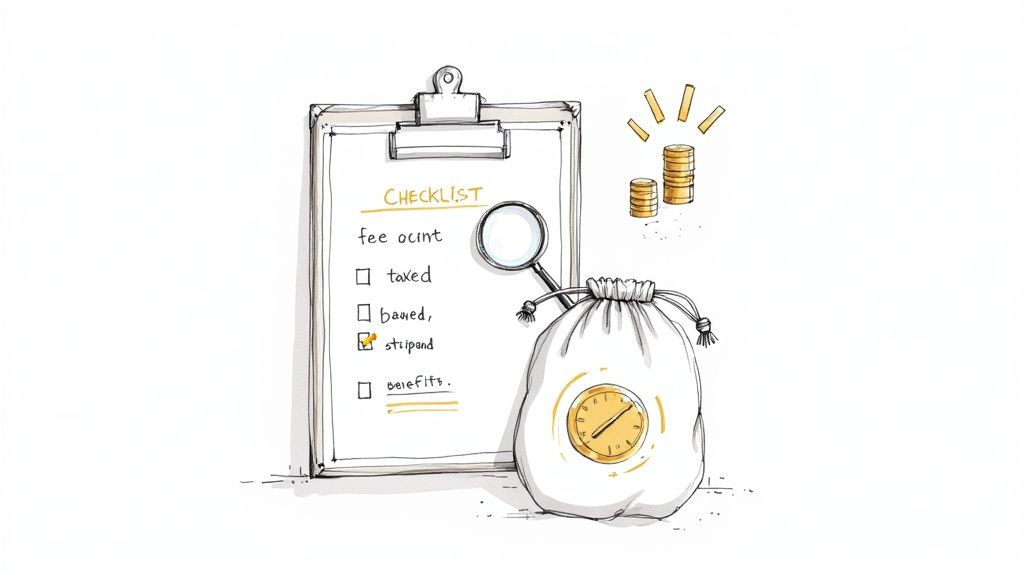
First, Verify the Agency's Credibility and Reputation
Before you get into pay and benefits, you need to know if the agency is even legitimate and well-respected. A flashy website doesn't mean much. You're looking for real proof of quality and honest feedback from other CNAs.
Start with the official stuff. Look for accreditations from The Joint Commission. This is the gold standard for healthcare staffing. If an agency has their Gold Seal of Approval, it means they’ve voluntarily gone through a tough review process to prove they meet high standards. It’s a huge green flag.
Next, it’s time to do some online sleuthing. Don’t just read the glowing testimonials on the agency’s own website. You need to find the real, unfiltered opinions.
- Glassdoor and Indeed: These sites are great for seeing what current and former employees have to say. Look for comments on payroll consistency, how supportive the recruiters are, and if the company seems organized.
- Social Media and Forums: This is where you’ll find the real talk. Search for the agency’s name in CNA Facebook groups or on Reddit forums like r/TravelNursing. This is where people share the good, the bad, and the ugly about their day-to-day experiences.
This initial check helps you quickly weed out any sketchy or poorly run agencies before you waste any more of your time.
Next, Get the Real Story on the Pay Package
Let's be honest—understanding your pay is probably the most important part of this whole process, especially for travel jobs. A big weekly pay number can be super misleading if you don't know what’s actually in it. Agency pay usually comes as a blended rate.
The blended rate has two main parts:
- A Taxed Hourly Wage: This is your base pay. It's the part that gets hit with federal and state income taxes. It might look a little low at first glance, but that's because the other piece of your pay is tax-free.
- Non-Taxed Stipends: These are fixed weekly payments for things like housing and meals. Because they are considered reimbursements for expenses you have while working away from home, you don’t pay taxes on them. This is the magic that makes travel pay so appealing.
Your recruiter should be able to break this down for you clearly. If they're vague or just keep repeating the "weekly take-home" number, you need to push for specifics. Knowing your true hourly wage is critical because it's what your overtime pay will be based on.
Heads Up: A common red flag is an agency that pushes the hourly wage way down and inflates the stipends to make the total package look bigger. Make sure your hourly rate is fair for your specialty and the location. This keeps you on the right side of the IRS.
Finally, Scrutinize the Benefits Package
Benefits are a massive part of your overall compensation, and they can be wildly different from one agency to the next. A solid benefits package shows that an agency actually cares about its people.
Picture this: A CNA—we'll call her Maria—takes a travel contract, thrilled about the high weekly pay. She assumes her health insurance will start on day one. A month into the job, she gets a nasty flu and ends up at urgent care, only to find out there’s a 90-day waiting period for her insurance to kick in. Now she’s stuck with a huge bill that a simple question could have prevented.
Don’t be Maria. Ask direct questions about their benefits, like:
- Health Insurance: When does it actually start? Day one of my contract, or is there a waiting period? What are the premiums, deductibles, and co-pays going to cost me?
- Retirement Savings: Do you offer a 401(k)? Is there a company match? And how long until I’m “vested”—meaning the company's contributions are actually mine to keep?
- Other Perks: What about paid sick time, liability insurance, or reimbursements for my licenses and certifications?
A top-tier agency will offer competitive benefits that start on day one. This isn't just a nice little extra; it's a sign that they see you as a valuable professional, not just a temporary body to fill a shift.
How to Interview Your Recruiter and Spot Red Flags
https://www.youtube.com/embed/OYkvq04Rtyc
Once you've done your homework on an agency’s reputation and what they offer, it's time for one of the most important steps: talking to a recruiter. It’s easy to feel like you’re the one in the hot seat, but you have to flip that script. You are interviewing them to see if they're good enough to represent your career.
This conversation is your best chance to get a real feel for an agency's integrity and how they operate. A great recruiter is your partner and advocate in this business, but a bad one can lead you straight into frustrating assignments and financial headaches. Knowing what to ask—and what to listen for—is your best defense.
Powerful Questions to Ask Your Recruiter
Don't be afraid to ask the tough questions. A professional, high-quality agency not only expects them but welcomes them. If you get vague or evasive answers, that’s your first major warning sign. Go into that call with a list of non-negotiables that get right to the point.
Here are a few essential questions to get you started:
- Guaranteed Hours: "What's your policy on guaranteed hours? If a facility cancels my shift, how many hours will I still be paid for that week?"
- Contract Cancellations: "How do you handle it when a facility cancels a contract early? What kind of support can I expect from you to find a new assignment quickly?"
- Pay Breakdown: "Could you email me a full pay breakdown? I need to see the taxed hourly rate, the non-taxed stipends for housing and meals, and any travel reimbursement."
- On-the-Job Support: "If I run into a clinical or professional problem at a facility, who is my direct contact? Do you have a clinical liaison available 24/7?"
These questions go way beyond the simple hourly rate. They dig into the real-world situations you’re bound to face as a traveling CNA. An agency with clear, supportive policies for these scenarios is one that actually has your back. For a deeper dive into this relationship, our guide on what to expect from a nurse recruiter can give you even more context.
A recruiter who gets cagey or just gives you a generic "don't worry, we'll handle it" when you ask about cancellations or pay issues is a red flag. You're looking for concrete policies, not vague promises.
The Recruiter Red Flag Checklist
As you’re talking to recruiters, keep your antennae up for warning signs that an agency might not be looking out for you. Always trust your gut—if something feels off, it probably is.
Use this checklist to spot trouble before you sign anything:
- Vagueness on Pay: The recruiter can only quote a "blended" or "weekly take-home" number and gets fuzzy when you ask for the specific hourly wage versus stipend amounts.
- High-Pressure Tactics: They try to rush you, saying you have to decide on a contract right now or this "perfect opportunity" will vanish. Good assignments are always out there; never let anyone pressure you.
- Poor Communication: They're hard to get ahold of, take days to return calls or emails, or just seem disorganized. This behavior will only get worse once you've signed.
- Ignoring Your Preferences: You were crystal clear that you don’t want to work night shifts or in a specific state, but they keep pushing those exact assignments on you.
Catching these signs early is everything. The way your recruiter treats you is often a direct reflection of the agency's entire culture.
A Real-World Scenario: Uncovering a Bait-and-Switch
Let's walk through a situation you might encounter. Imagine you're a CNA named Alex, on the phone with a recruiter about a 13-week contract that pays what seems like an amazing weekly rate.
Recruiter: "The weekly take-home for this assignment is $1,800! It's a fantastic rate for that area."
Alex: "That does sound great. Can you break that down for me? I'd like to see the taxed hourly rate and the exact amounts for the housing and meal stipends."
There's a slight pause on the other end of the line.
Recruiter: "Well, the housing stipend is $800 a week. It's a pretty high-cost-of-living area, so you'll definitely need it."
Alex (who already did their homework): "I just checked the GSA rates for that city, and the maximum weekly lodging rate is $650. Why is your stipend so much higher than the government-allowed maximum?"
The recruiter's friendly tone shifts. This is the moment of truth. An honest recruiter might explain it's a blended stipend or admit to a mistake. A dishonest one will try to deflect.
Recruiter: "Oh, that's just how our system calculates it. It all comes out the same in your paycheck."
This is a massive red flag. By knowingly offering a stipend above the official GSA maximum, the agency is playing fast and loose with IRS rules—putting both you and them at risk of an audit. Alex wisely recognized this as a classic bait-and-switch, where the juicy weekly pay was built on a risky, non-compliant foundation. He politely ended the call and moved on, saving himself from a potential nightmare down the road.
Making Sense of Your First Agency Contract
Getting that first agency contract in your hands is exciting, but it can also feel like you're trying to read a foreign language. It's tempting to skim and sign, but this document dictates everything about your assignment. Rushing this step is a recipe for disaster.
Before you put pen to paper, take your time. Think of the contract as your professional shield—it’s there to protect you just as much as it is the agency. Let's walk through the most critical parts so you know exactly what you're looking for.
Unpacking the Key Clauses
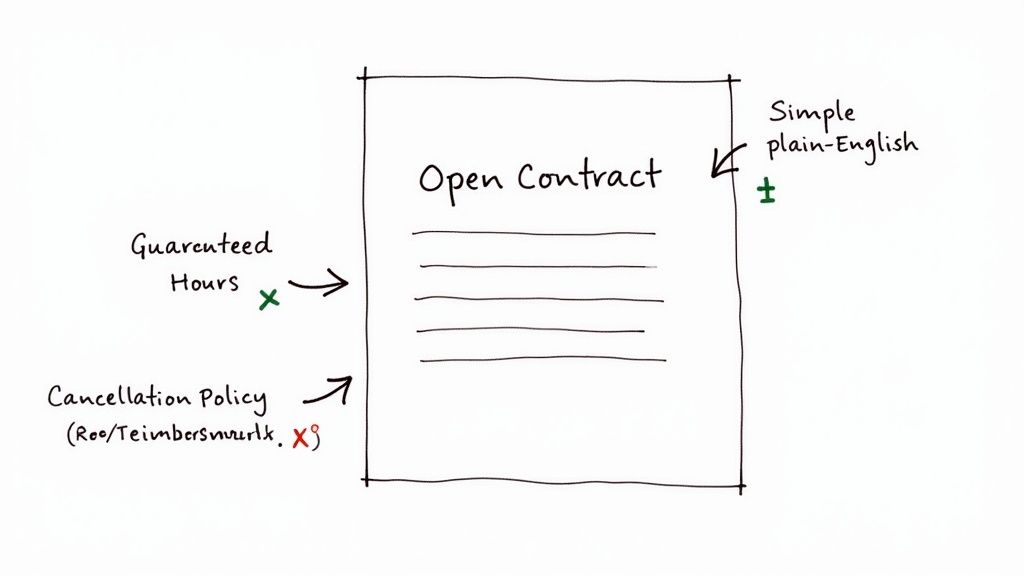
While every contract looks a little different, there are a few non-negotiable sections that will shape your entire experience. You'll want to zoom in on the language around guaranteed hours, shift cancellations, and any reimbursements. These are the areas that separate a great contract from a predatory one.
Keep an eye out for vague terms. Phrases like "as needed" or "reasonable effort" are huge red flags because they leave too much open to interpretation. A solid contract is specific and leaves no room for doubt.
Guaranteed Hours and Cancellation Policies
This is it—the single most important part of your contract. The guaranteed hours clause is the agency's promise to pay you for a minimum number of hours each week. This is your safety net if a facility has low census and tries to call you off.
A fair contract will lock in your full weekly hours, whether that’s 36 or 40 hours per week. A weaker one might offer fewer guarantees or have sneaky loopholes that let them cancel shifts without paying you.
Then there’s the cancellation policy. This spells out exactly what happens if the facility cancels a shift or, in a worst-case scenario, the entire contract. The difference between a good and bad policy is night and day.
- A Fair Policy Looks Like This: "The facility must give at least 48 hours' notice for any shift cancellation. If they don't, the CNA will be paid for the entire shift."
- A Predatory Policy Looks Like This: "Shifts can be canceled with just 4 hours' notice. The agency is not required to pay for canceled shifts."
That 48-hour notice gives you a fighting chance to pick up another shift, while a 4-hour notice just leaves you out of pocket.
Reimbursements and Non-Compete Agreements
Your contract needs to be crystal clear about what expenses the agency covers, especially if you’re traveling for the assignment. Look for detailed information on:
- Licensure & Certifications: Will they pay for or reimburse you for that new state license or your BLS renewal?
- Travel Costs: If you’re driving, do they offer mileage reimbursement? If you're flying, who pays for the ticket?
- Onboarding Expenses: What about the cost of drug screens, physicals, or any other pre-assignment requirements?
Another clause to watch out for is the non-compete agreement. This is a piece of legal language that might stop you from working at that same facility (or even in the same city) for a different company for a set period after your contract ends. They are pretty standard, but make sure the terms are reasonable. A six-month restriction is one thing; a two-year ban is another.
"The first offer is just the starting point. Always ask if there's flexibility in the pay package—the worst they can say is no." – Veteran Travel CNA
Don’t Be Afraid to Negotiate
Here’s something many CNAs don't realize: your contract is not always a take-it-or-leave-it deal. If the guaranteed hours seem low or the cancellation policy feels unfair, you have the right to speak up and ask for changes.
You can frame it politely to your recruiter: "I've reviewed the contract, and I had a question about this clause. Is there any flexibility here?" The worst they can do is say no. But by asking, you show them you’re a savvy professional who knows your worth. Advocating for a contract that truly protects you is the final, crucial step in picking the right agency.
A Few More Questions You’re Probably Asking
You’ve done your research, narrowed down your options, and you're just about ready to sign on the dotted line. Right about now is when a new wave of practical, "what if" questions usually pops up. That's a good thing—it means you're thinking through the reality of agency life.
Let's walk through some of the final-stage questions I hear most often from CNAs. Getting these sorted out will help you step into your first assignment with total confidence.
Can I Work With Multiple Agencies at Once?
You absolutely can. In fact, many seasoned agency CNAs keep a couple of agencies in their back pocket. It's a great way to see more job options and get a real feel for what the pay rates are in different places.
Just know what you're getting into. Juggling agencies means juggling paperwork. Each one will have its own set of compliance documents, background checks, and health screenings.
It's a classic trade-off: more opportunities versus more administrative work. Having two recruiters sending you jobs is great, but it also means two sets of paperwork to keep updated.
My advice? Start with one agency you really trust. Get a feel for the rhythm of agency work. Once you're comfortable, then think about adding a second agency to your roster to catch any assignments your primary one might miss.
What Do I Do if There's a Problem at a Facility?
This one is huge, and the answer is simple: Call your agency first. When you're on an assignment, the agency is your employer and your advocate. The facility is just the worksite.
Reputable agencies have a clinical liaison or a support person on call 24/7. This is usually a nurse or another clinician who has been in your shoes and gets it. They are your first line of defense.
If trouble pops up, here’s what you do:
- Call Your Agency Immediately: Don't get drawn into a major conflict with the facility’s management by yourself. Your recruiter or clinical liaison is paid to handle this.
- Document Everything: Write down what happened, sticking to the facts. Note the date, time, and who was involved. Keep emotion out of it.
- Let Them Handle It: Your agency contact will tell you exactly what to do next. They’ll talk to the facility for you and make sure your side of the story is heard and you're protected.
Trying to solve a serious issue alone can put you in a tough spot and might even go against your contract. Let your agency do its job.
How Soon Can I Actually Start Working?
It's easy to get excited and want to start tomorrow, but there's a process, and it all comes down to credentialing. Your agency and the facility have to verify every single one of your documents—license, certs, health records, background—before you can set foot on the floor.
The timeline really depends on the type of gig.
- For local, per-diem shifts: If your paperwork is ready to go, you could be picking up shifts within a week, sometimes even a few days.
- For a travel contract: This takes longer, especially if you need a new state license. Be prepared for it to take anywhere from two to six weeks to get everything approved.
Your recruiter should give you an honest-to-goodness timeline. If an agency claims they can get you started on a travel assignment across the country in three days, that’s a massive red flag. A proper, safe onboarding process takes a little time.
Navigating the world of CNA work, from finding the right training to choosing a staffing agency, requires reliable information. At The CNA Guide, we provide clear, up-to-date resources to support you at every stage of your career. Explore all our free guides at https://thecnaguide.com.