When you're a Certified Nursing Assistant, you expect tough days. But CNA burnout is something different. It’s a state of deep, chronic exhaustion—physically, emotionally, and mentally—that builds up over time from the relentless stress of the job.
This isn't just about feeling tired after a long shift. It's a bone-deep weariness that follows you home, making it feel almost impossible to give the compassionate care you set out to provide. You feel completely drained, cynical about the work, and start to question if you're even making a difference anymore.
What CNA Burnout Really Feels Like
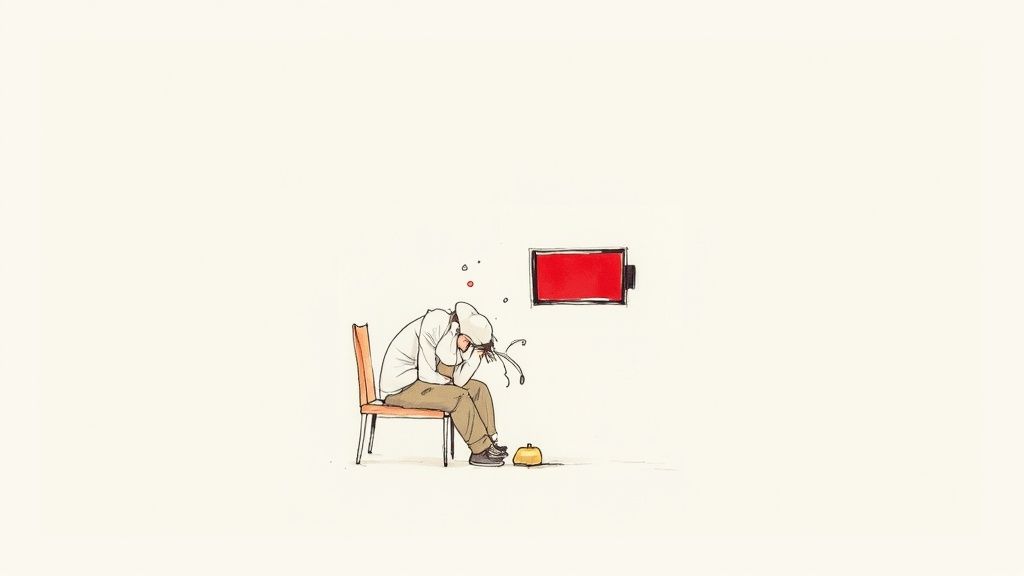
Think of your personal energy like a phone battery. When you first started, you probably had a 100% charge every morning, ready to handle whatever the day threw at you. Now, it feels like that same battery is old and worn out. It barely charges to 30%, and you start every shift already in the red, just hoping to make it to the end.
That’s the core of burnout: a profound exhaustion that a good night's sleep or a weekend off just can't fix. It’s your body and mind’s natural reaction to being in a constant, high-stress environment day after day.
It's Not a Personal Failure
Let's get one thing straight: burnout is not a sign of weakness. It's not a character flaw or proof that you can't handle the job. In fact, it often happens to the most compassionate and dedicated CNAs—the ones who give everything they have until there's nothing left.
You're feeling this way precisely because you care so much. The constant output of physical and emotional energy, often without the right support or resources, is what leads to this breaking point.
Burnout typically shows up in a few key ways:
- Emotional Exhaustion: This is that "at the end of your rope" feeling. You feel completely overextended by your work, leaving you irritable, anxious, or just plain numb.
- Depersonalization (Cynicism): This is when you start to feel detached and negative about everything. It might come out as a cynical attitude toward patients, a short temper with coworkers, or a general distrust of management.
- Reduced Sense of Accomplishment: You begin to feel like you're not good at your job anymore. You doubt your ability to make a difference, and the feeling that your hard work doesn't matter can kill your motivation.
Burnout is a warning sign. It’s your system telling you that the demands of the job are far greater than the resources you have to meet them. This is a workplace issue, not a personal one, often driven by things like chronic understaffing and unrealistic expectations.
Simply recognizing these feelings in yourself is a huge first step. You are far from alone in this. So many dedicated CNAs are walking this same path. Understanding what burnout really is helps you start to find your way back to feeling like yourself again.
What's Really Causing CNA Burnout?
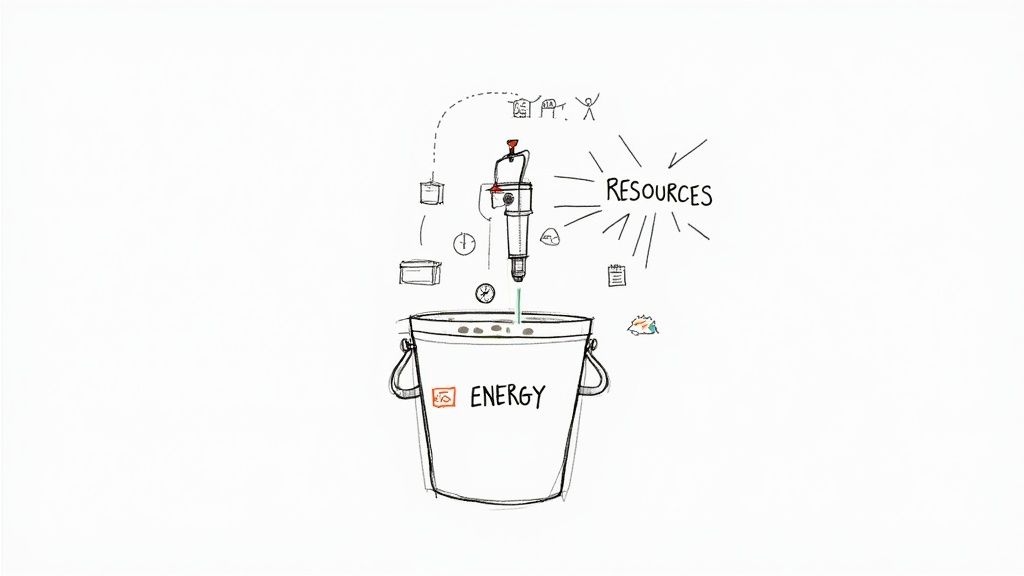
If you're feeling burned out, you know it's not just one thing. CNA burnout is rarely caused by a single bad day. It’s more like a perfect storm of intense, everyday pressures that slowly chip away at your resilience until you feel like you have nothing left to give.
Think of it this way: your personal energy is a bucket, but the demands of the job are constantly poking holes in it. At the same time, your support systems—like adequate staffing, fair pay, and appreciative management—are just a slow drip trying to fill it back up.
When the demands far outweigh the resources, the bucket eventually runs dry. That feeling of emptiness? That's the heart of burnout, and it’s an experience far too many CNAs know well.
The Double Whammy: Physical and Emotional Tolls
Being a CNA is incredibly physical. You're lifting, transferring, and repositioning patients all day long, putting a massive strain on your body. This isn't a desk job with built-in breaks; you are always on your feet, moving from one critical task to the next without a moment's rest.
On top of that, there's the invisible work: the constant emotional labor. You’re expected to be a pillar of compassion and calm for patients and families, even when you're exhausted or dealing with a difficult situation yourself. That takes a huge amount of mental energy, shift after shift.
This one-two punch of physical and emotional exhaustion is a recipe for burnout. When you add in challenges like low pay and high-stress environments, it’s easy to see why so many CNAs feel drained. Research confirms that when job demands are high and organizational support is low, job satisfaction plummets. You can read the full research about CNA job satisfaction to see the data behind this reality.
When the System is the Problem: Understaffing
Let’s be honest: chronic understaffing is one of the biggest elephants in the room. When a facility is short-staffed, the workload doesn't just increase—it multiplies. Suddenly, you're stretched thin, trying to care for an impossible number of residents.
A 2022 survey found that over half of all CNAs said staffing shortages were their biggest problem. It's not uncommon to be assigned 15 to 20 patients on a single shift. In those conditions, feeling overworked isn't just a possibility; it's a guarantee.
This isn't just about being busy. It creates a moral crisis. You know your patients deserve better, but you simply don't have the time to provide the level of care you were trained for. You can't meet the standards of a proper CNA job description (see an example here: https://thecnaguide.com/blog/cna-job-description/) when you're running on fumes.
That feeling of being set up to fail is incredibly demoralizing and feeds directly into the cynicism and exhaustion that define burnout. Recognizing these pressures for what they are—systemic issues, not personal failings—is the first real step toward taking back control.
2. Are You Burning Out? How to Spot the Early Warning Signs
Spotting CNA burnout is a bit like noticing a slow leak in a tire. If you catch it early, a simple patch gets you back on the road. But ignore it, and you'll eventually find yourself completely stranded. These early warnings aren’t signs of weakness. They’re your body and mind sending up a flare, telling you it's time to pull over and check in.
The tricky part is that these red flags often creep in slowly. It's easy to write them off as just a "bad week" or the usual stress that comes with the job. But when these feelings stick around and become your new normal, it’s a sign of something much deeper.
Burnout doesn't just live in your head; it shows up in your physical health, your emotional state, and even in the small, everyday things you do.
Physical Red Flags
Your body often keeps score, even when your mind is determined to push through. The constant demands of being a CNA—the lifting, the emotional labor, the long hours—can cause very real, physical symptoms. Don't ignore them.
Common signs that your body is running on empty include:
- Persistent Fatigue: This isn't just feeling tired after a tough shift. It’s a deep, bone-weary exhaustion that sleep just can’t seem to fix.
- Frequent Aches and Pains: Are tension headaches or a sore back becoming your constant companions? Chronic stress often shows up as physical pain.
- Changes in Sleep: You might be staring at the ceiling at 3 a.m. despite being exhausted, or maybe you're sleeping way more than usual but never feel rested.
Emotional and Behavioral Signals
Just as your body sends out distress signals, your mood and actions will also change under the weight of burnout. You might start to feel like a stranger to yourself, and the people closest to you might notice you're not quite the same.
Burnout makes you feel detached. It’s an emotional shield you put up when you’re overwhelmed, but it can leave you feeling cynical, irritable, and disconnected from the very work you once found meaningful.
This isn't just a CNA problem—it's a massive issue across the healthcare field. Burnout rates among nurses, who work side-by-side with CNAs, are sky-high, with over two-thirds reporting they feel burnt out multiple times a week. That kind of exhaustion is a recipe for errors, missed shifts, and a drop in patient care quality. You can find more data on these healthcare workforce trends at aag.health.
Emotionally, you might start dreading your shifts or feeling a growing sense of negativity about your job. Behaviorally, this can look like calling in sick more often, avoiding your coworkers, or having a short fuse with patients, colleagues, and even your family at home. Seeing these patterns is the first, most important step toward getting back on track.
CNA Burnout Self-Assessment Checklist
It can be hard to see the signs when you're in the thick of it. This checklist is designed to help you take a step back and honestly assess how you're feeling. Review these common symptoms of burnout and see which ones resonate with you.
- Physical Exhaustion: Do you feel chronically tired, even after sleeping? Are you experiencing frequent headaches, muscle pain, or digestive issues?
- Emotional Drain: Do you feel cynical, irritable, or detached from your work? Have you lost the sense of accomplishment or purpose you once had?
- Mental Fog: Is it hard to concentrate or make decisions? Do you feel forgetful or easily overwhelmed by your tasks?
- Behavioral Changes: Are you withdrawing from colleagues or loved ones? Have you increased your use of food, alcohol, or other substances to cope with stress?
- Reduced Empathy: Do you feel less compassionate toward your patients than you used to? Does caring for them feel like an unbearable burden?
Taking stock of where you are is a brave and necessary step. If you found yourself nodding along to many of these points, it’s a clear sign that it's time to focus on your own well-being.
Practical Strategies to Prevent and Reverse Burnout
Spotting the signs of CNA burnout is the first step, but the real power comes from taking action. Beating burnout isn’t about one giant, life-altering change. It’s about building a collection of small, sustainable habits that act as your armor against exhaustion. It’s all about learning to guard your energy, both on and off the clock.
Think of it like you're building a seawall to hold back a relentless tide of stress. Each small stone—a boundary you set, a proper break you actually take, a hobby you enjoy—adds to its strength. Over time, you become more resilient. You can start small, right now, on your very next shift.
On-the-Job Tactics to Protect Your Energy
The workplace is often where the stress piles on, but you have more control than you might realize. By using a few simple strategies during your shift, you can carve out moments of calm and stop feeling so constantly overwhelmed.
One of the best tools in your kit is the "micro-break." This isn't your scheduled 15-minute break; it's a deliberate 60-second pause to hit the reset button. Before you walk into the next resident's room, just stop and take one deep, slow breath. That tiny moment can lower your heart rate and clear your head, stopping stress before it spirals.
Burnout often feels like a loss of control. By mastering small, on-the-job techniques like micro-breaks and clear boundary-setting, you regain a sense of agency over your workday and your well-being. This shift from reactive to proactive is fundamental to recovery.
Getting a handle on your time management is another game-changer. Instead of viewing your shift as one long, chaotic marathon, try to "cluster" your tasks. Group similar things together—like checking vitals for everyone in one wing—to create a smarter workflow and cut down on backtracking. This simple change frees up precious mental space and reduces physical strain.
Setting Healthy Boundaries at Work
Boundaries aren’t about being difficult or unhelpful; they're about survival. Learning to say "no" or even just "not right now" is absolutely essential for preventing the kind of overload that leads straight to burnout. They are your first line of defense.
Here’s how you can start putting this into practice:
- Protect Your Breaks: Your break time is yours. It's not optional. Step away from the floor, put your phone down (or at least turn off work notifications), and truly disconnect, even if it’s just for 15 minutes. That time is critical for your mind and body to recharge.
- Learn to Politely Decline: If a coworker asks for a hand when you're already swamped, it's perfectly fine to say, "I'd love to help, but I have to finish this urgent task first. Can you check back with me in 20 minutes?" You're still showing you're a team player, but you're also protecting your immediate priorities.
- Leave Work at Work: When your shift is over, it’s over. Make a conscious effort to switch out of work mode. Maybe that means changing out of your scrubs the second you get home or listening to a podcast on the drive to decompress. Creating that separation is crucial to stop work stress from poisoning your personal life.
Active Recovery for Your Time Off
What you do on your days off matters just as much as what you do at work. Too many of us spend our free time just trying to recover from exhaustion, which is really just passive rest. A better approach is "active recovery"—doing things that genuinely refill your emotional and mental tank, rather than just helping you survive until the next shift.
This means making time for hobbies that use a different part of your brain than your job does. Whether it’s gardening, painting, hiking, or playing an instrument, losing yourself in an activity you love is a powerful reminder that you are more than your job title.
Don't forget to connect with your friends and family. Real social connection is a powerful antidote to the isolation that burnout often creates. Make time for the people who lift you up, the ones you can be your true self with—no caregiver hat required. These small, consistent actions will rebuild your resilience and help you find joy and balance again.
How a Supportive Workplace Can Fight Burnout
While taking care of yourself is a big piece of the puzzle, your own coping strategies can only do so much to prevent CNA burnout. Let's be honest: burnout isn't just a personal problem. More often than not, it’s a workplace problem. No amount of deep breathing or bubble baths can fix a fundamentally broken system.
A truly supportive work environment is your best defense against the constant stress that grinds you down. Think of it this way: your personal resilience is like a battery. Self-care helps you recharge it at home, but if you plug into a faulty, energy-draining outlet at work every day, that battery is never going to stay full. A healthy workplace is the proper charging station.
This all starts with having managers who actually listen and go to bat for their staff. It means building a culture where saying "I need help" is a sign of strength, not weakness.
The Power of Fair Staffing and Scheduling
Let's talk about one of the biggest burnout drivers: chronic understaffing. It’s the elephant in the room. When you're constantly scrambling to care for an unsafe number of residents, you're set up to fail. It's not just physically exhausting; it's emotionally draining and leads to serious moral distress. Good employers get this. They prioritize safe staffing ratios because they know it's a direct investment in both resident safety and your sanity.
Fair scheduling is just as critical. It’s about basic respect for your life outside the facility walls. This looks like:
- Predictable Schedules: Getting your schedule with enough notice to actually make plans. You know, like a doctor's appointment or a kid's soccer game.
- Respect for Time Off: When your vacation is approved, it’s approved. You shouldn't be guilt-tripped into covering a last-minute call-out.
- Flexible Options: Where possible, offering different shift lengths or start times can be a game-changer for balancing life's demands. For some CNAs, a complete change of pace is the answer. If you're feeling stuck, you might want to learn how to become a traveling CNA, which often provides more control and flexibility.
Fostering Growth and Professional Development
Feeling like you’re stuck in a dead-end job is a fast track to checking out mentally. When an employer invests in your professional growth, it sends a powerful message: they see you as a valued professional, not just a pair of hands.
Investing in career development is one of the most effective retention strategies. It transforms a job into a career, giving CNAs a reason to stay and grow with an organization rather than seeking opportunities elsewhere.
This doesn't always mean paying for a full nursing degree, either. It can be as simple as offering tuition reimbursement, providing access to interesting continuing education courses, or creating clear paths to advance into roles like a medication aide.
A recent study pointed out that the high national CNA turnover rate of 27.7% is often tied directly to the lack of a career ladder. The research showed that simply providing access to more training significantly boosted job satisfaction and cut down on burnout. You can read the full study about CNA career growth on wuga.org. A workplace that invests in your future is a workplace that's actively fighting burnout.
Finding Support and Professional Resources
While self-care is a powerful tool, sometimes it’s like putting a bandage on a wound that needs stitches. For the deep, bone-weary exhaustion of CNA burnout, you might need more. Reaching out for professional help isn't giving up; it’s a sign of strength and self-awareness.
Realizing you don’t have to carry this weight alone is the first real step toward feeling better. You wouldn't think twice about seeing a doctor for a sprained ankle, and your mental health deserves that same priority. Professional resources give you a safe, confidential space to unpack everything you're going through and build a new toolkit for coping.
When to Seek Professional Help
So, when is it time to call in a professional? The line is usually crossed when burnout stops being just a "bad week" and becomes your new normal, spilling over into every part of your life.
Listen to your gut. It's time to get help if:
- You feel a knot of dread in your stomach every time you think about your next shift.
- No amount of sleep leaves you feeling rested. You're just always tired.
- You feel disconnected or emotionally numb, not just with patients but with your own family and friends.
- You find yourself relying on unhealthy habits just to make it through the day.
If any of this sounds familiar, finding a therapist who gets the unique pressures of healthcare work can be a game-changer.
Your Roadmap to Getting Support
Knowing you need help is one thing; finding it is another. A great place to start is with your employer's Employee Assistance Program (EAP). These programs are completely confidential and usually offer a set number of free counseling sessions. It's a low-risk way to talk to someone who can help.
Taking action is empowering. Whether it’s talking to a therapist, joining a support group, or advocating for change at work, each step you take reclaims a piece of your well-being and helps you move forward.
Don't underestimate the power of community, either. Online forums and professional groups for CNAs can be a lifeline. Just talking to others who know exactly what you’re experiencing can lift a huge weight off your shoulders.
And if the root of the problem is a toxic workplace, sometimes the best move is a new one. If you’re craving more flexibility and control, check out our guide on choosing a staffing agency. It might just lead you to a work environment that truly supports you. Remember, your well-being has to come first.
Got Questions? We’ve Got Answers.
When you're dealing with something as heavy as burnout, it’s natural to have a lot of questions. Let's tackle some of the most common ones that CNAs ask.
Stress vs. Burnout: What's the Real Difference?
Think of it this way: stress is like drowning in responsibilities, while burnout is like the well has run dry.
When you're stressed, you're usually over-engaged. You're frantic, pushing hard, and feel like if you just try a little harder, you can catch up. Burnout is the opposite. It’s a state of total disengagement and emotional exhaustion. You don't feel like you're drowning; you feel empty, with absolutely nothing left to give.
Can I Really Get Better Without Quitting My Job?
Absolutely, it’s possible. Recovery often starts with making changes you can control, like setting firm boundaries (no more picking up every extra shift!), truly unplugging after work, and finding coping skills that actually help you recharge.
The tough truth, though, is that sometimes the job itself is the problem. If your workplace is toxic, chronically understaffed, or management is unwilling to listen and make real changes, then leaving might be the healthiest choice you can make for your long-term well-being.
How Can I Talk to My Manager About This?
This conversation can feel intimidating, but it's crucial. The key is to be calm and focus on solutions, not just complaints.
Schedule a time to speak privately. Instead of saying, "I'm burned out," try framing it around specific, observable issues. You could say something like, "I'm finding it increasingly difficult to give our residents the quality of care they deserve with the current patient loads. Could we discuss how work is being distributed or explore different scheduling options?" This approach shifts the focus to teamwork and problem-solving, which is much more constructive.
At The CNA Guide, we're committed to giving you the tools you need for a career that's both rewarding and sustainable. Whether you're looking for state-approved training programs or want to connect with the best staffing agencies, we're here to support you every step of the way.