A good study plan starts with one simple rule: know your enemy. Before you even think about cracking a textbook, you need to understand exactly what the CNA state exam looks like. It’s not just one big test; it’s split into two totally different parts—a written knowledge exam and a hands-on clinical skills test. Getting a handle on how each one works is the key to walking in on test day feeling prepared and confident.
Decoding the CNA State Exam Format
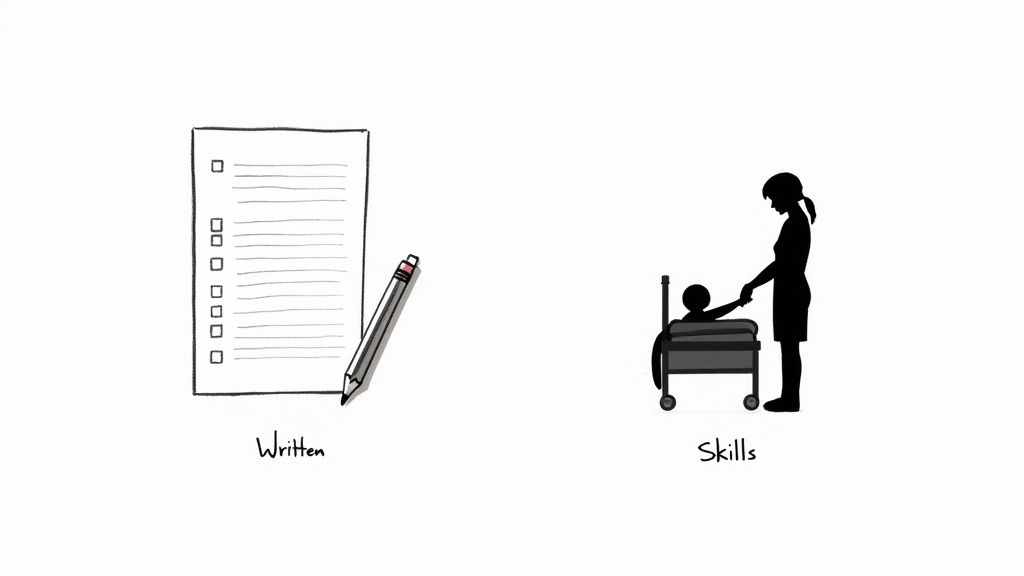
Let's break down what you're really up against. The CNA exam is designed to make sure you not only know the facts but can also apply them safely in a real-world setting. That’s why you have to pass both a "what you know" part and a "what you can do" part to earn that certification.
The exam has two distinct components:
- Written Knowledge Test: This part measures your understanding of core CNA principles, safety, patient rights, and basic nursing concepts. It's typically a multiple-choice test with about 60-70 questions and a 90-minute time limit. An oral option is often available.
- Clinical Skills Test: This part assesses your ability to correctly and safely perform essential patient care tasks under observation. It involves a hands-on demonstration of 3-5 randomly selected skills, usually within a 25-30 minute timeframe.
Passing both is mandatory. Excelling in one won’t make up for failing the other, so you’ll need a study strategy that gives each part the attention it deserves.
The Written Knowledge Exam
First up is the written test. This is your classic multiple-choice exam, usually with about 60 to 70 questions that you’ll have 90 minutes to answer. Its whole purpose is to check your grasp of the fundamental knowledge every CNA needs.
You can expect questions to fall into a few main categories:
- Activities of Daily Living (ADLs): Think about everything related to helping patients with their daily routines—hygiene, grooming, nutrition, and keeping them comfortable.
- Basic Nursing Skills: This is where they test your knowledge on things like infection control, taking vital signs, safety protocols, and proper documentation.
- The Role of the Nurse Aide: You'll see questions covering patient rights, effective communication, and professional ethics.
If reading English quickly is a challenge, don't worry. Most states offer an oral version where the questions are read to you through a headset. This lets you focus on the question itself without any reading pressure.
The Clinical Skills Test
Next comes the hands-on skills test, which is often the part that makes people the most nervous. Here, you'll physically perform a handful of CNA tasks in front of an evaluator, usually with a mannequin or another person acting as the patient.
You’ll be asked to demonstrate three to five skills in about 25 to 30 minutes. These skills are chosen randomly, but you can almost always count on one of them being proper handwashing—it’s that important for infection control.
A huge tip for the skills test: talk through everything you're doing. As you perform each step, say it out loud. For example, "I am now checking the water temperature to make sure it's safe and comfortable for the patient." This proves to the evaluator that you know why you're doing something, not just going through the motions.
Remember, both parts of the exam are equally important. You can’t get certified by just acing the skills portion; you have to pass the written test, too. According to data on CNA pass rates, a balanced approach is crucial, as candidates must pass both components to be successful. You can find more details in this report on CNA pass rates.
Getting a Handle on the Written Exam
The written part of the CNA state exam is where you get to show what you know. This isn't about just spitting back memorized facts; it’s about proving you understand the core ideas that keep patients safe and well-cared for.
Think of it this way: the questions are designed to mirror the real-life situations you'll face every day on the job. They want to see that you know the why behind everything you do, from the right way to wash your hands to how you protect a resident's privacy.
The Big Topics You Can't Ignore
While the exact test varies a bit from state to state, there are a handful of key areas that always show up. If you want to use your study time wisely, focus heavily on these—they make up most of the exam.
Here’s a look at what you absolutely need to nail down:
- Physical Care Skills: This is the big one. It covers all the hands-on stuff you’ll be doing, like helping with bathing and eating (Activities of Daily Living, or ADLs), taking vital signs, and preventing the spread of infection.
- The Role of the Nurse Aide: This part is all about being a professional. You’ll get questions on residents' rights, communicating effectively, and handling ethical dilemmas. It’s about being a trusted member of the healthcare team.
- Psychosocial Care Skills: This is about caring for the whole person, not just their physical needs. You’ll need to know how to support a resident's emotional and mental well-being, including respecting their spiritual and cultural beliefs.
The exam isn't trying to trick you. It’s simply checking that you can provide care that’s not only physically safe but also compassionate and respectful. Every single question comes back to that main goal: promoting the resident's well-being.
Smart Ways to Study the Tough Stuff
Just reading your textbook over and over won't cut it. To really learn this material, you have to get active with it. Let's talk about a few proven ways to tackle some of the trickiest topics.
Don't Just Memorize Medical Terms—Decode Them
Medical terminology can feel like learning a whole new language. Instead of trying to memorize hundreds of words, learn to break them down into their parts: a prefix, a root, and a suffix.
Take a word like "dysphagia." It looks scary, but let's pull it apart:
- Dys- is a prefix that means "difficult" or "painful."
- -phagia is a suffix that means "to eat" or "to swallow."
Put them together, and you know it means difficulty swallowing. Easy, right? Make some flashcards with common prefixes and suffixes. It’s a game-changer when you see an unfamiliar word on the exam.
Use Tricks to Remember Vital Sign Ranges
You will 100% be asked about normal vital signs. Just trying to cram the numbers into your brain is tough, so use little memory tricks (mnemonics) to make them stick.
A Quick Cheat Sheet for Adult Vital Signs:
- Blood Pressure: Think of a perfect test score: 120/80.
- Respirations: A teenager breathes more slowly than a little kid. Think about the teen years: 12-20 breaths per minute.
- Pulse: Picture a clock. The numbers 60 and 100 are key spots. That’s your normal range: 60-100 beats per minute.
Little hacks like these save you brainpower and time during the test, so you can focus on the harder questions.
How to Tackle Scenario Questions
A lot of the exam is made up of short stories, or scenarios, where you have to pick the best response. These questions are testing your judgment.
When you see one, don't panic. Just follow this simple thought process:
- Find the Real Problem: What's actually going on here? Is someone in danger? Is a resident's right being ignored? Is there a communication problem?
- Ditch the Bad Answers: You can usually spot one or two options that are just plain wrong or unsafe. Get rid of them right away.
- Think Safety and Rights First: Look at the choices left. Which one does the most to keep the resident safe while respecting their rights? That’s almost always the right answer.
By zeroing in on these key areas and using study methods that actually work, you’ll build the confidence you need. To get an even better feel for how these topics are presented on the test, check out our complete guide to the CNA written exam. It really helps connect what you're learning to how you'll be tested.
How to Ace the Clinical Skills Test
Alright, let's talk about the clinical skills test. This is where the rubber meets the road. It’s your chance to step away from the books and prove you can handle the hands-on tasks that are the absolute core of being a CNA.
For a lot of people, this is the most nerve-wracking part of the whole exam. It’s one thing to know the steps on paper, but it’s a whole different ball game to perform them smoothly while someone is watching you. The secret? Practice. Then practice some more, until the steps become pure muscle memory.
This infographic breaks down the fundamental principles you'll apply to every single skill. It all comes down to safety, resident rights, and compassionate care.
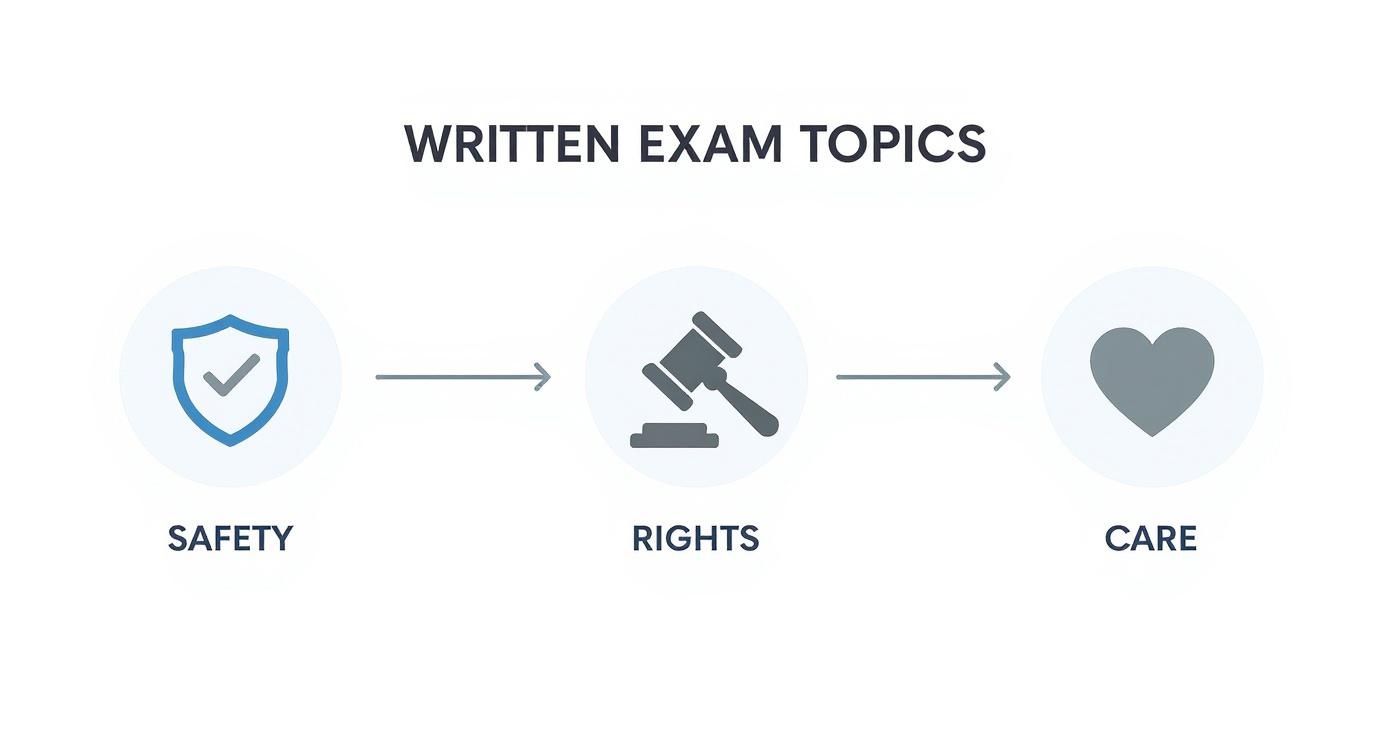
As you can see, these three pillars are completely intertwined. Mastering them is essential for passing both parts of your CNA state exam.
Talk Through Everything You Do
Here’s one of the most powerful—and most overlooked—strategies for the skills test: verbalize your actions. As you’re performing a skill, tell the evaluator what you're doing and, more importantly, why you're doing it.
Basically, you become the narrator of your own demonstration. For instance, when it's time to wash your hands, don't just go through the motions silently.
Instead, say it out loud:
- "I'm turning on the water and checking to make sure the temperature is comfortably warm."
- "Now I'm getting a good lather with the soap and making sure to scrub between my fingers and under my nails for at least 20 seconds."
- "I'm rinsing my hands now, keeping my fingertips pointed down so the dirty water doesn't run back up my arms."
This simple trick does wonders. It proves to the evaluator that you're not just a robot following a script; you actually understand the critical thinking behind each action. That gives them—and you—a huge boost of confidence.
Master the Most Common Skills
While your assigned skills are chosen at random, some pop up way more often than others. You’ll want to be able to do these in your sleep. Focusing your practice time here is just plain smart.
The essentials almost always include:
- Hand Hygiene: This is the absolute foundation of infection control. You can bet money this one will be on your test.
- Measuring Vital Signs: Get comfortable taking and recording a radial pulse, counting respirations, and measuring blood pressure.
- Patient Transfers: You need to be rock-solid on moving a resident from a bed to a wheelchair using a gait belt, ensuring everyone stays safe.
- Personal Care (ADLs): This is a big category covering everything from a partial bed bath to mouth care, denture care, and perineal care.
For a super-detailed breakdown of every possible skill, grab our CNA skills test checklist to use during your practice sessions. It’s a great way to make sure you haven’t missed a thing.
Staying Calm Under Pressure
Feeling nervous is completely normal. The key is not letting those nerves take over. Once you get your assigned skills, just stop and take a deep breath. Before you even touch the "patient" (which is usually a mannequin or an actor), take a second to walk through the steps in your head.
And if you make a small mistake? Don't panic. Forgetting a minor step isn’t always an automatic fail. If you can, just correct it and move on. For example, if you realize you forgot to pull the privacy curtain, just say, "I am now providing for privacy by pulling the curtain," and then do it.
Key Takeaway: The evaluators aren't looking for perfection; they are looking for safety. Your number one job is to show you can care for a resident without putting them in harm's way. Always put safety and infection control first.
This focus on real-world performance is why the skills test can be tough. In California, for example, pass rates for the written test are often quite high, but the skills test pass rate can sometimes hover around 79%–82%. That gap shows the difference between knowing what to do and actually doing it correctly, which is why hands-on practice is so incredibly important for every single aspiring CNA.
By talking through your actions, mastering those core skills, and keeping your focus on safety, you can walk into that clinical exam feeling confident and ready to show them what you’ve got.
Building a Study Schedule That Actually Works
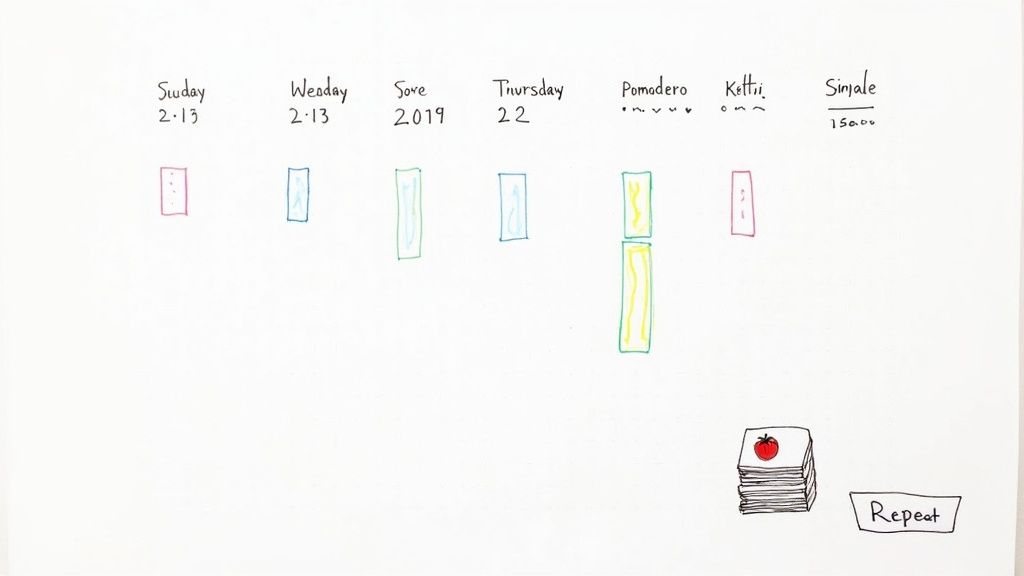
Let's be honest: a generic, one-size-fits-all study plan is a fast track to burnout. The real key to passing your CNA exam is building a schedule that actually fits your life, not forcing your life to fit some rigid schedule. Whether you're working full-time, raising a family, or juggling a dozen other things, you can create a plan that works.
The goal here isn't to cram for hours on end until your eyes glaze over. It’s about being strategic. A smart, balanced approach will have you walking into that test feeling ready and confident, not completely exhausted.
Finding Your Study Rhythm
Before you even touch a calendar, you need to get real about your daily routine. Are you a morning person who can grab a quiet hour before the rest of the world wakes up? Or do you find your focus in the evening after the day's chaos has settled?
There's no magic "best" time to study. The best time is simply when you can consistently focus. You’d be surprised what you can accomplish in focused 25-30 minute blocks. Consistency is way more powerful than marathon cram sessions.
Think of your study schedule as a friendly guide, not a strict rulebook. If you miss a session, don't sweat it. Life happens. Just adjust your plan for the next day and keep moving forward.
A fantastic tool for this is the Pomodoro Technique. It sounds fancy, but it's incredibly simple and effective for beating procrastination.
- Pick one topic to focus on (like vital signs).
- Set a timer for 25 minutes and go all in—no phone, no distractions.
- When the timer rings, take a 5-minute break to stretch or grab a drink.
- After four of these cycles, give yourself a longer break, maybe 15-30 minutes.
This method keeps you from getting overwhelmed and makes your study time incredibly productive.
Blending Knowledge with Hands-On Practice
Your study plan needs to tackle both parts of the exam: the written questions and the hands-on skills. Neglecting one for the other is a common mistake. A great schedule bounces between the two, which keeps things interesting and helps lock the information in your brain.
Think back to your training program. Which topics felt a bit shaky? If you need a refresher on the timeline and subjects covered, our guide on how long CNA training typically takes can jog your memory and help you pinpoint areas for review.
Here's how you could structure a single study block to connect theory and practice:
- Written Review (25 mins): Dive into a specific area, like Infection Control. Go through your notes, then do practice questions only on that topic.
- Skills Practice (25 mins): Now, put it into action. Ask a family member to be your "patient" (or just use a pillow) and run through a related skill. For Infection Control, this is the perfect time to nail down the exact steps for handwashing or putting on and taking off PPE.
When you link the "why" from the book to the "how" of the skill, the concepts stick so much better.
A Flexible Weekly Template
Instead of trying to stick to a rigid, hour-by-hour daily schedule, think in terms of a weekly template. This gives you the grace to adapt when life throws you a curveball, without completely derailing your progress. The goal is to hit a target number of study blocks per week, not to force a session every single day.
A sample weekly goal might look like this:
- Written Exam Blocks: 5 sessions (at 25 mins each)
- Skills Practice Blocks: 5 sessions (at 25 mins each)
- Full Practice Test: 1 session (about 90 mins for the written part, 30 for skills)
This structure gives you the freedom to double up on Monday if you know Tuesday is going to be hectic. Remember, consistency beats intensity every time. Slow, steady progress is what will get you across the finish line, and a well-planned, flexible schedule is your best defense against that last-minute panic.
Navigating Exam Day Fees and Logistics
Passing your CNA exam is about more than just what you know. It’s also about managing the real-world details—like scheduling, fees, and what to bring—so you can walk into the testing center cool, calm, and collected. Getting these logistics sorted out early on clears your mind to focus on what really counts: showing what you can do.
First things first, you need to actually schedule your exam. In most states, you'll do this online through a third-party testing service. Make sure you have your training program completion documents handy, as you'll need to prove you're eligible before you can even pick a date.
A word of advice: don't put this off. Testing centers book up fast, especially when a lot of training programs wrap up at the same time. Try to schedule your exam at least a few weeks out. This gives you a much better chance of snagging the date and location that's most convenient for you.
What to Expect for Costs
Let's talk money. Budgeting for your exam is a key step. The fees change from state to state, but they almost always cover both the written test and the hands-on skills evaluation. You can generally expect to pay around $120 for the whole package.
It's also smart to know the cost of a retake. Nobody goes in planning to fail, but knowing there's a financial consequence can be a pretty good motivator to study hard the first time. Exam fees can range from that initial $120 to separate fees for re-dos, like $40 for the written portion and $80 for the skills part. This structure definitely encourages you to be prepared. For context, you'll see top training centers advertising their high first-time pass rates, which speaks to the quality of their prep. For a real-world example, you can see how exam fees are structured at Golden West College.
Getting Ready for the Big Day
Once your test is officially on the calendar, it's time to shift your focus to the practical side of exam day. The night before is your time to get everything together. You don't want to be scrambling around looking for an ID a half-hour before you need to leave.
Here’s a quick checklist of what you absolutely need to have ready:
- Two forms of valid, unexpired ID. They are serious about this. One usually has to be a government-issued photo ID (like a driver's license), and the second could be something like a Social Security card.
- Your admission letter or confirmation email. It's a good idea to have a printed copy, but having it on your phone works too.
- A watch with a second hand. This is a must for skills like taking a pulse or counting respirations. Remember, smartwatches are a no-go.
- Comfortable clothes and non-skid shoes. Think about what you’d wear for clinicals. You need to look professional but also be able to move around easily for the skills portion.
My Best Advice: Map out your route to the testing center a few days before your exam. Better yet, do a practice drive during the same time of day to get a real feel for traffic. Getting there 30 minutes early isn't just a suggestion—it gives you a buffer to find parking, check in, hit the restroom, and just breathe before you start.
Finally, leave everything else in the car. Your phone, your purse, your study notes—lock them up. Testing centers have very strict rules about personal items. By taking care of these simple details beforehand, you’re not just being organized; you’re setting yourself up for success by eliminating any last-minute stress.
Your CNA Exam Questions Answered
Even with the best study plan in hand, a few last-minute questions always seem to pop up. Feeling uncertain about the little details can be a huge source of stress, so let's tackle some of the most common worries that CNA candidates have right before the big day. Getting these sorted will help you walk into that testing center feeling confident and ready.
One of the biggest anxieties is, of course, the possibility of not passing. It’s a completely valid fear, but knowing what happens next helps you create a solid plan B, just in case.
What Happens If I Fail One Part of the Exam?
First, take a deep breath. If you pass one section but fail the other—say, you nailed the written test but fumbled a skill—you don't have to start over from scratch. In nearly every state, you only need to retake the specific part you didn't pass.
This is a massive relief for most people. It means you can pour all your energy into your weaker area instead of re-studying everything. Usually, you’ll be given a set amount of time and a limited number of tries (often up to three attempts) to pass the remaining section. After that, you might have to retake your training program.
Don't think of a failed attempt as the end of the road. See it as targeted feedback. Your score report will show you exactly which skills you missed, giving you a crystal-clear roadmap of what to practice for your next try.
How Quickly Do I Get My Results?
The wait for test results can feel like an eternity, but thankfully, it’s usually pretty short. With today's testing systems, you'll often know where you stand very quickly.
- For computer-based exams, you might get a preliminary pass/fail notice right there at the testing center when you finish.
- Official score reports are typically posted to your online testing account within a few hours to a couple of business days.
In some cases, especially if results are sent by mail, it could take five to seven business days. Once you've officially passed both parts, your name is added to your state's Nurse Aide Registry, and you are officially a Certified Nursing Assistant!
Can I Ask for an Oral Version of the Written Test?
Yes, you absolutely can. Testing providers know that not everyone shines on traditional written exams. If you have trouble with reading or if English is your second language, requesting an oral version of the knowledge test is a great option.
In the oral test, the questions are read to you through a headset. This lets you focus on just the question itself, without the added stress of reading speed. Just remember, you have to select this option when you first register for your exam, so be on the lookout for it during the sign-up process.
Common Questions About the Skills Test
The hands-on skills test is what really gets people nervous. Its practical nature and the pressure of being watched can be a lot to handle. Here are a few quick answers to the questions I hear most often.
- Will I know my skills ahead of time? Nope, the skills are randomly assigned on test day to keep things fair. The only skill you can pretty much count on being on your list is Hand Hygiene—it's almost always included.
- What if I make a mistake? A small slip-up isn't necessarily an automatic fail. If you realize you forgot a step (like closing the privacy curtain), you can often correct it. Just state what you missed—"I forgot to provide privacy"—and then do the step correctly. The key is showing the evaluator you know the right procedure, even if you had a momentary lapse.
- Do I have to bring my own equipment? Definitely not. The testing center provides everything you'll need, including the mannequin or live actor who will be your "resident" for the exam.
Clearing up these final details is a vital part of any good cna state exam study guide. When you know exactly what to expect, you can kick the fear of the unknown to the curb and focus on what matters most: showing that you have the skills and knowledge to be a fantastic CNA.
The CNA Guide is your partner for every step of your CNA career. From finding the right training program to passing your exam and landing your first job, we provide the clear, reliable information you need to succeed. Start your journey with us today!