When you boil it down, the main difference between a CNA and an RN is this: A Registered Nurse (RN) is a licensed medical professional who oversees and manages the big picture of patient care. A Certified Nursing Assistant (CNA) provides the vital, hands-on support that makes it all possible, working under the RN's guidance. They’re two sides of the same coin—a collaborative team with very distinct roles, training, and levels of autonomy.
CNA vs. RN: The Core Differences
Choosing a career in nursing often means picking a starting point. Comparing the CNA and RN roles is a great way to understand two critical—but very different—paths in healthcare. One is all about foundational, direct patient support, while the other requires complex clinical judgment and decision-making.
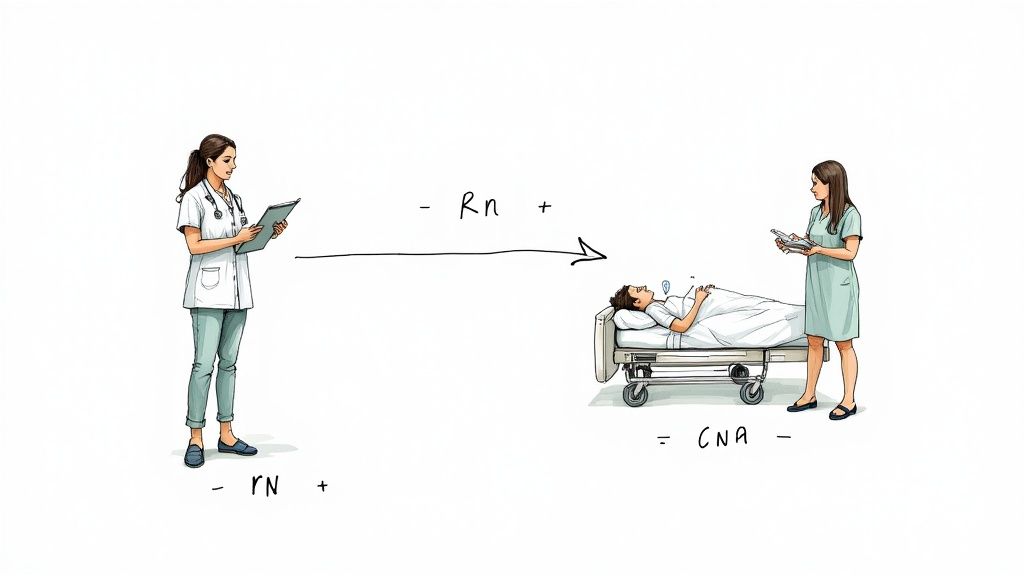
Think of a CNA as the backbone of day-to-day patient care. They are right there with patients, helping with what we call activities of daily living (ADLs). This means assisting with bathing, dressing, getting around, and eating. They are the eyes and ears of the clinical team, noticing subtle changes in a patient's condition and reporting them straight to the nurse.
An RN, on the other hand, operates with a much broader scope of authority and responsibility. RNs are licensed to perform advanced clinical tasks. They administer medications, develop and manage patient care plans, run diagnostic tests, and educate patients and their families about health issues and treatment.
Here’s a quick summary of their distinct functions:
- A CNA's primary role is to provide direct, hands-on support with daily activities. They work under the supervision of a nurse, focusing on patient comfort and safety.
- An RN's primary role is to manage the overall clinical picture. They assess patients, create treatment plans, administer medications, and supervise other staff like CNAs.
Comparing Education and Training Requirements
When you look at the CNA vs. RN debate, the biggest difference by far is the education. These two paths couldn't be more different in the time, money, and academic effort they demand, which ultimately shapes what each person can do on the job. The route to becoming a CNA is all about getting you into the healthcare field quickly.
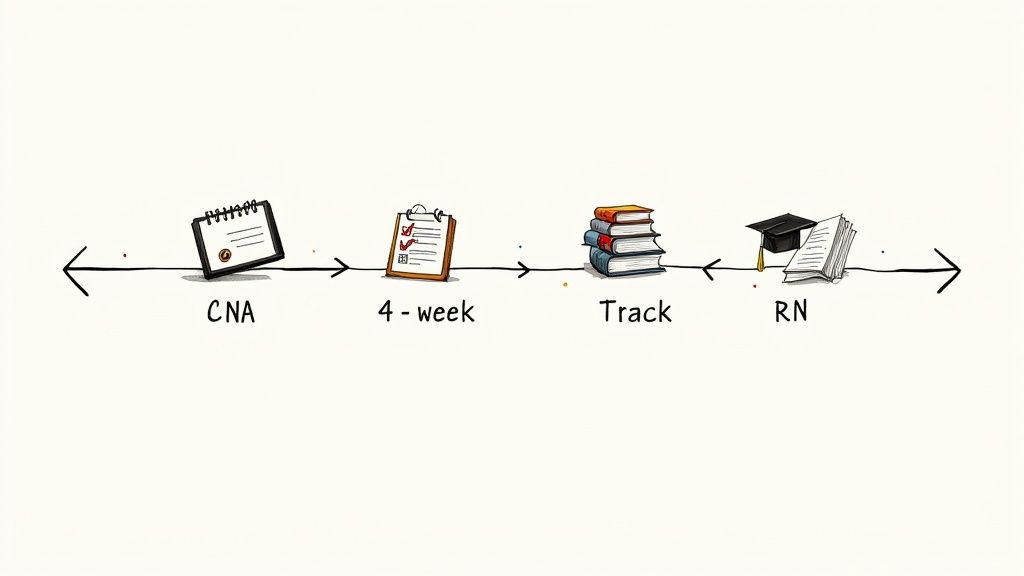
If you want to be a CNA, you’ll need to finish a state-approved training program. These programs mix classroom learning with real, hands-on clinical experience. While every state has its own rules, you can expect the training to take anywhere from 4 to 12 weeks. Once you've completed the program, you have to pass a state competency exam to get your certification and officially be listed on the state registry. This streamlined process means you can be working directly with patients in just a few short months. We cover this in more detail in our guide on how long CNA training takes.
The Path to Becoming a Registered Nurse
Becoming an RN, on the other hand, is a much bigger commitment. It requires a formal college degree, which makes sense given the role's advanced clinical duties and independence. This journey involves years of intensive study.
There are two main ways to get there:
- Associate Degree in Nursing (ADN): This is a two-year degree, usually offered at community colleges and some four-year schools.
- Bachelor of Science in Nursing (BSN): This is a four-year university program that digs deeper into subjects like leadership, research, and public health.
Did you know the RN role is the largest healthcare profession in the U.S.? There are nearly 5.2 million registered nurses. This massive number highlights the strict educational and licensing standards needed to ensure patient safety and quality care.
No matter which degree you choose, every single aspiring RN must pass a national exam—the NCLEX-RN—to get licensed. This tough test ensures every nurse meets a consistent, high standard of competence before they can practice. To keep that license active, RNs also have to complete continuing education courses throughout their careers.
A Day in The Life: What CNAs and RNs Actually Do
If you really want to understand the difference between a CNA and an RN, the best place to start is with what they do all day. While they both work closely with patients, their roles and legal responsibilities couldn't be more different. Think of it this way: the CNA's world is all about direct, hands-on support, while the RN's is focused on clinical judgment and managing the bigger picture of patient care.
The CNA: The Heart of Hands-On Care
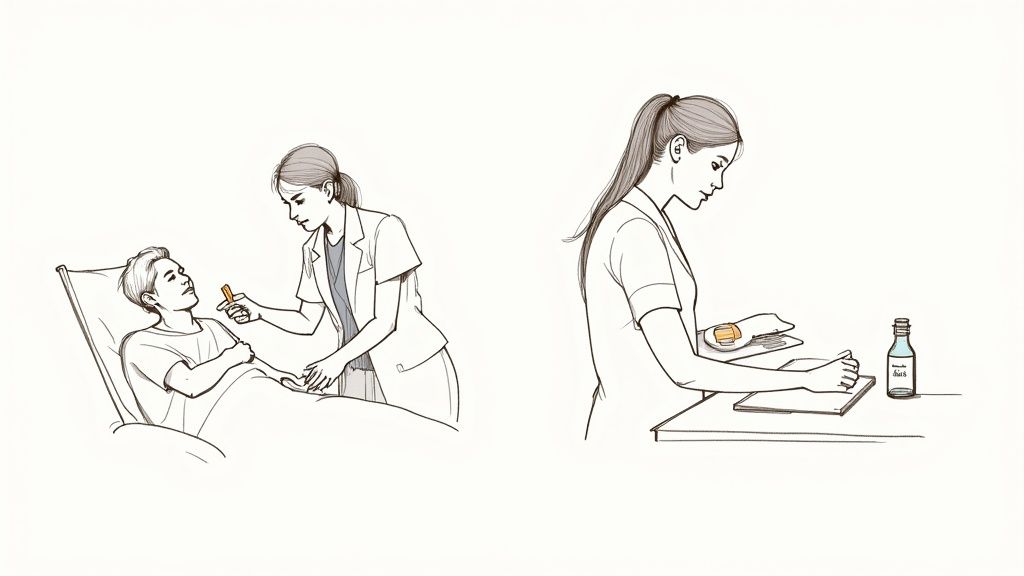
Certified Nursing Assistants are the backbone of direct patient care. Their entire day revolves around helping patients with activities of daily living (ADLs), which are the essential tasks that ensure comfort, safety, and dignity.
A typical CNA's shift is a flurry of activity. They might start the morning helping residents with bathing, getting dressed, and grooming. Later, they’ll be busy transferring patients from a bed to a wheelchair, assisting them with walking, or repositioning someone who is bedridden to prevent painful pressure sores. A huge part of their job is also monitoring, which means taking and charting vital signs like temperature and blood pressure and—most importantly—alerting the nurse to any changes. You can get a deeper look at these duties in our full CNA job description.
The RN: The Clinical Strategist
Registered Nurses, on the other hand, operate with a much broader and more analytical scope. While they certainly provide hands-on care, their work is defined by a licensed practice that requires deep medical knowledge and critical thinking. An RN's day isn't so much about the routine ADLs; it’s about assessment, planning, treatment, and evaluation.
An RN is the one who performs in-depth patient assessments to figure out what's going on with a patient's health. From there, they create and manage a detailed nursing care plan.
This means they handle tasks that CNAs are legally not allowed to do, such as:
- Administering medications, including complex IV drugs.
- Performing advanced medical procedures like sterile wound care or inserting catheters.
- Educating patients and their families about their conditions and treatment plans.
- Supervising CNAs and other support staff, delegating tasks appropriately.
A key difference between a CNA and an RN comes down to delegation. The RN uses their clinical judgment to assess a patient's condition and then delegates certain tasks (like taking vitals) to a CNA. But ultimately, the RN is the one who remains fully responsible for the patient’s overall care and outcomes.
The roles are distinct yet completely intertwined. One area where their collaboration is critical is in safety. For example, effective nursing home infection control strategies depend on both roles working together. The CNA is on the ground carrying out fundamental hygiene and safety protocols every day, while the RN oversees the entire infection control plan, ensuring the facility remains a safe environment for everyone.
Salary Potential and Career Outlook
When you’re weighing a CNA path against an RN path, the conversation almost always turns to salary and long-term career growth. Let's be frank: the difference is significant. Both roles are absolutely vital and in high demand, but the paychecks and career ceilings are worlds apart.
This gap really reflects the deep differences in education, daily responsibilities, and the legal scope of what each professional is allowed to do.
The numbers tell a clear story. As of 2025, a Registered Nurse in the U.S. can expect a median annual salary of around $93,600, which works out to about $45.00 per hour. On the other hand, a Certified Nursing Assistant earns an average of $38,130 per year, or about $18.33 per hour. That means RNs, on average, earn more than double what CNAs do. The Bureau of Labor Statistics is a great resource for tracking these figures.
Understanding the Pay Discrepancy
So, what’s behind that massive difference in pay? It boils down to a few key things: licensure, autonomy, and accountability. RNs are licensed professionals. They’ve gone through years of tough schooling to be able to make critical clinical decisions, administer complex medications, and create patient care plans from scratch. That license comes with a heavy weight of legal and ethical responsibility.
CNAs are the backbone of patient care, but they work under an RN's supervision. Their training prepares them for essential, hands-on tasks, but they aren't licensed to perform the advanced medical procedures that are central to the RN role. To get a closer look at what CNAs earn based on their location and experience, we put together a detailed guide on how much CNAs make.
The takeaway is clear: while a CNA role offers a stable and respectable entry-level wage, the RN path provides a significantly higher income ceiling and greater financial security over the long term. This financial advantage is a key motivator for many CNAs who choose to advance their education.
Job security is strong for both professions—the demand for healthcare isn't going anywhere. But the career outlook for an RN is just so much broader. It opens doors to specialized clinical fields, leadership roles, and advanced practice nursing, all of which come with their own substantial pay bumps.
Career Advancement and Specialization Paths
Thinking about your career long-term is a smart move. When you look at the paths for a CNA versus an RN, you're really looking at two very different futures. For many, becoming a CNA is the perfect way to get their foot in the door of the healthcare world. It's a quick route to hands-on experience and a chance to see if nursing is truly your calling before diving into years of college.
Many CNAs discover their daily interactions with patients ignite a passion for more clinical responsibility. This makes the move from CNA to RN a very natural progression. That on-the-ground experience is a huge asset in nursing school; former CNAs just seem to have a better feel for patient care and the flow of a clinical setting.
The RN's World of Opportunity
Once you have that "RN" after your name, a whole world of possibilities opens up. The opportunities to specialize are vast, letting you build a career around what truly interests you.
An RN can earn advanced certifications to work in exciting, high-demand areas like:
- Critical Care: Caring for the most vulnerable patients in the Intensive Care Unit (ICU).
- Pediatrics: Working with everyone from newborns to teenagers.
- Oncology: Supporting patients and their families through cancer treatment.
- Emergency Nursing: Thinking on your feet in the high-energy, fast-paced ER.
But it doesn’t stop there. RNs can step into leadership roles as a nurse manager or move into hospital administration. For those with even bigger goals, an advanced degree is the key. A Master of Science in Nursing (MSN) or a doctorate can lead to elite roles like an Advanced Practice Registered Nurse (APRN) or Nurse Practitioner.
The professional journey for an RN is not just a job—it's a dynamic career with multiple branches for growth, leadership, and specialization. While the CNA role provides an essential start, the RN path offers a much broader and more varied professional future.
The demand for these advanced roles is booming. Employment for RNs is projected to grow 5% by 2034, with an incredible 189,100 job openings expected each year. The CNA field, while essential, is projected to grow by a more modest 2%. You can dig into the data on this trend and the growing nursing shortage on RegisteredNursing.org. This really shows how central the RN career path is to meeting our future healthcare needs.
How to Choose Your Nursing Path
Figuring out whether to become a CNA or an RN really boils down to what you want right now versus where you see yourself in the long run. There’s no single right answer; it all depends on your timeline, your finances, and what you hope to achieve in your career.
The CNA route is a brilliant starting point if you’re eager to get into healthcare quickly. It's a low-commitment way to get your foot in the door, see if patient care is truly for you, and start earning a paycheck in a matter of months. That hands-on experience is priceless and gives you a real-world foundation that a textbook never could.
For many, the choice isn't really CNA or RN—it's CNA, then RN. Starting as a Certified Nursing Assistant can give you a massive confidence boost and make you a much more capable nursing student down the line.
If you’re thinking about switching from a completely different profession, taking a look at some effective career change tips can help you map out a smooth transition.
On the other hand, if you're already certain that you want a career with more autonomy, higher pay, and a huge variety of specialization options, then heading straight for an RN degree makes the most sense. It's a much bigger investment of time and money, but the professional doors it opens are on a completely different level.
This visual helps map out how the journey from CNA to a specialized RN role can look.
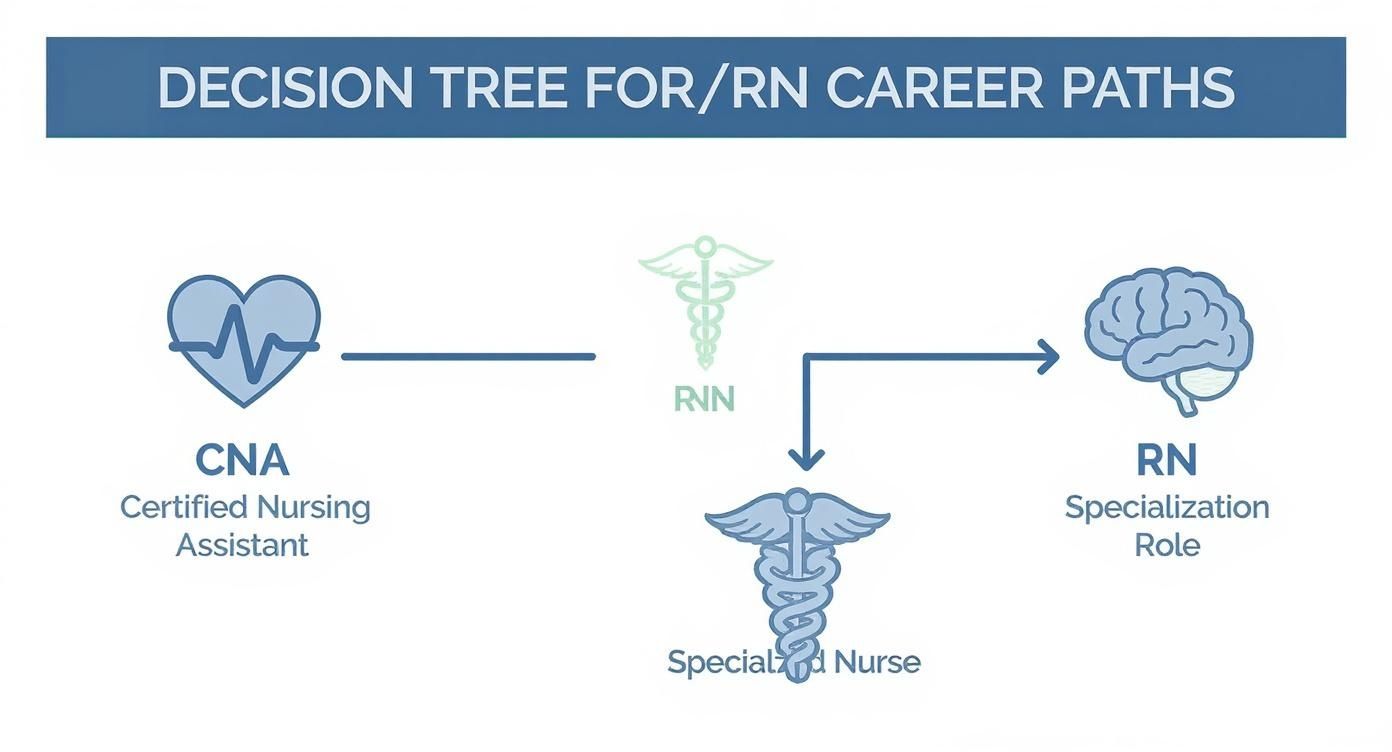
As you can see, the CNA role is often the perfect launchpad for becoming an RN and finding an advanced specialty you're passionate about.
Common Questions About CNA and RN Roles
Thinking about a career in nursing? It's easy to get the roles of CNA and RN mixed up. Let's clear the air and answer a few of the most common questions people ask when they're starting out.
Can a CNA Perform RN Duties?
That's a definite no. CNAs are absolutely essential for patient comfort and daily care—think helping with bathing, moving around, and checking vital signs. But they always work under the supervision of a nurse.
RNs, on the other hand, are licensed professionals. Their job involves a much broader scope, including things like administering medications, developing official patient care plans, and handling more complex medical procedures. The roles are distinct for a reason, mainly centered on patient safety and legal responsibility.
Is CNA a Good First Step to Becoming an RN?
It’s one of the best first steps you can take. Working as a CNA gives you a real-world, hands-on look at what nursing is all about, long before you commit to years of nursing school. You'll see the good, the bad, and everything in between.
This kind of practical experience is a huge plus when you do start your RN program. In fact, some nursing schools even give you credit for your CNA certification, which can be a nice head start.
At The CNA Guide, we provide clear, reliable information to help you navigate every step of your career. Explore our free resources on training, certification, and job opportunities at https://thecnaguide.com.