The CNA written exam is a multiple-choice test designed to measure what you know about providing safe, effective patient care. Most states give you about 90 minutes to answer somewhere between 60 and 70 questions, and you’ll typically need to score around 70% to pass.
Understanding the CNA Written Exam Blueprint
To pass the CNA written exam, you first need to know exactly what you’re up against. Think of it like a coach studying the other team’s playbook before a big game—understanding the structure is your first step toward a winning strategy. This test isn’t just a random collection of questions; it’s a carefully crafted assessment to make sure you have the essential knowledge to be a great CNA.
The format itself is pretty straightforward. You’ll likely be sitting at a computer, answering multiple-choice questions. But these aren’t just simple trivia. The questions are almost always scenario-based, meaning they’ll describe a real-world situation and ask you to decide on the best course of action. It’s a test of not just what you’ve memorized, but how well you can apply that knowledge on the job.
Key Exam Metrics
While the exact numbers can shift a bit from state to state, there’s a general framework you can count on. Here’s a quick rundown to help you set clear targets for your study sessions.
This table breaks down the typical structure of the CNA written exam.
CNA Written Exam At a Glance
| Exam Component | Typical Standard | What This Means for You |
|---|---|---|
| Number of Questions | 60-70 questions | You need to answer a little more than one question per minute. Pace yourself. |
| Time Limit | 90 minutes | Time management is key. Don’t get stuck on any single question. |
| Question Format | Multiple-choice | Familiarize yourself with how to eliminate wrong answers to find the best one. |
| Passing Score | Around 70%-80% | You don’t need to be perfect! Aim for solid competency across all areas. |
Having these numbers in mind gives you a clear, achievable goal. It’s not an impossible mountain to climb; it’s a structured test with rules you can learn to master.
This infographic gives you a visual breakdown of what to expect.
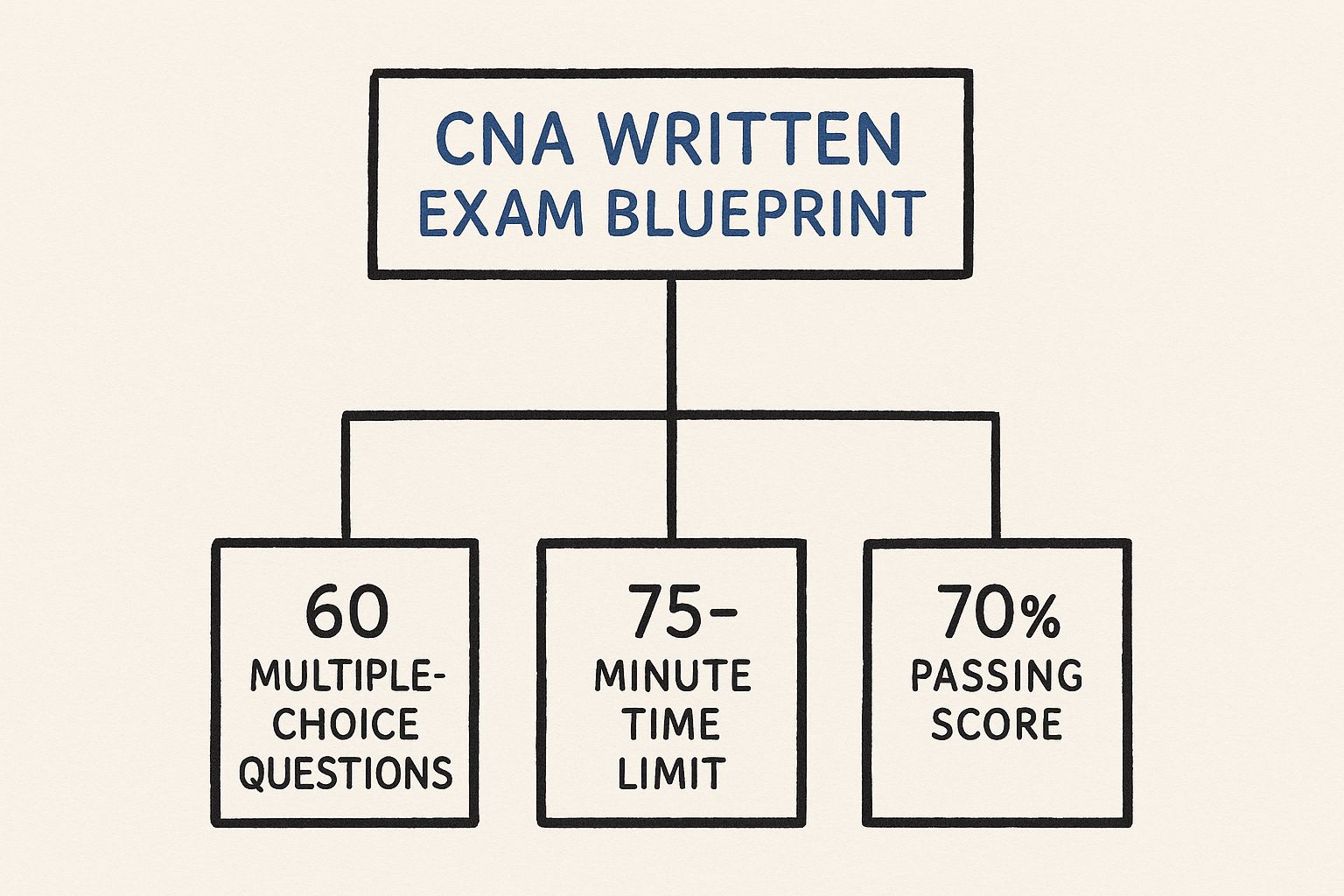
As you can see, the path to passing is well-defined.
How Structure Influences Your Study Plan
Knowing these details helps you build a smarter study plan. For example, if you have 90 minutes for 70 questions, that’s roughly 77 seconds per question. That simple math tells you that practicing your timing is just as important as reviewing your notes. You have to be able to read, think, and answer without getting bogged down.
A well-structured study approach, informed by the exam’s blueprint, removes guesswork and anxiety. It transforms your preparation from a scattered effort into a focused mission, allowing you to allocate your time and energy where they will have the most impact on your score.
Understanding that the passing score is usually around 70% should also help ease some of that test-day pressure. You don’t need a perfect score; you just need to demonstrate you have the core knowledge to be a safe and competent nursing assistant. This can help you stay calm, make educated guesses when you’re unsure, and avoid panicking.
Once you have this foundation, a great next step is to explore our detailed guide on CNA programs available in your state. By matching your study habits to the exam’s actual design, you’re not just studying harder—you’re studying smarter.
Mastering the 5 Core Knowledge Areas
Think of the CNA written exam less like a pop quiz and more like a roadmap. It’s not designed to trick you with random healthcare trivia. Instead, it’s broken down into five core areas that directly mirror the essential duties you’ll handle every single day as a CNA. To pass, you don’t just need to know the facts—you need to understand how to apply them in real situations.
The questions are crafted to feel like mini-scenarios. They won’t just ask you for a definition; they’ll drop you into a situation and ask, “What’s the right thing to do here?” This ensures that everyone who passes isn’t just book-smart but is truly ready for the hands-on, human side of the job.
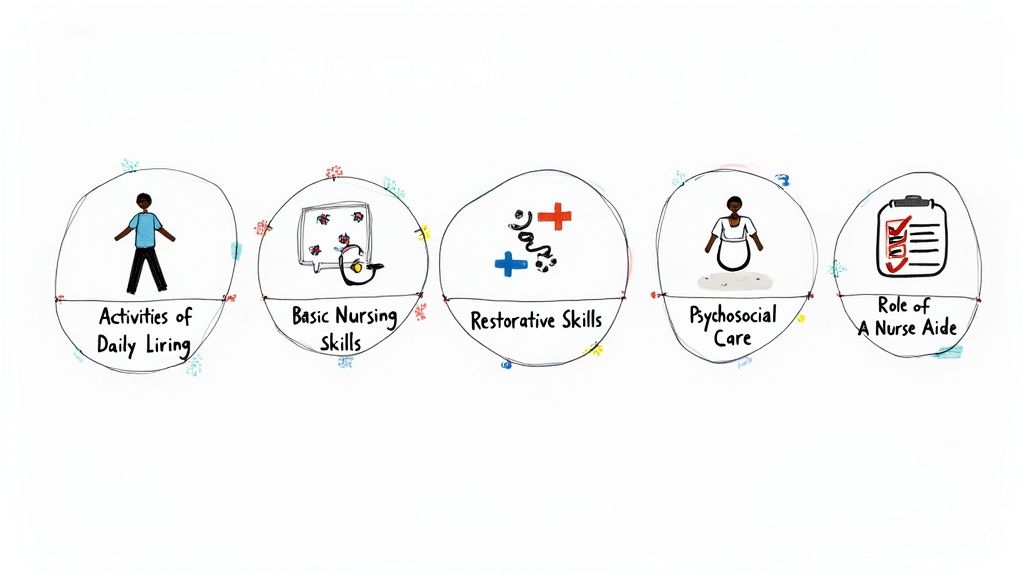
Area 1: Activities of Daily Living
This is the bedrock of CNA work, often shortened to ADLs. It’s all about providing the hands-on support that helps patients maintain their comfort and dignity. We’re talking about the essentials: hygiene, grooming, dressing, eating, and toileting.
For instance, you might get a question describing a resident who has a weak right side. It will then ask you the proper way to help them put on a shirt. The answer involves starting with their weaker arm—a simple but crucial technique that prevents injury and makes the process easier for them. This section is a big one, because ADLs are a huge part of your daily routine.
Area 2: Basic Nursing Skills
Moving beyond daily routines, this section dives into the more technical side of your role. In fact, this is the largest knowledge area on the test, often making up more than a third of the questions. It’s where your grasp of safety procedures and clinical skills is really put to the test.
This category covers critical topics like:
- Infection Control: Knowing exactly when and how to wash your hands or use Personal Protective Equipment (PPE).
- Safety and Emergencies: What’s your first move if a resident falls? How do you respond to a fire alarm?
- Collecting Information: Can you accurately take and record vital signs like blood pressure, temperature, and pulse?
- Assisting with Treatments: This could involve anything from applying elastic stockings correctly to helping with simple range-of-motion exercises.
It’s a common myth that the CNA exam is just about “basic” care. The reality is, they weigh your knowledge of infection control and safety protocols very heavily. Why? Because in any healthcare facility, these skills are absolutely non-negotiable for keeping vulnerable people safe.
Area 3: Restorative Skills
This area is all about helping patients get back on their feet—or at least maintain the highest level of independence they possibly can. It’s about being proactive, not just reactive. Your role here is to help prevent problems like muscle weakness or bedsores and empower residents to do more for themselves.
A question here might ask about the correct way to position a bed-bound patient to promote circulation or how to use a transfer belt safely while helping someone walk. This is where you show you’re thinking about a person’s long-term health and well-being.
Area 4: Psychosocial Care Skills
Great care isn’t just physical. This part of the exam evaluates how you handle the emotional, mental, spiritual, and social needs of your patients. It’s about proving you can communicate with empathy and provide compassionate support, even in tough situations.
For example, a question might describe a resident who is confused and agitated and ask for the best way to approach them. Another might focus on how to respectfully accommodate a patient’s unique cultural or religious traditions.
Area 5: Role of the Nurse Aide
Last but not least, this section makes sure you understand your place within the larger healthcare team. It covers your professional, legal, and ethical responsibilities. You’ll see questions on patient rights, confidentiality (think HIPAA), and, most importantly, your scope of practice.
You absolutely have to know what tasks you are allowed to do, what you aren’t, and when it’s critical to report an observation or concern to the supervising nurse. This is all about being a responsible and trustworthy professional.
How to Study Smarter for the CNA Exam
Knowing what’s on the CNA written exam is one thing. Knowing how to get that information to stick is something else entirely. If your study plan is just rereading your textbook until your eyes glaze over, you’re working way harder than you need to.
Let’s be honest, that’s one of the least effective ways to learn. To really lock in the material, you need to get your hands dirty with active, engaging study strategies.
Think of it this way: you can’t learn to swim by just watching videos of swimmers. You have to get in the water. The same goes for studying. You need to actively work with the information, not just passively look at it.
Put Your Brain to Work with Active Recall
One of the best techniques I’ve seen work time and time again is active recall. This is just a fancy term for pulling information out of your brain from memory, rather than simply looking at it on a page. Flashcards are a perfect, old-school example of this. But don’t just flip them over. Force yourself to say the answer out loud first.
That small act of trying to remember is what builds strong connections in your brain, making it much easier to pull up that info when the pressure’s on during the actual exam. It’s a quick and powerful way to see what you actually know versus what you just kind of recognize.
Another great trick is the Feynman technique. Here’s how it works:
- Pick a topic you find tricky, like proper infection control.
- Try to explain it out loud in super simple terms, as if you were talking to a friend who knows nothing about healthcare.
- If you stumble, get stuck, or have to use a bunch of jargon, you’ve just found a weak spot. That’s a good thing!
- Go back to your study materials, fill in that knowledge gap, and try explaining it again. Keep going until your explanation is simple and clear.
Get a Feel for the Real Thing with Practice Tests
When it comes to prepping for the CNA written exam, nothing beats high-quality practice tests. They’re more than just a quiz; they’re a full dress rehearsal. You get used to the timing, the pressure, and the way the questions are worded, which helps dial down the anxiety on test day.
The real magic happens after you finish a practice test. You need to review it—and I mean really dig in. Don’t just glance at the ones you got wrong. Take a hard look at any question you had to guess on, even if you guessed right. This is how you find your specific weaknesses and focus your study time where it will have the biggest impact.
Practice tests aren’t about memorizing the answers to those specific questions. They’re about learning to think through the why behind each answer, so you can apply that logic to any question the real exam throws at you.
This kind of focused preparation truly pays off. Just look at the numbers. In Minnesota, during the first quarter of 2021, some CNA programs had a 100% pass rate for first-timers, while others were as low as 67%. You can dig into these state-specific performance metrics yourself. That gap shows just how much a solid study plan can influence your chances of success. By studying smarter, not just harder, you’re setting yourself up to pass with confidence.
Navigating Test Day Registration and Logistics
https://www.youtube.com/embed/tx3V8Yh2ojw
Before you can even think about the questions on the CNA written exam, you’ve got to tackle the paperwork and scheduling. Getting these logistics handled correctly and well ahead of time is one of the best things you can do for a smooth, stress-free test day.
Think of it this way: you wouldn’t start a road trip without knowing your destination or having gas in the car. This is the same idea.
Your first move is to find out who actually runs the test in your state. Most states don’t administer the exam themselves; they contract with a third-party company. You’ll likely see names like Prometric, Pearson VUE, or Credentia pop up when you search for “[Your State] CNA exam provider.”
The Application and Scheduling Process
Once you’ve tracked down the right company’s website, you’ll need to create an account and fill out an application. This is where you officially prove you’re eligible to take the test, which usually just means uploading proof that you finished your CNA training program. After they approve your application (which can take a few days), you’ll finally be able to schedule your exam.
It generally breaks down into these simple steps:
- Find Your Provider: Figure out which company administers the CNA exam in your state.
- Create an Account: Get yourself registered on their online system, like Credentia’s CNA365 platform.
- Submit Your Application: Upload your training certificate and any other paperwork they ask for.
- Get the Green Light: Wait for that email confirming you’re approved to schedule.
- Schedule and Pay: Pick your test date and location, then pay the exam fee, which is usually around $100.
Pay close attention to the deadlines and what documents you need. A simple mistake, like forgetting to upload a file, can cause a huge delay and a lot of last-minute panic.
Don’t Forget the Small Stuff
It’s often the little things that trip people up on test day. Double-check the exact address of the testing center and plan your route. Make sure you have two forms of valid, unexpired government-issued ID ready to go.
And just in case, look up the rescheduling policy. Life happens. Knowing your options beforehand can save you from losing your exam fee if something unexpected comes up.
For a more detailed look at the specific requirements where you live, check out our guide on CNA license registration. Taking care of these administrative details early means you can walk into that exam room feeling confident and ready to focus on what really matters—passing the test.
Common Mistakes That Test-Takers Make
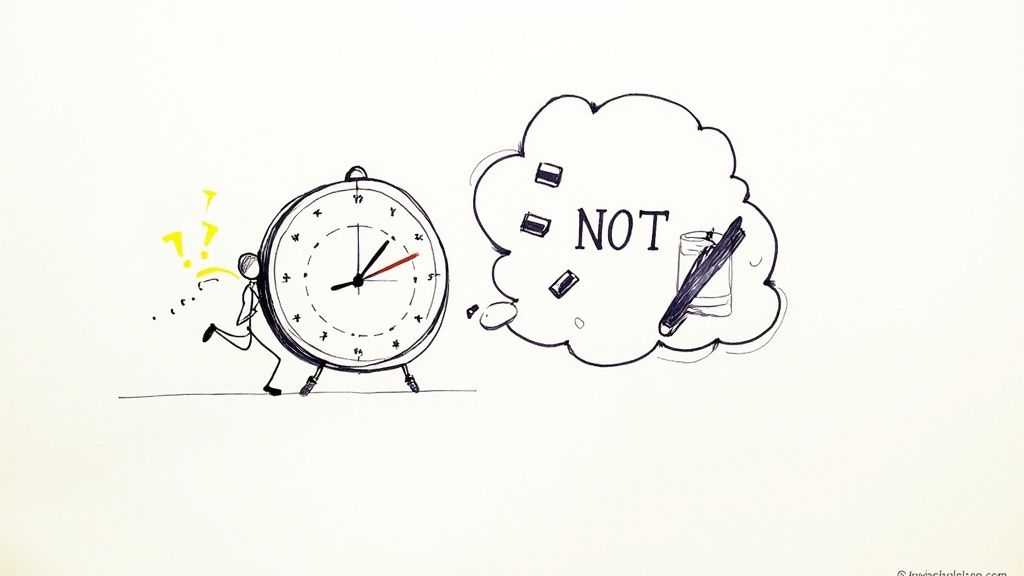
Sometimes, passing the CNA written exam has less to do with memorizing every last detail and more to do with sidestepping the common traps that snag even well-prepared students. Knowing what trips people up is half the battle. If you can anticipate these pitfalls, you can walk in with a much smarter strategy.
One of the biggest culprits? Simply misreading the question. It sounds basic, but it happens all the time. Test creators love to use words like “NOT,” “EXCEPT,” or “LEAST LIKELY” to check if you’re paying close attention. Your mind is wired to spot the correct action, so a question that flips the script and asks for the incorrect one can easily throw you for a loop if you’re moving too fast.
Another classic mistake is second-guessing yourself. Trust your gut. More often than not, especially if you’ve put in the study time, your first instinct is the right one. When you start overthinking, you can easily talk yourself out of a perfectly good answer and into a trap.
Poor Pacing and Time Management
It’s the age-old story: the clock is ticking down, panic sets in, and you end up rushing through the last set of questions. This is a totally preventable error. Getting bogged down on one tough question can cost you the chance to answer several easier ones that come after it.
The key is to practice your pacing before test day. Here’s a solid game plan: give each question a quick look. If the answer doesn’t come to you right away, don’t dwell on it. Just mark it for review and move on. You can circle back to the tricky ones after you’ve locked in the points for all the questions you know for sure.
This strategy ensures you at least have a chance to read and answer every single question, which is critical for hitting your best possible score.
“The most common reason for failing isn’t a lack of knowledge, but a failure to demonstrate that knowledge under pressure. Avoiding simple mistakes in reading and timing is as critical as knowing the material itself.”
Failing to Eliminate Wrong Answers
When you hit a question that stumps you, don’t just throw a dart and hope for the best. Use the process of elimination. The multiple-choice format is your friend—the correct answer is literally staring you in the face. Your job is to play detective and weed out the obvious decoys.
Here’s what to look for when crossing off wrong answers:
- Too extreme: Options that use absolute words like “always” or “never” are often incorrect.
- Unrelated to the question: The answer might be a true statement, but does it actually answer the specific question being asked?
- Clearly unsafe or unprofessional: Any choice that violates patient safety or basic rights is an immediate red flag. Get rid of it.
Nailing these test-taking skills is about more than just a grade; it’s a direct reflection of your readiness for the job. Data from the National Nursing Assistant Survey confirms that the exam serves as a crucial gatekeeper for entering the U.S. healthcare workforce. You can read more about these important national survey findings to understand the context. By showing you can think critically under pressure, you’re proving you have what it takes.
Answering Your Top Questions About the CNA Written Exam
As your test date gets closer, you’re bound to have questions about the nuts and bolts of the CNA written exam. Getting straight answers can do wonders for your confidence and make sure you’re ready for anything that comes your way.
Let’s tackle some of the most common uncertainties head-on. Consider this your go-to FAQ for everything from how the test is scored to what happens if things don’t go as planned.
How Is the CNA Written Exam Scored?
The exam is graded on a simple pass/fail system. There’s no A+ or C-, you either meet the standard or you don’t.
Most states consider a score between 70% and 80% to be a passing grade. Keep in mind, this isn’t always just the raw percentage of questions you got right. Testing companies often use a scaled score to account for small variations in difficulty between different test versions, which keeps things fair for every test-taker. Your goal isn’t to get a perfect score; it’s to demonstrate you have the essential knowledge to be a safe, effective CNA. You’ll usually find out if you passed the same day.
What Happens If I Fail the CNA Written Exam?
First off, don’t panic. It might feel like a major setback, but it’s just a bump in the road—and a common one at that. Many fantastic CNAs didn’t pass on their first try.
States typically give you up to three attempts to pass, usually within a one or two-year window. A failed attempt actually gives you a powerful tool for your next try.
Your score report is an incredibly valuable diagnostic tool. It breaks down your performance by subject area, showing you exactly where you need to focus your study time.
Use that feedback. Dive back into your weak spots, review your materials, and reschedule the exam when you feel truly prepared. This is a learning experience, not a final judgment.
Can I Take the CNA Written Exam Online From Home?
This is a great question, but the answer really depends on your state and which company administers its exam. The skills portion of your certification is almost always done in person. No exceptions there.
The written test, however, is a computer-based test (CBT) that you’ll take at a designated, proctored testing center. While a few states might offer a remotely proctored version you can take from home, it’s not the norm for CNA certification.
The only way to know for sure is to check with your state’s Board of Nursing or the official testing provider. It will almost certainly be one of these:
Are Accommodations Available for the Exam?
Yes, absolutely. The Americans with Disabilities Act (ADA) ensures that candidates with documented disabilities can request reasonable accommodations. This is all about giving everyone a fair shot to show what they know.
Common accommodations include things like extra time, a reader to assist with the questions, or a private room to minimize distractions. You have to request these well in advance of your test date. The process involves submitting official documentation from a doctor or other qualified professional, and it can take some time to get approved, so don’t leave it until the last minute!
At The CNA Guide, we provide clear, state-by-state information to help you navigate every step of your career journey, from finding training programs to understanding exam logistics. Your go-to resource for CNA certification