Becoming a Certified Nursing Assistant (CNA) is one of the fastest ways to jumpstart a career in healthcare. Most state-approved training programs can be completed in just 4 to 12 weeks, which means you can go from the classroom to caring for patients in a matter of months.
Your Roadmap to a Rewarding CNA Career
Choosing to become a CNA is a big step—it's your entry into the very heart of patient care. This isn't a role you train for by sitting in a lecture hall for years. The path is designed to be quick and hands-on, getting you into the field where you can make a real difference, fast.
And you couldn't be picking a better time. The demand for CNAs is booming. The U.S. Bureau of Labor Statistics (BLS) expects around 220,000 new job openings for nursing assistants every single year between 2022 and 2032. This isn't just a number; it's a reflection of the growing needs of an aging population, which translates to incredible job security. You can find more details on this trend and explore the CNA job outlook to see what's ahead.
What to Expect Along the Way
The journey to certification is straightforward, built to give you the practical skills you need to excel. But being a great CNA is about more than just technique; it’s about who you are as a person. It's a role that truly puts you on the front lines of the patient experience.
To really thrive, you'll need a few core qualities:
- Empathy and Patience: You'll be the person patients lean on during tough times. A kind and understanding presence makes all the difference.
- Physical Stamina: The job keeps you on your feet. You'll be lifting, turning patients, and constantly moving, so being physically prepared is key.
- Strong Communication Skills: You’re the bridge between the patient, their family, and the rest of the medical team. Clear communication is vital for safety and comfort.
- An Eye for Detail: From taking vital signs to noticing small changes in a patient's condition, your accuracy and observation skills are crucial.
This visual guide lays out the key phases you'll go through, from student to certified pro.
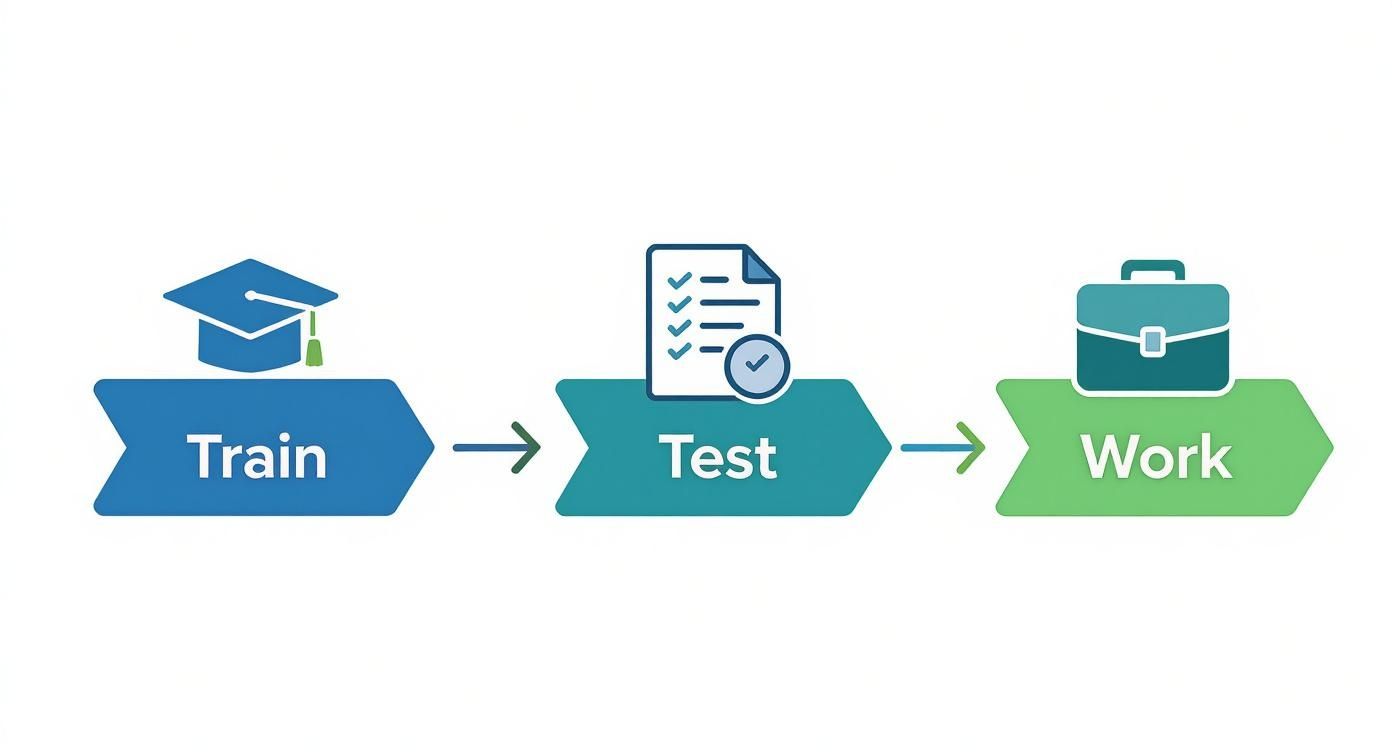
As you can see, the process boils down to three core milestones: training, testing, and getting to work.
CNA Career Snapshot
Here is a quick overview of what to expect in a CNA role, from training timelines to key responsibilities:
- Typical Training Time: 4-12 weeks, depending on the state and program intensity.
- Key Responsibilities: Assisting with daily living activities (bathing, dressing, eating), taking vital signs, reporting changes to nurses.
- Work Environments: Nursing homes, hospitals, assisted living facilities, and home healthcare.
- Essential Skills: Compassion, physical strength, clear communication, and attention to detail.
- Career Advancement: A great stepping stone to becoming an LPN or RN.
This gives you a bird's-eye view of the role, helping you understand the commitment and the day-to-day realities of being a CNA.
Your success as a CNA starts with recognizing that you are the eyes and ears of the nursing team. The observations you make and the care you provide directly influence patient outcomes and comfort every single day.
Choosing the Right State-Approved CNA Program
This is where your journey to becoming a CNA really kicks off—picking your training program. It feels like just the first box to check, but this decision sets the stage for your entire career. It’s about more than just finding the closest school; it’s about finding the right fit that will give you the skills and confidence to succeed from day one.
The good news is that the path to becoming a CNA is designed to get you into the healthcare field quickly. No matter where you are in the U.S., you'll need to complete a state-approved training program. These typically require 75 to 150 hours of training, blending classroom instruction with real-world clinical practice.
This mix is intentional. It ensures you master the fundamentals—things like patient safety, communication, and infection control—long before you ever sit for your certification exam.
Where to Find Your Program
State-approved CNA programs are offered in all sorts of places, and each has its own vibe. The best one for you really depends on your budget, schedule, and how you like to learn.
Here’s a quick rundown of your main options:
- Community Colleges: A classic choice for a reason. They offer well-rounded programs with experienced instructors and all the campus resources you’d expect, like libraries and career centers.
- Vocational or Technical Schools: These schools are all about job training. Their CNA programs are usually fast-paced and focused on getting you certified and working as soon as possible.
- Medical Facilities and Nursing Homes: This is a fantastic route. Some hospitals and nursing homes will train you themselves, often for free or at a reduced cost, if you agree to work for them after you’re certified. It’s a great way to get your foot in the door with an employer.
If you want to see what’s available near you, a great next step is to check out our guide on state-by-state CNA programs to find an accredited course.
Key Questions to Ask Admissions Staff
Before you sign on the dotted line, you need to do a little detective work. Don’t be afraid to call or email the admissions office—the way they answer your questions says a lot about the quality of their program.
The number one thing you want to know is their certification exam pass rate. A strong program will be proud to share this. A high pass rate, ideally above 85-90%, is a great sign that their teaching methods actually work.
A program's pass rate is a direct reflection of its teaching quality. If they are hesitant to share this number, consider it a major red flag. Your goal is to pass the exam on the first try, and your school should be your biggest ally in achieving that.
You should also ask about job placement support. Do they help you build a resume? Do they have connections with local healthcare facilities? Strong relationships with employers are a hallmark of a well-respected program.
Understanding the Financial Commitment
CNA programs can range from just a few hundred dollars to several thousand. The total cost usually covers tuition, textbooks, scrubs, and basic supplies like a stethoscope.
Always ask for a complete breakdown of costs so there are no surprises. And don’t forget to look into financial help.
- Financial Aid: Many community colleges and vocational schools are eligible for federal aid (FAFSA). It's always worth checking if your program qualifies.
- Workforce Grants: Your state’s workforce development office might offer grants for people entering high-demand fields like healthcare.
- Employer-Sponsored Training: As I mentioned, some facilities will foot the bill for your training if you commit to working for them for a little while.
Accelerated vs. Part-Time Schedules
Finally, think about how a program’s schedule will fit into your life. The right pace makes all the difference.
- Accelerated Programs: Best for anyone who can commit to full-time study and wants to get to work fast. These typically last 4-6 weeks.
- Part-Time Programs: Ideal for people juggling a job, family, or other commitments who need more flexibility. These often run for 8-12 weeks or longer.
Accelerated programs are intense. They require your full attention but get you certified in record time. Part-time options, which often run in the evenings or on weekends, give you the breathing room to study without putting the rest of your life on hold. Be honest with yourself about what you can handle and choose the path that sets you up for success.
Excelling in Your CNA Coursework and Clinicals
Alright, you’re in. Now the real journey begins. Getting through your CNA program is an intense mix of hitting the books and getting your hands dirty with real, practical skills. This is where you build the foundation for your entire healthcare career, so it's about more than just passing tests—it's about becoming a caregiver you'd want taking care of your own family.
Think of your program as two sides of the same coin. You'll spend a lot of time in a classroom learning the "why"—anatomy, patient rights, safety rules. Then, you'll head to a clinical setting to practice the "how." The two are totally connected; what you learn in the classroom makes your clinical work make sense, and your clinical work brings the textbook to life.
Mastering the Classroom Material
Let's be honest, the classroom part can feel like drinking from a firehose at first. You're hit with a ton of new information, from medical jargon to the serious legal and ethical rules of the job. You can't just coast through this part; you need a solid game plan.
To keep your head above water, try these tried-and-true tactics:
- Make Flashcards Your Best Friend: Don't just stare at a list of terms. Get active. Create flashcards (digital or old-school paper ones) for all the medical terms, abbreviations, and procedures. It’s a simple trick, but it's a powerhouse for locking things into your memory.
- Find a Study Buddy (or Two): Partnering up with a couple of classmates is a game-changer. You can quiz each other, talk through confusing concepts, and just generally keep each other from procrastinating.
- Always Connect Theory to Reality: As you learn something new, like infection control, immediately picture yourself doing it. When you study the proper handwashing steps, actually visualize yourself at a sink, going through the motions before helping a patient.
This isn't just about memorizing. It’s about turning abstract facts into knowledge you can actually use on your feet.
The CNAs who really shine don't just memorize for the test. They get the "why" behind every single thing they do. Understanding why a patient needs to be positioned a certain way or why a specific vital sign is a red flag is what separates a task-doer from a true caregiver.
Thriving During Your Clinical Hours
Your clinical rotation is where the magic happens. This is your first taste of working with real patients, performing the skills you’ve learned under the watchful eye of a licensed nurse. It’s nerve-wracking for sure, but it's also the single most important part of your education.
You’re not supposed to be perfect—no one expects you to be. Your supervisors want you to ask questions and look for help. That’s how you learn.
Making a Great Impression
Remember, the nurses and staff you meet during clinicals aren't just your teachers. They're your future coworkers, and they could even be your future boss. Your attitude says everything.
Here’s how to be the student they remember for all the right reasons:
- Be Eager, Not Passive: Don't just stand around waiting for an assignment. If you have a minute of downtime, find your supervising nurse and ask, "Is there anything I can help with?" or "Can you walk me through how to document fluid intake correctly?"
- Talk to Patients with Confidence and Kindness: When you walk into a room, introduce yourself, explain what you're there to do, and always be mindful of their privacy. A simple, "Hi, Mrs. Jones, my name is [Your Name], and I'm a student nursing assistant. I'm just here to help you get ready for breakfast," works wonders.
- Treat Feedback Like a Gift: You will be corrected. It's part of the process. Instead of getting defensive, a simple "Thank you for showing me, I appreciate that" shows you’re mature and serious about getting it right.
These little things prove you're engaged, professional, and ready to become a great CNA.
Handling Stress and Building Resilience
Let’s be real for a second: a busy healthcare facility is stressful. You’re going to run into tough situations, whether it's a difficult patient or an unexpected emergency. Learning how to manage that pressure is a skill in itself.
Time management is a huge one. You might be responsible for the basic care of several patients, all at once.
Here's a real-world scenario:
Imagine it's 7 AM. You have to take vitals for four patients, help two with morning hygiene, and get another to the dining hall—all before 8 AM. It feels impossible.
- First, Prioritize: What's the most time-sensitive task? The patient who needs to be in the dining hall has a hard deadline. They come first.
- Next, Bundle Your Care: When you go into a room to take vitals, what else can you do while you're there? Can you refill their water pitcher? Adjust their pillows? This saves you from running back and forth.
- Finally, Communicate: If you're falling behind, tell your supervising nurse. It's always better to ask for help than to rush and risk making a mistake.
Clinicals are your training ground. By getting a handle on both the "book smarts" from class and the "people skills" on the floor, you're not just setting yourself up to pass an exam—you're preparing to be an exceptional Certified Nursing Assistant.
How to Pass the CNA Competency Exam
After all those weeks of hitting the books and putting in time at your clinicals, you've finally reached the last major hurdle: the CNA competency exam. Think of this test as your official entry ticket into the profession. It’s designed to confirm that you have the skills and knowledge to provide safe, compassionate care to patients.
The exam itself is a two-part challenge. It’s not about tricking you, but rather giving you a chance to show what you've learned.
First, you’ll tackle a written (or sometimes oral) multiple-choice test. Then comes the hands-on skills evaluation, where you'll perform a few nursing tasks in front of an evaluator. You’ll need to pass both sections to officially earn your certification.
Cracking the Written Knowledge Test
The written exam covers a lot of ground—everything from patient rights and safety to basic anatomy and infection control. The secret to passing isn't cramming the night before; it's about consistent, focused studying over time.
Your best resource is right in front of you: your training program materials. Dust off those notes, review your textbook chapters, and go over every handout your instructors gave you. That’s where the gold is.
Practice tests are also your best friend. They do more than just test your memory; they get you comfortable with the question format and the pressure of the clock. You can find tons of free practice questions online that are set up just like the real thing. To get an even better handle on what to expect, explore our detailed breakdown of the CNA written exam at https://thecnaguide.com/blog/cna-written-exam/ for more study strategies.
Mastering the Practical Skills Evaluation
For many students, the skills demonstration is the most intimidating part. I get it. Performing tasks in front of an evaluator can be nerve-wracking. You’ll be asked to perform several randomly selected skills, and the key is to stay calm and perform them correctly, just like you did in class.
They’ll be watching to see if you follow the critical steps, keep your patient safe, and communicate what you're doing. Simple things like washing your hands properly, pulling the privacy curtain, and explaining the procedure to your "patient" (who is usually a mannequin or a classmate) are huge.
The skills evaluation is less about absolute perfection and more about demonstrating you are safe and competent. The evaluator wants to see you remember the non-negotiable checkpoints, like locking the bed wheels before a transfer or checking the patient's ID band.
You can expect to see some of these skills pop up on your test:
- Handwashing: This one is a given. You will almost certainly be tested on proper hand hygiene.
- Taking and Recording Vital Signs: Be ready to accurately measure temperature, pulse, respirations, and sometimes blood pressure.
- Ambulating a Patient: This usually involves helping a patient walk safely, often with a gait belt.
- Performing Range of Motion Exercises: A common task is demonstrating passive range of motion on a patient's arm or leg.
- Making an Occupied Bed: This tests your ability to change sheets while a patient is in the bed, all while keeping them safe and comfortable.
Final Tips for Exam Day Success
When exam day arrives, your mindset is just as critical as your knowledge. Get there a little early so you aren't rushing and feeling stressed. Double-check that you have everything you need, like your photo ID and registration confirmation.
For the skills part, take a deep breath before you start each task. Listen closely to the instructions. It’s okay to take a second to run through the steps in your head before you even touch the patient.
And if you make a small mistake? Don't panic. It's often perfectly fine to correct yourself out loud. For instance, you could say, "I should have pulled the privacy curtain first, so I'm doing that now." This actually shows the evaluator that you know the right procedure.
Remember, plenty of amazing CNAs didn't pass on their very first try. If you have to retake a section, don't look at it as a failure. See it as a dress rehearsal. The next time you walk in, you'll know exactly what to expect, and that’s a huge advantage.
Landing Your First CNA Job
You did it. You passed your exam—congratulations! That certification isn't just a piece of paper; it’s your green light to start your career as a Certified Nursing Assistant. Now it’s time to move from student to professional, which starts with getting on your state's registry and then hitting the job market.
https://www.youtube.com/embed/yvaKNB857Y8
First thing's first: you need to get listed on your state’s official CNA registry. This is the public database employers use to verify that your certification is active and in good standing. Usually, the company that administered your exam sends your results directly to the state board of nursing. But don't just assume it happened—it's on you to follow up and make sure your name is officially on that list.
Building a Resume That Showcases Your Skills
Once your name is on the registry, it’s time to craft a resume that gets you noticed. As a brand-new CNA, you might not have a long history of paid healthcare work, but you have something equally powerful: fresh, hands-on clinical training. Your resume needs to shout about the skills you just mastered.
Don't be passive. Use strong action verbs that show exactly what you did.
Here’s how to frame your clinical experience:
- Instead of: "Helped patients with daily needs."
- Try this: "Assisted a daily caseload of 8-10 residents with Activities of Daily Living (ADLs), including bathing, dressing, and mobility support."
- Instead of: "Took vital signs."
- Try this: "Accurately measured and recorded vital signs for multiple patients, promptly reporting any abnormal findings to the supervising nurse."
See the difference? Specifics show employers that you’re ready to handle the real-world demands of the job from day one.
Finding and Applying for the Right Positions
The great news for you is that CNAs are in incredibly high demand. Despite providing up to 90% of direct resident care in many nursing homes, the profession is facing a serious shortage that's only getting worse. This situation was pushed to a crisis point during the pandemic, with U.S. nursing homes losing a staggering 223,700 employees (14.1% of their entire workforce) between February 2020 and July 2022.
The impact is huge. A 2022 survey revealed that 98% of U.S. nursing homes were struggling to hire staff. For a deeper look, you can check out the research on CNA shortages from Academic OUP. All this means you are in a very strong position as a job seeker.
Get strategic with your job search. Of course, hit the big online boards like Indeed and LinkedIn, but don't stop there. Go directly to the websites of local hospitals and long-term care facilities—they often post openings there first.
Don't just apply for a job; apply for the right environment. Think about what kind of pace you enjoy and what type of patient care gets you excited. A good fit is more than just a job description—it's finding a place where you can actually see yourself growing and thriving.
Nailing the CNA Interview
The interview is where you make your resume come alive. Hiring managers want to see your personality and confirm you have the compassion and professionalism the job demands. You should be ready for a mix of questions about your skills and how you’d handle certain situations.
They’ll probably ask about your clinicals and what you’d do in common scenarios. For example:
- "Tell me about a time you had to deal with a difficult or confused patient. What did you do?"
- "How do you prioritize your tasks when you have several patients needing your attention at once?"
- "What do you believe is the most important quality in a CNA?"
Answering with a real, specific example from your training is so much more impactful than a generic response. For more advice on common questions and crafting great answers, check out our guide on how to prepare for a CNA interview.
Comparing Different Work Environments
Your first job sets the tone for your early career, so it pays to be picky about where you work. Every setting offers a completely different experience.
- Nursing Homes: Expect consistent routines and the opportunity to build long-term relationships with patients. Responsibilities focus on comprehensive ADL support and monitoring for subtle health changes.
- Hospitals: These are fast-paced, dynamic environments with rapid patient turnover. You'll likely assist with post-surgical care and conduct frequent vital sign checks.
- Home Health Care: This role is more independent, providing one-on-one care in a patient's home. Duties can include meal preparation, light housekeeping, and providing companionship.
- Assisted Living: The focus here is on promoting residents' independence with some support. This may involve medication reminders and helping with social activities.
A hospital job can be a high-energy whirlwind of diverse medical cases. A nursing home, on the other hand, lets you build deep, meaningful relationships with residents you’ll see every day. Home health offers a lot of autonomy, while assisted living is more about helping residents stay independent. Think about what you really want, and then go find it.
Got Questions? We've Got Answers.
As you start mapping out your path to becoming a CNA, it’s totally normal to have questions. You've got the big picture, but what about the smaller, more specific details? Let's clear up a few of the most common things that come up for people just starting out.
Can I Become a CNA with a Criminal Record?
This is a big one, and the honest answer is: it depends. Patient safety is the absolute top priority in healthcare, so states are very careful about who they certify.
A conviction for a violent crime, theft, abuse, or neglect will almost certainly be a disqualifier. However, a minor offense from a long time ago might not stop you. The key is to be upfront and honest from the very beginning.
Before you even spend money on a program, your best move is to contact your state's Board of Nursing directly. They are the only ones who can give you a definite answer based on your specific situation and their regulations.
Your state's Board of Nursing is the final authority on this. Don't guess—reach out to them for clarification to get a reliable answer before you invest your time and money.
What’s the Real Difference Between a CNA and a Medical Assistant?
It’s easy to get these two roles mixed up since they're both crucial entry-level healthcare jobs. The easiest way to think about it is that CNAs are all about direct, hands-on patient care, while Medical Assistants (MAs) split their time between clinical tasks and administrative work.
- CNAs are right at the patient’s bedside. You'll find them in nursing homes, hospitals, and doing home health, helping with vital daily activities like bathing, dressing, eating, and moving around safely.
- Medical Assistants usually work in clinics or doctor's offices. Their day might include taking vital signs, giving injections, prepping exam rooms, and then switching gears to schedule appointments or handle patient records.
So, if your passion is providing personal, direct support to people, the CNA role is probably your calling. If you like the idea of a more structured clinic environment that mixes patient contact with office duties, you might be a great fit for an MA role.
How Much Can I Expect to Earn?
Your paycheck as a CNA can look pretty different depending on where you live, the type of place you work, and how much experience you have under your belt.
The U.S. Bureau of Labor Statistics reported that the median annual wage for nursing assistants was $38,200 as of May 2023. But that's just a starting point.
Here’s what can move that number up:
- Location, Location, Location: Working in a state with a higher cost of living or where CNAs are in high demand often means a bigger paycheck.
- Type of Facility: Hospitals and specialized units frequently pay more than some long-term care facilities.
- Experience & Extra Skills: As you gain experience or get certified in specialty areas like dementia care, your value and earning potential grow.
Plenty of CNAs also increase their income by picking up overtime shifts or working on a per diem (as needed) basis.
Here at The CNA Guide, our whole mission is to give you clear, trustworthy guidance for every step of your journey. From finding a top-notch state-approved training program to acing your certification exam and building your career, we're here to help you succeed. Check out all our free resources at https://thecnaguide.com.