If you’ve only ever worked as a CNA in a hospital or nursing home, stepping into home health care is a completely different world. It’s a move that swaps the controlled chaos of a busy facility for the quiet intimacy of a client’s personal space. This isn’t about juggling a dozen patients at once; it’s about giving your full attention to one person at a time, right where they live, under the direction of a home health care agency.
This kind of work is a perfect fit for CNAs who are self-starters, thrive on their own, and truly enjoy getting to know the people they care for.
What Working in Home Health Care as a CNA Is Really Like
Picture this: no more call lights blaring from every direction, no more racing from room to room. As a home health CNA working for an agency, you are assigned specific clients and given a care plan to follow. You walk into their personal world, and this role is built on a foundation of trust. You’re not just a caregiver; you become a consistent, reliable part of someone’s everyday life.
It’s like shifting from being one musician in a massive orchestra to being a solo artist. Each home is a new venue, and every client has their own unique script of needs and preferences.
The Shift to a Personal Environment
Your workplace is no longer a sterile, clinical building—it’s someone’s home, filled with their memories and routines. This requires a huge amount of respect and flexibility. You have to learn to work within their space, adapt to their way of doing things, and understand their family dynamics. The beauty of it is that this one-on-one focus allows you to deliver care that is genuinely personal.
Here’s what really sets this environment apart:
- You’re in the driver’s seat. You manage your own schedule and tasks during a visit, without a supervisor looking over your shoulder. This is greater autonomy.
- You build real bonds. With focused time, you can form deeper connections with clients and their families, moving beyond just tasks to true companionship.
- Every day is different. You’ll travel between homes, each with its own layout, resources, and challenges, keeping the work from ever getting stale.
The heart of home health is independence—both for the client you’re helping and for you as the caregiver. You are the hands-on professional they rely on, making you an essential link in their entire healthcare journey.
This responsibility is exactly what makes the job so rewarding. You get to see the immediate difference you’re making, helping people live with dignity and comfort in the place they love most.
What You’ll Actually Be Doing: A Day in the Life of a Home Health CNA
As a home health CNA, you’re more than just a caregiver; you’re the front line of your client’s well-being. Think of your role as a unique mix of hands-on clinical tasks and genuine, compassionate support, all directed by a plan of care from your agency. Often, you’ll be the only healthcare professional a client sees all day, which makes your work incredibly important.
A big chunk of your time will be spent helping with Activities of Daily Living (ADLs). These are the basic, essential tasks that we all do to care for ourselves. You’ll be assisting clients with bathing, getting dressed, grooming, and using the restroom, all while making sure they feel respected and comfortable in their own home.
But it’s not just about personal care. You’re also the guardian of their safety and nutrition. That means helping them move around safely to prevent falls, preparing simple, healthy meals that fit their dietary plan, and giving gentle reminders about taking their medications. Checking and recording vital signs like blood pressure and temperature is also a standard part of most visits.
Your Most Important Skill: Observation and Reporting
While all the hands-on tasks are vital, your sharp observational skills are your superpower. You’re in the perfect position to notice small changes in a client’s health—physically or mentally—that could easily go unseen by anyone else. This is why accurate documentation is such a massive part of the job, often done using specialized medical documentation software.
Noticing a change is only half the battle; writing it down clearly is just as crucial. Your detailed notes give the supervising nurse the full picture, allowing them to make smart adjustments to the care plan and head off potential problems before they start.
You’re not just ticking boxes on a to-do list. You are the eyes and ears of the entire medical team. Catching a subtle change in someone’s breathing or a new hint of confusion can literally change everything for your client.
The emotional support you offer and the early warning signs you detect are just as powerful as the physical care you provide. It’s what makes the role of a home health CNA so truly essential.
How Agency Pay and Scheduling Works
One of the biggest differences between working in a facility and working in home health is who signs your paycheck. In home health, you are typically employed by a home health care agency, not directly by the patient or their family. This structure provides a professional framework for your work.
Think of the agency as your home base. They’re the ones who find clients, have a registered nurse create a detailed care plan, deal with all the billing and paperwork, and, most importantly, manage your schedule. This leaves you free to do what you do best: care for people.
This agency model is what gives home health its signature flexibility. You aren’t stuck with the same rigid, repeating schedule you often find in a hospital or nursing home. You get more say.
Finding Your Ideal Schedule
Home health agencies know that a one-size-fits-all schedule doesn’t work for everyone. That’s why they usually offer a few different ways to work, letting you build a schedule that fits your life.
Here are the most common setups you’ll run into:
- Full-Time Routes: This is your classic 40-hour-a-week gig. You’ll typically have a consistent group of clients you see every week, which makes for a predictable routine and a steady paycheck.
- Part-Time Shifts: Perfect if you’re juggling school, kids, or other commitments. You can work a set number of days or shifts each week without committing to a full-time schedule.
- PRN (As Needed): This is the ultimate in flexibility. You’re the free agent who picks up open shifts when other CNAs are sick, on vacation, or when a new client needs immediate help. You work when you want to.
The real beauty of working for an agency is the power of choice. Whether you need the stability of a full-time route or the freedom to pick up just a few shifts here and there, the agency model makes it possible.
Of course, how you get paid is just as important as when you work. Most agencies pay a straight hourly rate. Make sure you ask about their overtime policy for any hours you work over your shift or the standard work week.
And don’t forget to ask about mileage reimbursement! Since you’ll be driving your own car between clients’ homes, this is a critical piece of your compensation. It can really add up, so get the details on their rate during your interview.
For CNAs who really thrive on this kind of flexibility, it’s not uncommon to work for more than one agency at a time. This gives you even more control over your schedule and income. To learn more, check out our guide on choosing a staffing agency.
The Essential Skills You Need to Succeed
Sure, your CNA certification gives you the clinical know-how, but thriving as a home health aide is a whole different ballgame. You’re often working on your own, which means you have to be a confident problem-solver who can handle whatever the day throws at you with a calm, professional attitude.
Success in this role isn’t just about what you do; it’s about how you do it inside someone else’s personal space. It really comes down to building trust, one visit at a time.
Mastering Communication and Boundaries
You can’t overstate the importance of communication in home health. You are the direct link between the client, their family, and your supervising nurse back at the agency. This requires a delicate balance—you need to clearly explain care activities to a client, give a reassuring update to a worried family member, and then turn around and deliver concise, factual reports to your clinical supervisor.
Just as important is maintaining professional boundaries. It’s easy to build close, personal relationships with clients you see every day, but you have to remember your professional role.
Key soft skills that will make or break your success include:
- Empathy and Patience: Really trying to understand a client’s frustrations and giving them the time they need without rushing.
- Time Management: Juggling multiple client visits and navigating travel time is a daily puzzle you have to solve.
- Adaptability: No two homes are the same. You have to quickly adjust to different environments, family dynamics, and client personalities.
- Independent Judgment: You have to know when you can handle a situation on your own and, crucially, when you need to pick up the phone and call your supervisor for guidance.
Your ability to connect with people is just as critical as your ability to perform clinical duties. Trust is your most valuable tool, and it’s built through consistent, compassionate, and professional interaction.
While your hands-on skills are essential, these soft skills are what truly set great home health CNAs apart. Knowing how to effectively list your soft skills on a resume will help you show potential employers you have what it takes. In fact, many of these same interpersonal skills are evaluated during your certification, which you can brush up on with this helpful CNA skills test checklist.
How to Land Your First Home Health CNA Job
So, you’re ready to jump into home health care as a CNA? That’s a fantastic move. Landing that first job with an agency is a pretty straightforward process, and with so many agencies looking for skilled caregivers, you’re in a great spot to find a position that really works for you.
The job outlook is incredibly strong. Projections show that CNA employment will grow by about 4–5% between 2022 and 2032. That translates to over 220,000 new job openings expected every single year. A big reason for this is the aging Baby Boomer population, which gives the home health field a lot of stability. If you’re curious, you can dig into more home health care statistics to see just how much the need is growing.
Getting Your Essentials in Order
Before you even think about applying, let’s get your non-negotiables sorted out. Every single home health agency will ask for these, and having them ready to go will make your job search so much faster.
- Active State CNA Certification: This is the big one—your license to practice. It’s the most important document you’ll need.
- Valid Driver’s License and Reliable Transportation: You’ll be on the road between client homes, so this is an absolute must.
- Current CPR Certification: Agencies need to know you’re prepared to handle any emergency that might come up.
Once you have those basics covered, the path from certified to hired follows a simple, three-step journey.
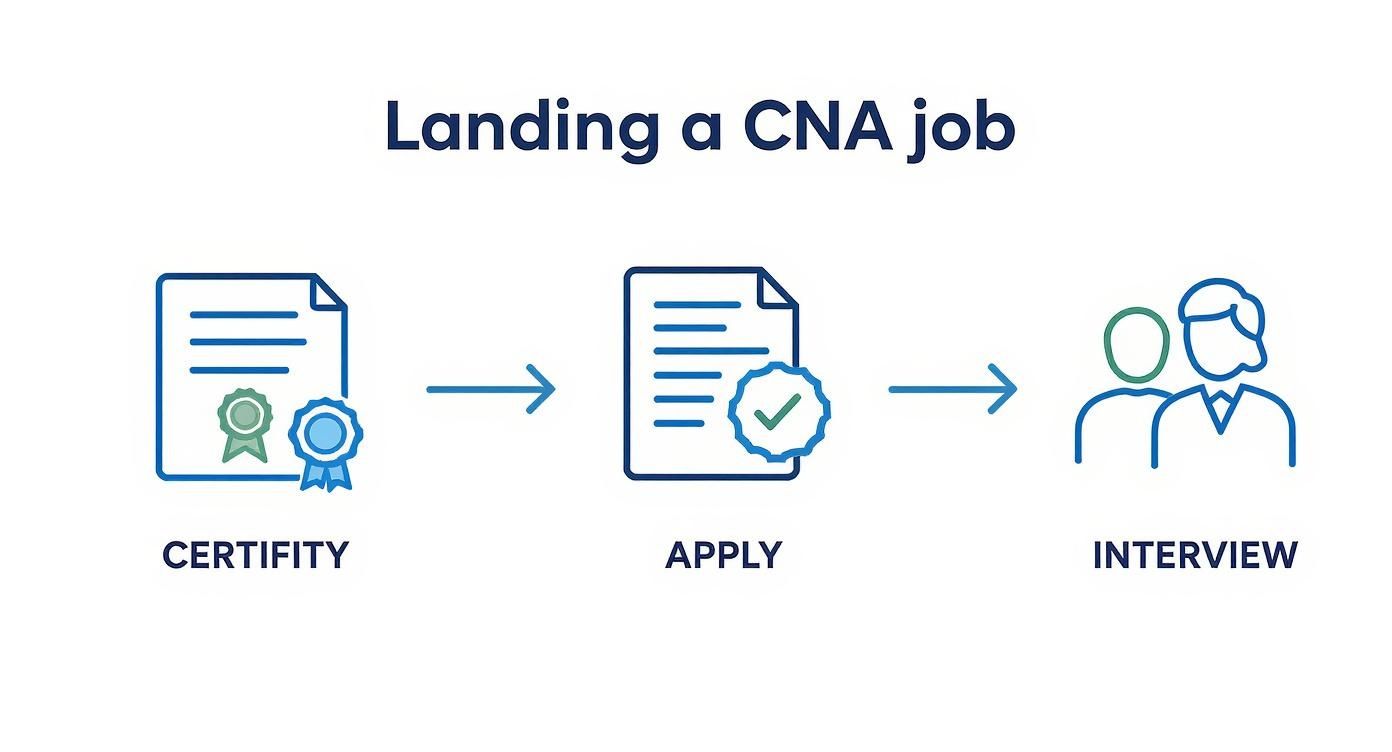
Think of this as your roadmap. You’ve done the hard part by getting your credentials. Now, it’s all about taking focused action and showing them what you’ve got.
Tailoring Your Application and Interview
When you polish up your resume, make sure you highlight the skills that really matter in a home health setting. You’ll want to emphasize things like your ability to work independently, manage your time without a supervisor looking over your shoulder, and solve problems on the fly. These are the qualities that make an agency say, “We need that person on our team.”
When you get to the interview, be prepared for questions that test your real-world judgment.
An interviewer might throw a scenario at you, like, “What would you do if you arrived at a client’s home and they refused care?”
They aren’t looking for a textbook answer. They want to see your critical thinking, your communication skills, and how you handle yourself professionally when things don’t go as planned. Preparing thoughtful answers for these kinds of questions shows you can handle the freedom—and the challenges—that come with working in home health.
Got Questions About Being a Home Health CNA?
Stepping into a client’s home for the first time is a big deal, and it’s natural to have a lot of practical, “what-if” questions running through your mind. Knowing what to expect can make all the difference. Let’s walk through some of the most common things new home health CNAs wonder about.
Do I Really Need My Own Car?
In short, yes. Having your own reliable transportation isn’t just a suggestion—it’s pretty much a must-have for this job. You’ll be driving from one client’s home to another all day, and you need to be able to stick to a tight schedule that public transit just can’t accommodate.
When you apply, agencies will definitely ask for your valid driver’s license and proof of insurance. The upside? Most good agencies won’t leave you hanging with the costs. They typically offer a mileage reimbursement policy to help cover gas and the wear-and-tear on your car, so make sure to ask about their specific rates during your interview.
What if My Client Has a Medical Emergency?
Your training is your lifeline here. The absolute first thing to do is take a breath, stay calm, and immediately follow your agency’s emergency protocol. That protocol will always, always start with one action: call 911.
Once you’ve done that, your very next call is to your agency’s on-call nursing supervisor. They’ll walk you through the next steps and handle communication with the client’s family. While you’re trained to provide basic first aid and comfort until paramedics arrive, your primary role is to get that professional response started, fast.
Think of yourself as the first, crucial link in the emergency chain. You aren’t expected to be a paramedic, but you are the person who sets the entire life-saving system in motion.
How Should I Handle Difficult Clients or Family Members?
Working so intimately in someone’s personal space means you’ll eventually encounter challenging personalities or stressful family dynamics. Your best tools are always empathy and professionalism. Try to listen to their concerns without getting defensive, and always respond in a calm, reassuring way.
But let’s be clear: your safety and professional boundaries are non-negotiable. If a situation with a client or their family ever feels unsafe, or if they ask you to do something outside your scope of practice, you need to stop. Your next move is to contact your nursing supervisor immediately.
Your agency has your back. They have policies and people in place to manage these tricky situations, and you are never expected to figure it out all on your own. That’s what your support team is for.