You already know what it feels like to carry the hard parts of patient care.
You answer call lights. You notice when a resident seems “off” before anyone else does. You calm families, protect dignity, and keep moving through long shifts even when your feet are telling you to sit down. If you're a CNA, you've probably also had the same thought many strong aides have at some point: I want to do more.
Not because your current work isn’t valuable. It is. But because you want a bigger clinical role, more decision-making, and a clearer long-term career path.
Accelerated online nursing programs can be that next step. They aren't easy, and they aren't a shortcut. They're a focused route for people who already know healthcare is where they belong and who are ready to commit to an intense stretch of school to become a registered nurse.
The Fast Track from CNA to Registered Nurse
A lot of CNAs reach this point after an ordinary shift.
You help with morning care, catch a skin issue early, report a change in breathing, and watch the nurse assess, call the provider, and set the plan in motion. You think, I can see the bigger picture now. I want that level of responsibility.
That instinct matters. Your bedside experience gives you a real advantage. You already understand patient flow, teamwork, documentation habits, infection control, and how unpredictable a care setting can be. You aren't walking into nursing blind.
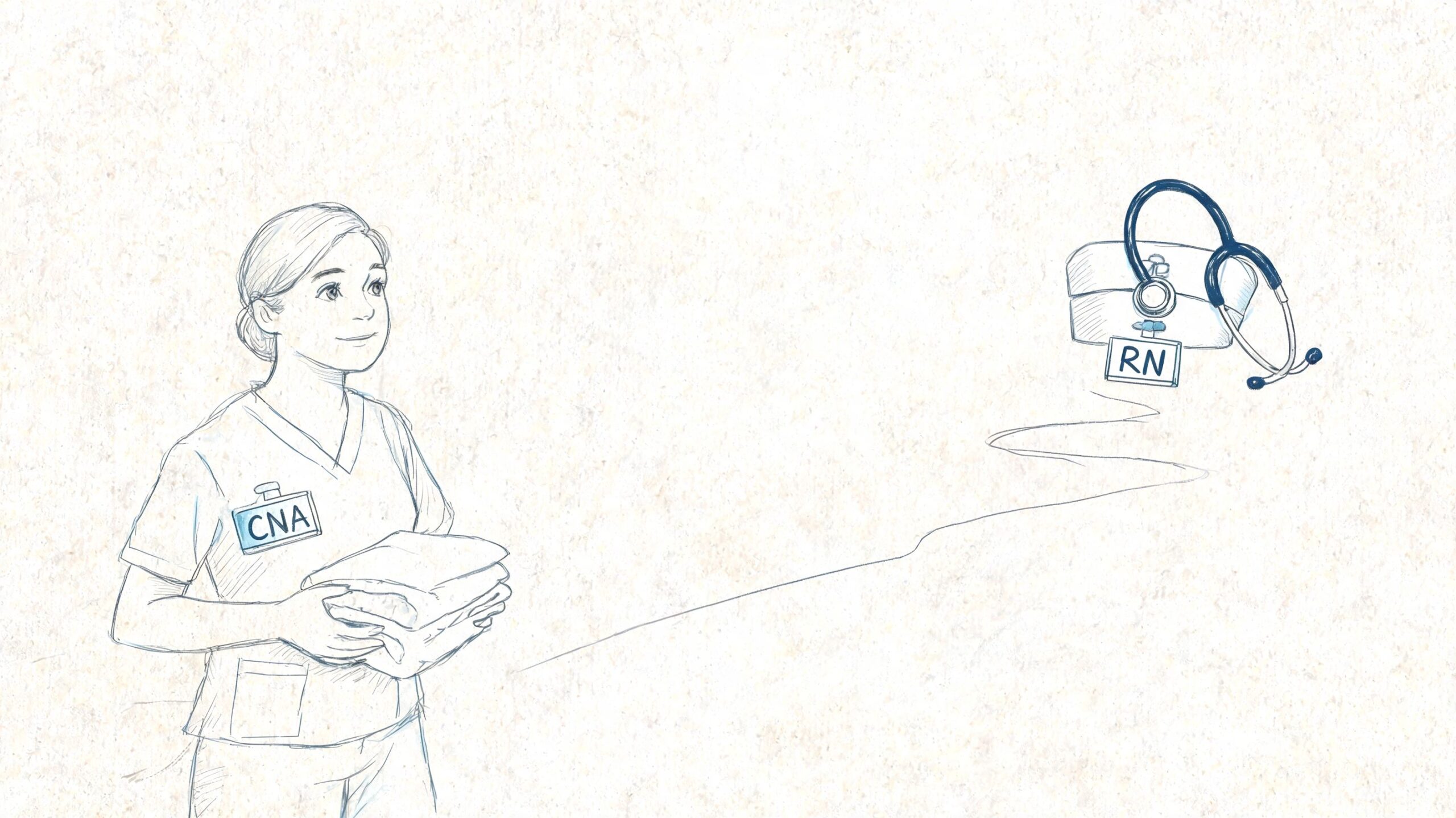
If you're also thinking practically, that's normal too. More autonomy, broader job options, and better income are common reasons CNAs start looking at RN pathways. If you spend all day on your feet while planning that transition, even small tools help. Many aides and nurses compare support and comfort before long shifts, and Swift Running's guide for nurses is a useful example of the kind of practical resource worth bookmarking.
One point causes confusion early: CNA to RN isn't one single path. Some people go through an associate degree first. Others choose a bachelor's route. If you want a quick overview of how the roles differ before you choose, this breakdown of CNA vs RN responsibilities and scope can help frame the decision.
Practical rule: If you already love patient care but feel limited by your scope, that’s often a sign to explore nursing school, not leave healthcare.
For the right student, accelerated online nursing programs offer an efficient way forward. The key is knowing what “accelerated” and “online” mean before you apply.
What Exactly Is an Accelerated Online Nursing Program
Think of nursing school in two travel styles.
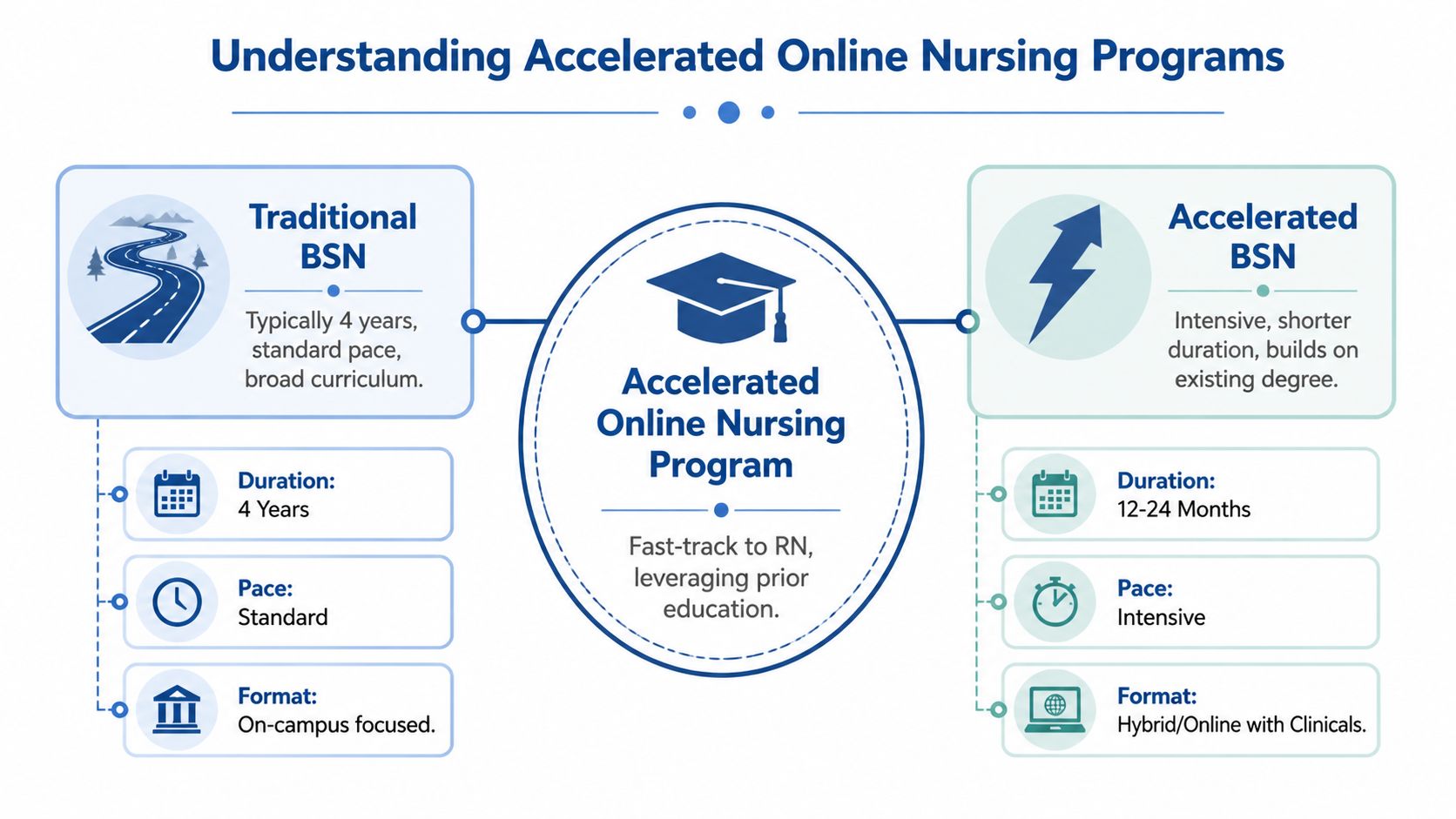
A traditional BSN is the longer route. It moves at a steady pace, includes breaks, and spreads requirements over a wider timeline. An accelerated program takes the same destination and compresses the trip. You move faster, with fewer pauses, and the schedule expects you to keep up from the first week.
That’s why I tell CNAs not to hear the word “accelerated” as “easier.” It means denser. In 2024, the U.S. had 330 accelerated entry-level baccalaureate nursing programs with 27,706 students enrolled, according to AACN’s accelerated nursing program overview. These programs are established, widely available, and built to move students into the workforce efficiently.
What the word online really means
This trips people up all the time.
In most accelerated online nursing programs, the theory portion is online. That means lectures, assignments, discussion boards, quizzes, care plans, and some exams may happen through a learning platform. But nursing is a hands-on profession, so you should expect in-person requirements too.
Those usually include:
- Skills labs where you practice assessments, medication administration, sterile technique, and core procedures
- Clinical rotations in approved healthcare settings with supervision
- Possible immersion visits on campus for check-offs, simulations, or concentrated lab days
So when a program says “online,” read it as hybrid unless the school clearly explains otherwise.
Why this format attracts CNAs
Many CNAs need some flexibility, but not a vague promise. They need a structure that works with real adult life. Online coursework can reduce commuting for classroom time while still preserving the clinical training nursing licensure requires.
If you're still completing entry prerequisites before applying, some students start by reviewing resources on entry to university nursing to understand what schools may expect before nursing coursework begins.
Accelerated online nursing programs work best for students who want flexibility in where they study theory, not students who are trying to avoid hands-on training.
The commitment level
The pace feels closer to a sprint than a jog.
Assignments stack quickly. Reading loads are heavy. Clinical preparation takes time. Travel to clinical sites may vary. Most students need strong routines, reliable childcare if applicable, and honest conversations with family before the term starts.
If you're a CNA, your patient care background helps. But time pressure is what catches learners off guard, not the desire to learn.
Decoding Different Program Types and Timelines
When CNAs search “accelerated online nursing programs,” they often lump very different pathways together. That creates frustration fast. The right path depends on what education you already have.
The path for career changers with a prior bachelor’s degree
If you already hold a bachelor’s degree in a non-nursing field, the option you’ll usually examine first is the Accelerated Bachelor of Science in Nursing, or ABSN.
These programs are built for second-degree students. They assume you’ve already completed much of the general education work in your first degree, so the curriculum can focus heavily on nursing courses and clinical preparation. According to Baylor’s overview of accelerated online BSN structure, these programs typically span 12 to 16 months and compress 58 to 62 credits into a continuous schedule.
That tells you two things at once. First, the route is fast. Second, the workload is concentrated enough that many programs advise students not to work during it.
A simple way to tell if this is your lane:
| Your starting point | Most likely fit |
|---|---|
| You’re a CNA with a non-nursing bachelor’s degree | ABSN |
| You’re a CNA with some college but no bachelor’s degree | Often a traditional or bridge pathway first |
| You’re already a licensed RN with an associate degree | RN-to-BSN |
The path for nurses who already hold an RN license
An RN-to-BSN is different. It is not an entry-to-practice nursing program. It’s for someone who is already licensed as an RN, often after earning an associate degree in nursing or diploma-based preparation, and now wants the bachelor’s degree.
If you're a CNA and not yet an RN, this is not your immediate next step. It may become relevant later, but it won't replace the prelicensure nursing education needed to sit for NCLEX-RN.
Other pathways you may see
Schools also use terms like direct-entry master’s or bridge program. Those can be legitimate options, but they aren't always the cleanest fit for a CNA who wants the most straightforward route into RN practice.
For many readers in that position, the best first question is not “Which program sounds fastest?” It’s “What credential do I already have, and what credential does the next program require?”
A fast program that doesn’t match your current education wastes time. The right fit starts with your transcript, not the marketing headline.
One more point matters here. Your CNA experience is valuable, but schools usually sort applicants by completed college education, prerequisite science courses, and program readiness. Being an excellent CNA strengthens your application story. It doesn’t usually change which academic pathway you qualify for.
Navigating Clinicals Accreditation and State Approval
If a school offers an appealing schedule but gets fuzzy when you ask about clinicals, accreditation, or state approval, stop there and investigate.
Those three areas aren't side details. They determine whether your education will lead to licensure and employment.
Clinicals are not optional
No matter how polished the website looks, nursing education must include real hands-on learning.
In accelerated online nursing programs, the online portion covers knowledge. Clinicals and labs teach you how to apply that knowledge with actual patients, equipment, time pressure, and supervision. That’s where students learn how to organize care, communicate in a clinical setting, and perform safely when the shift gets busy.
Top accelerated online BSN programs report graduation rates of 89 to 95 percent and first-time NCLEX pass rates often exceeding 95 percent, according to A-State nursing program statistics. Those outcomes matter because they show that a fast format can still produce practice-ready graduates when the academic and clinical structure is strong.
What to verify before you apply
Use this checklist every time you review a school:
- Accreditation status: Look for nursing accreditation such as CCNE or ACEN.
- State approval: Confirm the program is approved by the board of nursing in the state where you plan to train or seek licensure.
- Clinical placement process: Ask whether the school arranges placements, assists with placements, or expects students to find sites.
- Residency or immersion requirements: Find out whether you must travel to campus for labs or check-offs.
- NCLEX eligibility: Ask directly whether completion makes you eligible to pursue RN licensure in your intended state.
Accreditation and approval are different
Students often blend these together, but they serve different functions.
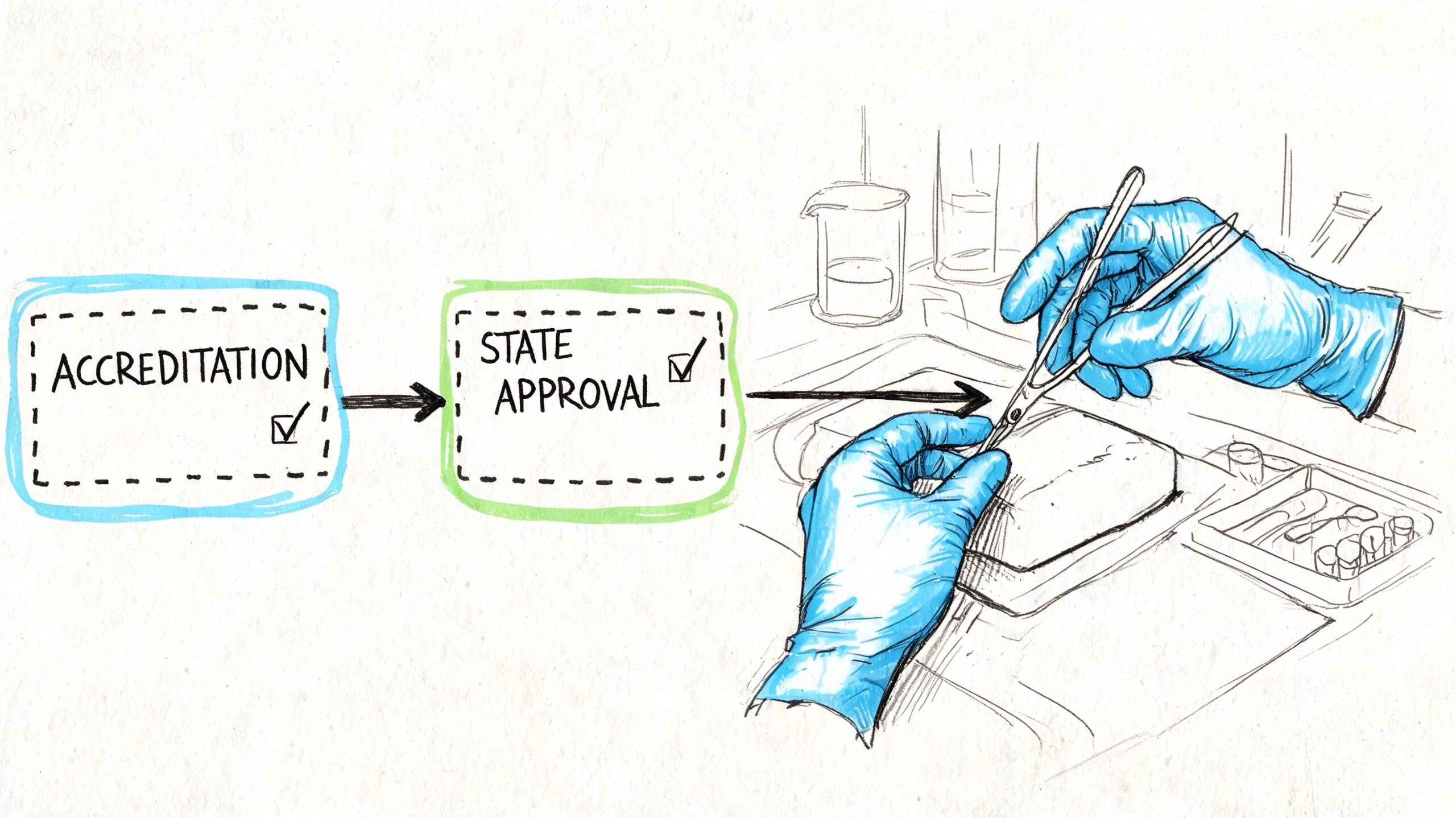
Accreditation is a quality review process. It tells you the program meets recognized educational standards. State approval means the state board accepts that program for prelicensure nursing education in that jurisdiction.
You need both questions answered clearly.
A quick explainer can help if the terminology still feels abstract:
If a school says, “We serve students nationwide,” ask a sharper question: “Am I eligible for licensure in my state after graduating from your specific program?”
How clinical logistics affect your life
In this situation, many CNAs have to make a reality-based decision.
A school may offer online lectures, but your clinical site could still be a long drive away. Lab weekends may require travel. Day, evening, and weekend shifts can all appear during rotations depending on the program and placement setting.
That doesn't mean the program is a bad fit. It means you need the full calendar before you commit. Nursing school gets much harder when transportation, childcare, or job scheduling problems show up halfway through the term.
The Real Costs and How to Pay for Your Program
Tuition is only one part of the bill.
When CNAs first price accelerated online nursing programs, they often focus on the headline tuition number and forget the smaller items that add up fast. Books, uniforms, background checks, immunization updates, testing fees, transportation to clinicals, and equipment can all affect your budget.
Think in total program cost, not just tuition
A smarter approach is to build a personal cost worksheet with three buckets:
- School charges: Tuition, university fees, course materials, lab or technology fees
- Licensure-related costs: Exam registration, application costs, fingerprinting or compliance items
- Living expenses: Rent, food, gas, childcare, and reduced work hours if you cut back employment
That last category is the one many students underestimate. If a program expects near full-time attention, lost income can matter as much as tuition.
How students usually fund the gap
Start with the basics.
Complete the FAFSA as early as you can. Then review school-based aid, state aid if available, and scholarships aimed at nursing students, career changers, or healthcare workers moving into licensed roles. Some employers also offer tuition support, though the terms vary and may require a work commitment after graduation.
If you want a practical starting point for aid options, this guide to financial aid and scholarships for CNAs gives a helpful overview of funding categories to check.
A BSN can also expand your earning options over time. According to West Coast University’s summary of AACN-related BSN outcomes, BSN-prepared nurses may qualify for roles in Magnet hospitals and can earn 10 to 20 percent higher salaries than associate-degree counterparts.
Money mindset: Don’t ask only, “Can I afford school?” Ask, “What funding mix and life changes would make this possible for one intense stretch of time?”
Questions worth asking financial aid offices
Call or email with specific questions, not just “What does it cost?”
Ask things like:
- What is included in tuition?
- What extra program expenses should I expect outside tuition?
- Can I attend part-time, or is the program lockstep full-time?
- Are there scholarships for second-degree or healthcare-experienced applicants?
- When do aid packages get finalized?
Clear answers help you compare schools accurately instead of reacting to a brochure.
Your Roadmap from CNA to Accelerated BSN Graduate
This is the part where the goal becomes a plan.
If you're a CNA aiming for an accelerated BSN, don’t try to solve everything at once. Move in sequence. Each step makes the next one clearer.
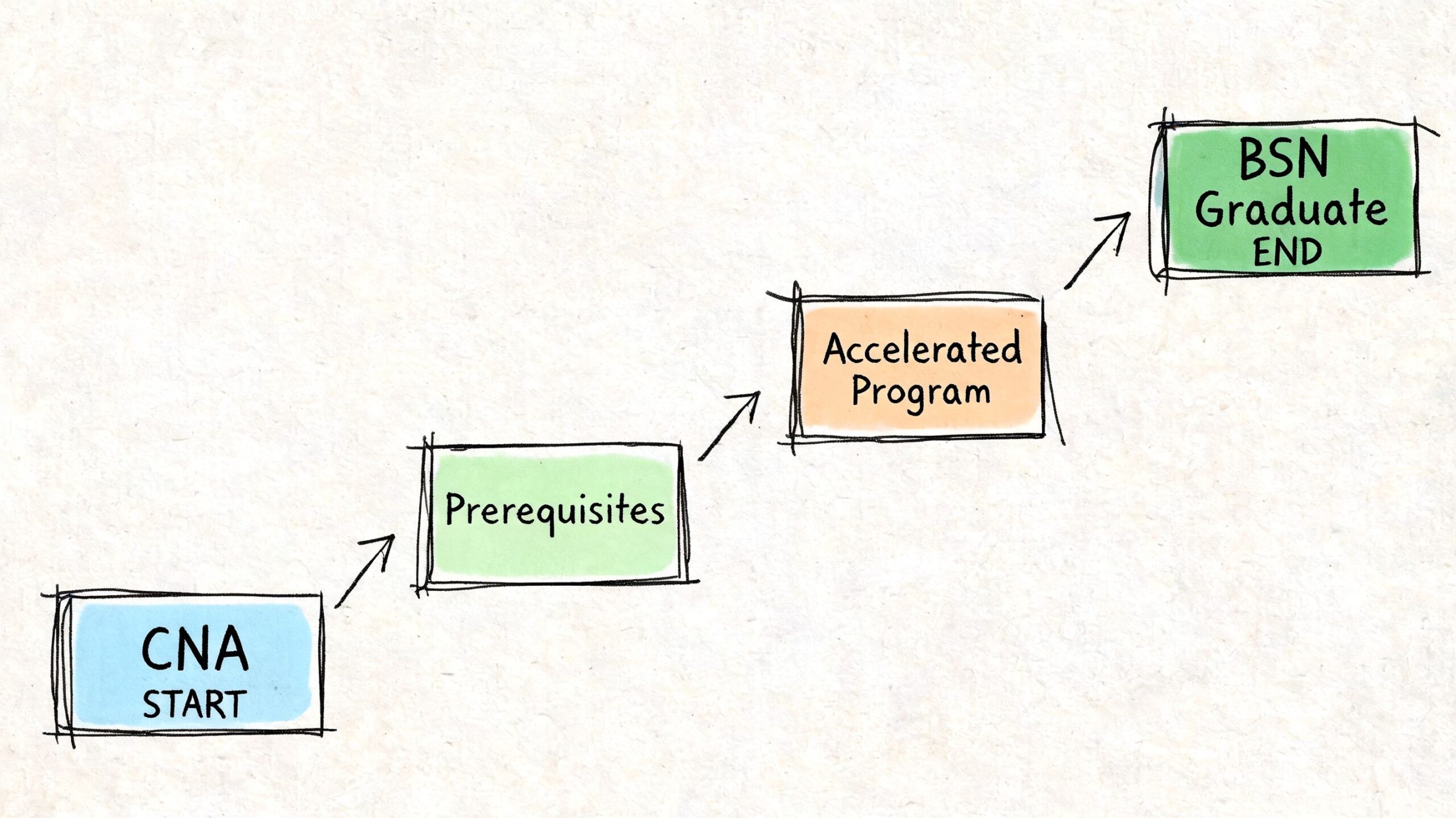
Step 1 complete your prerequisite review
Before you fall in love with a program, gather every transcript.
Then compare your academic history against common prerequisite courses such as Anatomy, Microbiology, and Statistics. Some CNAs have a prior bachelor’s degree but still need several sciences. Others have many prerequisites finished through earlier college work.
Create a simple document with three columns:
| Course area | Already completed | Still needed |
|---|---|---|
| Science prerequisites | List prior courses | Add missing items |
| General education carryover | Note transfer-friendly credits | Flag any gaps |
| Admissions requirements | GPA, documents, certifications | Add deadlines |
This one-page map saves a lot of confusion.
Step 2 build a shortlist of legitimate programs
Once you know your academic starting point, narrow your list.
Look at delivery format, clinical support, location expectations, accreditation, and state approval. For CNAs comparing bridge-style pathways and education routes, CNA to RN bridge programs can help you sort which models exist before you focus on individual schools.
Don’t just collect names. Rank programs by fit:
- commute or travel burden
- prerequisite match
- application timeline
- clinical placement support
- whether the schedule is realistic for your family and finances
Step 3 use your CNA experience well in the application
In this situation, many strong applicants undersell themselves.
Admissions teams don’t need a dramatic story. They need evidence that you understand patient care and have a realistic reason for becoming an RN. Your CNA background gives you exactly that. You’ve seen what consistent bedside work looks like. You’ve worked within a care team. You know nursing isn’t just a title.
In your essay or interview, talk about:
- the patient moments that sharpened your judgment
- what you learned about teamwork and communication
- why expanding your scope matters now
- how you’ve prepared academically for a demanding program
If you want help shaping professional language later for clinical applications or your first RN job search, looking at professional nurse cover letter samples can give you a sense of tone and structure.
Your CNA role may not substitute for nursing coursework, but it can make your application more grounded and believable than one built only on interest.
Step 4 make your financial and life plan before acceptance day
Do this early, not after you get in.
Estimate monthly living costs. Decide whether you’ll keep working, reduce hours, or stop temporarily. Talk with the people affected by your schedule. Arrange backup childcare if needed. Build a small emergency cushion if you can.
Students who plan only for tuition often struggle. Students who plan for time, fatigue, transportation, and home responsibilities usually adapt better.
Step 5 prepare like the program starts tomorrow
Once admitted, simplify your life.
Set up a calendar system. Reduce avoidable commitments. Organize your study space. Batch meals. Review basic sciences if you’ve been out of school for a while. If you use digital tools, keep it simple. One calendar, one task manager, one place for files.
You do not need a perfect routine. You need a repeatable one.
And keep perspective. As a CNA, you’re not starting from zero. You’re expanding the skills, discipline, and patient awareness you already use every shift.
Frequently Asked Questions
Can I keep working while enrolled
Usually, you should assume no, or at least not in the way you work now.
Accelerated online nursing programs move quickly, and the “online” part doesn’t reduce the total demand. Clinical prep, coursework, travel, labs, and exams can crowd out regular job hours fast. Some students manage limited flexible work, but many programs strongly discourage employment because the pace is so compressed.
Will my CNA certification count for college credit
Usually, not as direct nursing course credit in a prelicensure BSN program.
Your CNA certification and work history still matter a lot. They strengthen your application, help you adapt to patient care settings, and make the transition into clinical learning less jarring. But schools typically award progression based on prior college coursework and transfer policies, not bedside aide experience alone.
What if I fail a class
In an accelerated format, one failed course can create a major delay.
Because courses run in sequence and terms move quickly, you may have to pause progression, repeat the course later, or in some cases face dismissal depending on policy. Read the progression rules before enrolling, and use tutoring, faculty office hours, and academic support at the first sign of trouble.
Are these programs changing with technology
Yes, but carefully.
Emerging trends for 2026 include AI-driven simulations being added to supplement clinical learning, and some programs are cutting in-person residency time by up to 20 percent, according to Edgewood’s discussion of online accelerated nursing trends. That said, there’s still active debate about how these tools affect hands-on skill development, so I’d treat simulation as a supplement, not a replacement for strong clinical training.
If you're mapping out your next move, The CNA Guide is a practical place to keep researching CNA training, reciprocity, bridge options, and career planning tools as you move from bedside support into nursing school and beyond.