Starting a career as a Certified Nursing Assistant is a fantastic goal, but figuring out how to pay for it can feel like a huge roadblock. The good news? Financial aid for CNA classes is a lot more common than most people think. Because skilled CNAs are in such high demand, plenty of organizations are ready and willing to help you cover the cost of your training.
Your Path to a Funded CNA Education
Launching your CNA career doesn't have to break the bank. It's a common myth that financial aid is just for four-year degrees, but tons of resources are out there specifically for certificate programs like CNA training. The trick is simply knowing where to look and how to get your paperwork in order.
This guide will cut through all the confusion and show you the real-world options available. We’ll cover everything from federal grants you never have to pay back to local nursing homes that will train you for free. Think of this as your practical roadmap to getting certified without the financial stress, so you can start your healthcare career with confidence.
Why Is Funding So Available?
The simple answer is demand. The need for CNAs is exploding, and that has created a lot of funding opportunities. Right now, the healthcare system depends on 1.3 million CNAs, and that number is set to grow by 4% through 2033.
A huge part of this is the aging baby boomer generation—about 10,000 Americans turn 65 every single day. You can learn more about the growing need for CNAs and available programs in our guide on how to become a CNA.
This high demand means that government agencies, schools, and employers are all highly motivated to remove financial barriers for aspiring CNAs just like you.
One of your first stops for many of these opportunities will be the federal student aid website.
This is the homepage for the FAFSA (Free Application for Federal Student Aid), which is your key to unlocking federal grants. We'll dig into the FAFSA and other fantastic funding options throughout this guide.
Where to Find Money for Your CNA Training
Alright, so you know financial help is out there. But where, exactly? Let's walk through the most common—and sometimes overlooked—places to find funding for your CNA classes. Think of this as your personal treasure map to an affordable education.
Federal and State Aid: The Heavy Hitters
For many people, the first stop is federal aid, and for good reason. It's often the biggest source of funding.
The big one here is the Pell Grant. This is the best kind of money because it’s a grant, not a loan—you don’t have to pay it back. It’s all based on financial need, which you'll figure out by filling out the FAFSA (Free Application for Federal Student Aid). A lot of people think Pell Grants are just for four-year universities, but that's not true! Plenty of accredited CNA programs at community colleges and trade schools are eligible.
Your state is another powerhouse for funding. Look into the Workforce Innovation and Opportunity Act (WIOA). This is a federal program that your state manages to get people into training for jobs that are in high demand. Guess what's always on that list? Yep, CNAs.
To get the ball rolling, you’ll want to find your local American Job Center or workforce development board. They're the gatekeepers to WIOA funds and can walk you through the whole process. They can often cover the entire cost of your training.
Here's a pro-tip: These workforce centers are on your side. Their job is to help you find training that leads directly to a job, so don't be shy. Call them, visit them, and ask for help.
The Best-Kept Secrets: Community and Employer Funding
Some of the best opportunities are right in your own backyard. Hospitals, nursing homes, and other healthcare facilities are often desperate for good CNAs, so much so that they'll pay for your training themselves.
How does it work? Typically, these employer-sponsored programs ask for a work commitment in return. You might agree to work for them for six months or a year after you get certified. It’s a fantastic deal: you get free training and have a job waiting for you the second you’re done.
Don't forget to check with organizations like the American Red Cross. They often run their own low-cost or even free CNA training programs that are highly respected in the industry.
While you're figuring out tuition, it's smart to look at your overall financial situation. For example, some people might find flexibility by understanding IRS guidance on retirement plan withdrawals for student loan payments. Every little bit of financial knowledge helps.
To give you a clearer picture, here’s a quick breakdown of where to look.
Common CNA Financial Aid Sources
Let's break down the most common types of financial aid you'll encounter and who they're best for.
- Federal Pell Grant: This is ideal for students with significant financial need. The main requirement is completing the FAFSA and enrolling in an eligible CNA program.
- WIOA Grants: These grants are perfect for individuals who are currently unemployed or underemployed. You'll need to prove your eligibility through your state's local workforce agency.
- Employer Sponsorship: If you want a guaranteed job right after you finish your training, this is a fantastic option. The typical requirement is signing a work commitment, agreeing to work for the facility for a specific period.
- Scholarships: Scholarships are for everyone! They can be based on financial need, academic merit, or your personal background. The requirements vary widely but usually involve an application and sometimes an essay.
- American Red Cross Programs: These are a great choice for those seeking a reputable, often low-cost training option. You'll need to meet the requirements of your local chapter, and availability can vary.
Your best bet is to explore a few of these at once.
Finally, don't underestimate the power of scholarships. There are tons of scholarships specifically for aspiring CNAs. Beyond that, look into work-study programs that let you earn as you learn, low-interest federal loans, and tuition reimbursement from future employers.
We've put together an in-depth guide on financial aid and scholarships for CNAs that digs even deeper into these options.
How to Successfully Apply for Funding
Knowing where to look for financial aid is half the battle. The other half? Putting together an application that actually gets you the money. Think of your application packet as your very first professional impression—it tells the organization you're serious, organized, and ready to take on the responsibilities of a CNA.
This isn't just about filling in blanks on a form. It's your chance to tell your story and show them why you're a great investment. Let's walk through how to build a standout application.
Gathering Your Essential Documents
Before you even think about filling out an application, get your paperwork in order. Trust me, scrambling to find an old tax return or your birth certificate at the last minute is a special kind of stress you can easily avoid.
Most financial aid for CNA classes will ask for a similar set of documents. Get these together in a folder (digital or physical) so you're ready to go.
- Proof of Identity and Residency: A driver's license, state ID, or even a recent utility bill usually does the trick.
- High School Diploma or GED: Nearly every program requires proof that you've finished high school.
- Social Security Number: This is a must-have, especially for federal aid like the FAFSA.
- Financial Information: This is the big one. You’ll need access to your tax returns and W-2s from the last year (or your parents' if you're a dependent). Many applications also ask for recent bank statements to verify your financial need. You can learn how to easily get your bank statements to make this part of the process a little easier.
This flowchart gives you a bird's-eye view of the different paths your funding journey might take.
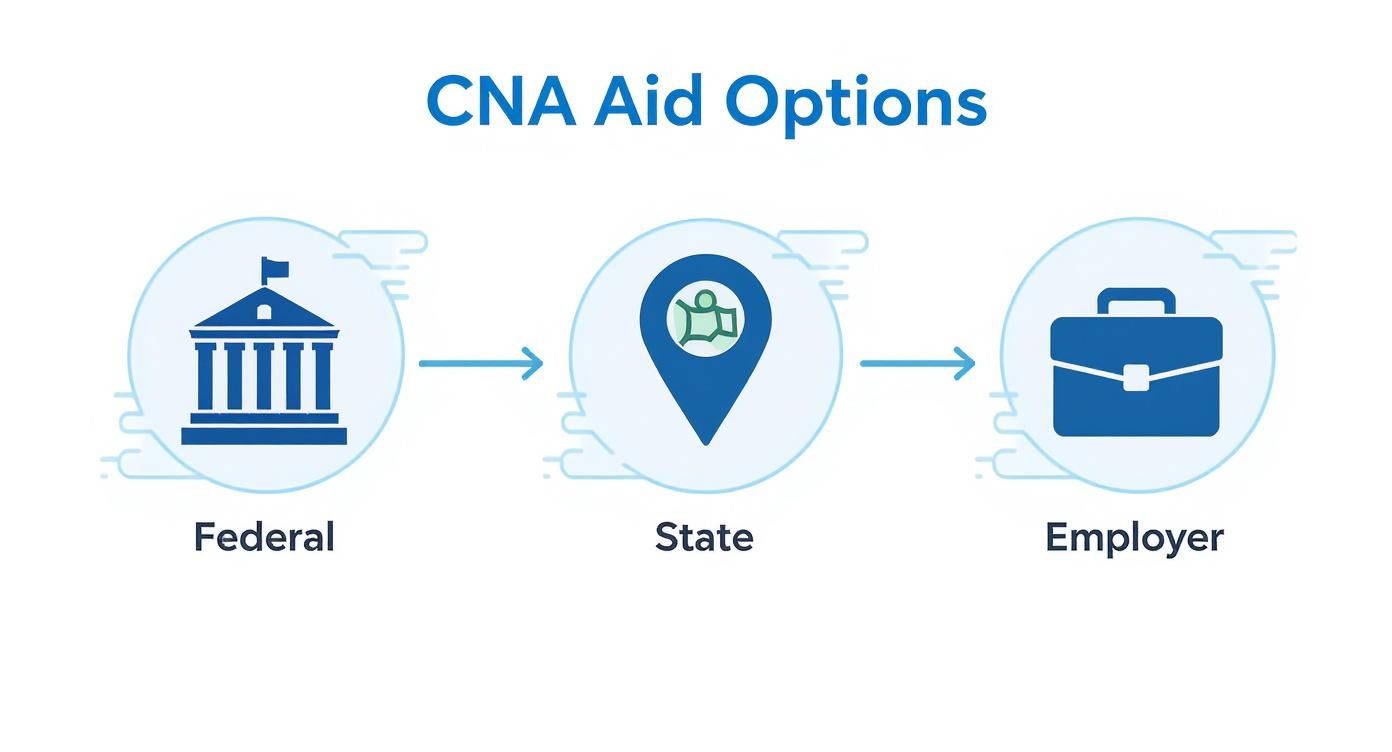
Whether you start by applying for federal grants, state programs, or help from a future employer, the end goal is always the same: getting your certification paid for so you can start your career.
Crafting a Compelling Scholarship Essay
If a scholarship application asks for an essay, see it as an opportunity. This is your one chance to connect with the selection committee on a human level. The key is to avoid clichés like, "I've always wanted to help people." They've read that a thousand times.
Instead, tell a real story. Were you inspired by the CNA who took care of your grandmother? Did you have a volunteer experience that solidified your desire to work in healthcare? Use specific, personal examples that reveal your empathy, determination, and genuine passion for this work.
A powerful essay doesn't just tell the committee you're compassionate and hardworking—it shows them through a personal narrative. It helps them see you as a future CNA who will make a real difference.
And please, proofread it! Then have a friend proofread it. A clean, polished essay shows you have an eye for detail, which is a non-negotiable skill for any healthcare professional.
Reaching Out for Information and Support
Don't ever hesitate to pick up the phone or send an email. A quick, professional message to a school's financial aid office or a nursing home's HR department shows you're proactive and can get you crucial information you won't find on a website.
Here’s a simple template you can tweak and use:
- Subject: Question about Financial Aid for CNA Program
- Body:
- Dear [Name of Contact Person or Department],
- My name is [Your Name], and I am incredibly excited about pursuing a career as a CNA. I'm writing to inquire about any financial aid, scholarships, or employer-sponsored training you might offer for your upcoming program.
- I'm committed to starting a career in patient care and would be grateful for any information you could provide to help make this training affordable. Could you please point me toward the right resources or person to speak with?
- Thank you so much for your time and help.
- Sincerely,
- [Your Name]
- [Your Phone Number]
This kind of direct, polite outreach makes it easy for them to help you. Taking these extra steps can genuinely be the difference between paying out of pocket and getting your training fully funded.
Finding Free and Local CNA Training Programs
While big national grants are great, some of the best ways to get financial aid for cna classes are right in your own backyard. Local hospitals and nursing homes are almost always looking for good people, and many are more than willing to pay for your training to bring you on board.
This is where a little old-fashioned legwork can really pay off. These opportunities aren't usually plastered on billboards; they're found by talking to the right people. Let's dig into how you can find these local gems.

Go Straight to the Source: Healthcare Facilities
Sometimes, the most direct path is the best one. Nursing homes, assisted living facilities, and hospitals are the biggest employers of CNAs, and they often have programs to cover your training costs.
The deal is usually straightforward: they pay for your class and certification exam, and you agree to work for them for a specific period—maybe six months or a year—after you're certified. It's a true win-win. You get a free education and a guaranteed job, and they get a dedicated new team member.
When you reach out, be specific. Don't just ask if they're hiring. You want to ask about training support.
Here are the key questions to ask when you call or email their HR department:
- "Do you offer any paid CNA training programs?"
- "Do you have a tuition reimbursement plan for employees who take a CNA course?"
- "If you sponsor training, what is the work commitment after I get my certification?"
Having these questions ready shows you're serious and professional, which immediately sets you apart from other applicants.
Check with Schools and Government Agencies
Your local community colleges and vocational schools are goldmines of information. Their financial aid advisors know all about state-funded programs and local scholarships you'd never find on Google. Set up a meeting with one of them—they can be your biggest advocate.
Also, don't forget to check your state's Department of Health or workforce development agency websites. These government sites often list approved training programs and sometimes highlight specific facilities that have grants to train new CNAs. Try searching for "[Your State] CNA training grants" to see what pops up.
The key takeaway here is to be proactive. These local programs are looking for dedicated students. A polite phone call or a well-written email can open doors that simply browsing online won't.
As you start your search, keeping things organized is a huge help. To get a bird's-eye view of all the training options near you, check out our comprehensive list of CNA programs organized by state. It's a great starting point for finding accredited schools to contact about local funding.
What to Do If Your Aid Request Is Denied
Getting a denial letter is a punch to the gut. There's no sugarcoating it. But it absolutely does not mean your dream of becoming a CNA is over. Think of it less as a "no" and more as a "not this way."
Before you do anything else, take a breath. Then, find out exactly why your application was rejected. Don't just file the letter away in frustration. A polite, professional follow-up call or email can give you the specific feedback you need to succeed next time.
Figure Out the "Why" and See If You Can Appeal
When you contact the organization, frame your question constructively. Something as simple as, “Thank you for considering my application. I’m still very passionate about this path and was hoping you could share any feedback on why I wasn't selected, so I can improve for future opportunities,” goes a long way.
You might be surprised by the reason. Sometimes it's a simple fix—a document that didn't upload correctly or a misunderstanding about your eligibility.
While you have them on the line, ask if they have an appeals process. Many don't, but it never hurts to ask. If they do, this is your chance to correct a mistake or provide new information that could change their decision. If not, the feedback you gather is still invaluable for your next attempt.
A denial is not a reflection of your potential as a future CNA. It’s a data point that helps you refine your strategy and find a better-fitting opportunity to secure financial aid for cna classes.
Time to Pivot: Explore Your Other Options
Okay, so one door closed. It's time to start knocking on others. A rejection from a single program just means it's time to broaden your search, because there are plenty of other avenues to explore.
Here are a few fantastic backup plans to get you started right away:
- Go Hyper-Local with Scholarships: Instead of competing against thousands for national awards, look for smaller scholarships in your own backyard. Local community foundations, civic groups like the Rotary Club, and even area businesses often have funds set aside with far fewer applicants.
- Ask Schools About Payment Plans: Call the admissions or financial aid office at your target CNA schools directly. Many offer in-house payment plans that let you break up the tuition into manageable monthly chunks. This can make the cost much more affordable without needing a formal loan or grant.
- Revisit Employer-Sponsored Programs: The nursing home that turned you down isn't the only one hiring. Go back to your list of local healthcare facilities. A different hospital or long-term care center might be starting a new training cohort and desperately needs dedicated people like you.
The most important thing is to not let a setback stall your momentum. Every application, even a denied one, is a learning experience. Use that knowledge, tap into these alternative resources, and stay focused on the incredible career that’s waiting for you.
Your Top Questions About CNA Financial Aid, Answered
Let's be honest, figuring out financial aid can feel like a maze. As you get closer to starting your CNA journey, you're bound to have questions. Here are some straightforward answers to the things people ask most often, so you can move forward feeling sure of your next steps.
I'm an Adult Learner. Can I Still Get Financial Aid?
Yes, absolutely! In fact, many of the best financial aid options are designed with adult learners and career-changers in mind. Your age is not a factor.
Think about it: programs like the federal Pell Grant or state-level WIOA funding exist to help people enter in-demand fields. Their main focus is on your financial need, not how old you are. What they really care about is your income, residency status, and whether you have a high school diploma or GED.
Financial aid isn't just for 18-year-olds heading off to college. It's there to support anyone, at any point in life, looking to build a career in a vital field like healthcare.
How Long Does This Whole Financial Aid Thing Take?
This is a big one, and the honest answer is: it depends on where the money is coming from. My best advice is to start early, no matter what. You'll thank yourself later.
- Federal Aid (FAFSA): After you submit your FAFSA, it can easily take several weeks before you get an official award letter from your school. There's a lot of processing that happens behind the scenes.
- Scholarships: These are all over the map. Each one has its own deadline, so you'll need to be organized and keep a calendar.
- Employer Programs: These are often the quickest. If a local nursing home needs CNAs, they'll want to get you trained and on the floor fast. You could get an answer in just a couple of weeks.
As a rule of thumb, give yourself a solid two to three months before your classes start. That gives you enough breathing room to research, apply, and handle any unexpected bumps in the road.
Are There Really CNA Programs That Are 100% Free?
There are, but it’s really important to know what "free" means in each case. For instance, if you qualify for a full Federal Pell Grant, that’s money for school you don't have to pay back. It's a true grant.
On the other hand, you’ll see many nursing homes and hospitals offering "free" training. This is a fantastic deal, but it usually comes with a string attached. They pay for your schooling, and in return, you agree to work for them for a specific period of time—often a year or two. It’s a work commitment. Just make sure you read the agreement carefully so you understand exactly what you're signing up for.
At The CNA Guide, we provide clear, state-by-state information to help you find accredited training programs and navigate every step of your career path with confidence. https://thecnaguide.com