So, you’re wondering, how much do CNAs make? The short answer is: it really depends. While the national average gives us a starting point, your actual take-home pay can swing quite a bit based on where you live, the type of facility you work in, and your experience level.
Nationally, a Certified Nursing Assistant can expect to earn around $38,130 a year. That works out to roughly $18.33 per hour. Think of this number as a solid baseline—the foundation you can definitely build upon.
Understanding Your Earning Potential as a CNA
That national average is helpful, but it doesn’t paint the whole picture. It’s like knowing the average temperature for the country; it doesn’t tell you if you’ll need a jacket in San Francisco or shorts in Miami. Your personal salary journey is unique.
Recent numbers from the U.S. Bureau of Labor Statistics show the salary range for CNAs stretching from about $31,000 all the way up to $42,000 and beyond. That’s a pretty wide gap! This just goes to show how much your individual circumstances—like your location and certifications—really matter.
Let’s take a quick look at the national averages to get our bearings.
CNA Average Salary Snapshot
This table gives a simple breakdown of what CNAs are earning across the country on average.
| Pay Metric | Average Amount |
|---|---|
| Annual Salary | $38,130 |
| Hourly Wage | $18.33 |
While these figures provide a great starting point, the real story is in the details that can push your income higher.
Key Factors That Influence Your Paycheck
Before we get into the nitty-gritty, it’s good to have a high-level view of what moves the needle on a CNA’s salary. These are the big four—the core elements that work together to shape your compensation.
- Geographic Location: This is a huge one. A CNA in a high-cost-of-living area like New York City will almost always earn more than one in a rural town in the Midwest. It’s all about local demand and living expenses.
- Work Environment: Where you work matters. A government hospital or a specialized clinic often pays more than a small, private nursing home.
- Years of Experience: It’s simple: the longer you’ve been on the job, the more you’re worth. Seasoned CNAs with years of hands-on experience can command a much higher wage.
- Specialized Skills: Earning extra certifications in areas like dementia care or phlebotomy doesn’t just make you a better caregiver; it makes you a more valuable—and higher-paid—employee.
It all starts with getting certified. That exam is more than just a test; it’s your official entry ticket into a career with real room for financial growth.
Nailing that exam is your first big step. If you’re getting ready for it, you might find our guide on what to expect from the CNA written exam incredibly helpful.
How Experience Shapes Your CNA Paycheck
When it comes to your CNA paycheck, one thing is certain: time on the job equals more money in your pocket. It’s a truth across almost every field, and healthcare is no exception. Think of your career path as a journey—you start out with a solid foundation as a new CNA, build on that experience over the years, and eventually become a seasoned pro.
Each step up doesn’t just come with more responsibility; it comes with a bigger paycheck. This isn’t just about a standard annual raise. It’s about the real-world value you bring. The more hands-on experience you get, the faster and more efficient you become at handling everything from daily routines to complex patient needs. Employers see that expertise and are more than willing to pay for the kind of skill and reliability that only comes with time.
The Entry-Level Starting Point
As a freshly certified CNA, you’re at the very beginning of your earning potential. The main goal right now is to put your training into practice, get a feel for the flow of your workplace, and show everyone you’re a reliable member of the team. Naturally, your pay reflects this starting phase.
While it’s the lowest you’ll earn, it’s an essential first step. Based on current industry data, most new CNAs can expect to start somewhere between $15 and $17 per hour. That works out to an annual salary in the ballpark of $31,000 to $35,000. You can see how these numbers stack up by checking out more detailed 2025 CNA salary expectations.
Mid-Career Earning Growth
Fast-forward a few years, and you’re no longer the new face on the floor. With two to four years under your belt, you’ve honed your skills and have a deep understanding of patient care. You’ve become a go-to person on the team, and your compensation starts to show it.
At this stage, you’re not just completing tasks. You’re anticipating patient needs, helping guide newer aides, and making the whole unit run more smoothly. That makes you a huge asset to any facility.
This leap in confidence and capability brings a nice bump in pay. CNAs with this level of experience often see their hourly rate climb into the $18 to $20 range. Annually, that pushes your income to between $37,000 and $41,000.
Senior-Level and Veteran Pay Scales
After five or more years, you’ve reached the top tier of CNA earning potential based on experience alone. You’re now a veteran professional. It’s common to see CNAs at this level taking on leadership roles, training new staff, or expertly handling the most challenging patient situations.
Your extensive knowledge and proven track record make you incredibly valuable to your employer. That expertise commands top dollar, with senior CNAs earning $21 to $24 per hour. This translates to a strong annual salary of $43,500 to $50,000, and sometimes even more, proving just how much financial growth is possible over a dedicated CNA career.
Why Your Location Determines Your Salary
When you’re trying to figure out how much a CNA makes, where you live is one of the biggest parts of the answer. It’s a lot like real estate—location, location, location. The same job, with the exact same responsibilities, can pay vastly different amounts depending on the state, or even the city, you’re in.
This isn’t arbitrary. It all comes down to basic economics. Things like the local cost of living, how much a state invests in healthcare, and the simple supply and demand for caregivers all play a huge role. For example, in high-cost states like California or New York, employers have to offer more just to help you keep up with rent and groceries.
This infographic gives you a great visual on just how much salaries can swing from one region to another.
As you can see, where you decide to work has a direct and significant impact on your paycheck. The coastal states often lead the pack, while many states in the South tend to lag behind.
State-by-State Salary Differences
The gap between the highest- and lowest-paying states is frankly staggering. A CNA in a top-paying state could easily earn $18,000 more per year than someone doing the identical job in one of the lowest-paying states. That kind of difference is life-changing.
Let’s dig into the numbers a bit. The data shows a clear pattern: states in the Pacific Northwest, the Northeast, and along the West Coast consistently offer the most competitive pay for Certified Nursing Assistants.
Knowing these regional pay scales is a powerful tool. It gives you the leverage to either negotiate for a better salary right where you are or to think about relocating to a place where your skills are valued more highly.
And remember, this isn’t just a big city versus small town thing, though that’s part of it. Urban areas almost always pay more than rural ones to offset higher living expenses and meet a greater demand for care.
Where You Work Matters: How Facility Type Impacts Your Earnings
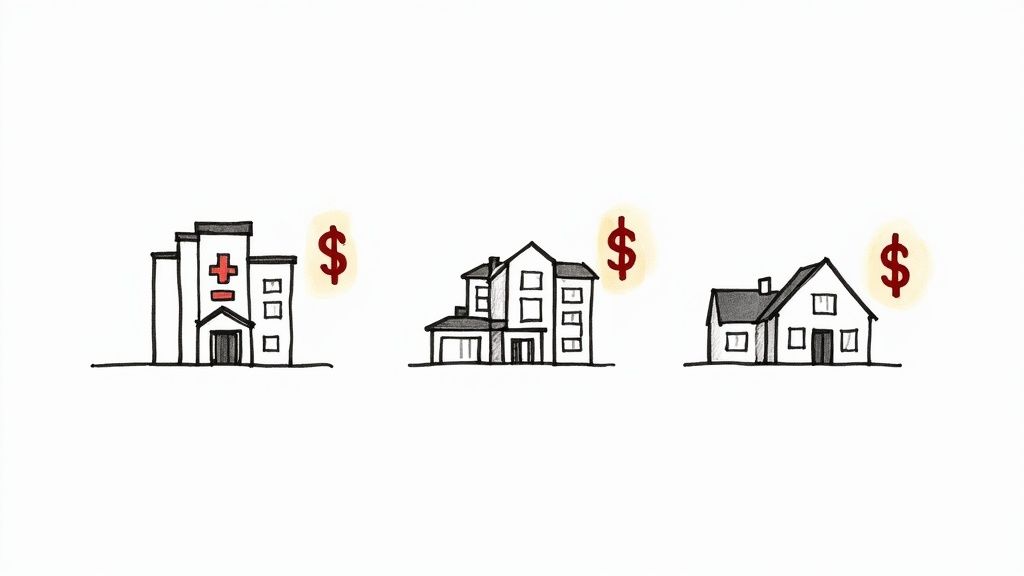
Just like your state, the type of building you walk into for your shift plays a huge role in how much you’ll make as a CNA. Let’s be clear: not all healthcare facilities are created equal, especially when it comes to your paycheck. The day-to-day work—and the compensation—at a bustling city hospital is a completely different world from a role at a quiet, private home healthcare agency.
Figuring out these differences is one of the smartest things you can do for your career. Think of it this way: a hospital is like a major international airport, with complex cases coming and going constantly. A nursing home might be more like a smaller regional airport—still busy, but with a different pace and structure. Each has its own budget, patient needs, and operational demands that directly shape what they can afford to pay.
Choosing your work environment is a powerful, strategic decision. If you know which places consistently offer better pay, stronger benefits, and more chances for overtime, you can target your job search to meet your financial goals head-on.
A Look at Pay Scales Across Different Workplaces
The paychecks really do vary from one setting to the next. Generally, government-run facilities—think VA hospitals or state medical centers—are at the top of the food chain. They tend to have larger, more secure budgets, which means they can offer more competitive wages and great benefits to get and keep good people.
On the flip side, you have private nursing homes and assisted living communities. While the work they do is incredibly important, they often run on much tighter budgets, which can mean a lower base salary compared to a hospital. But, they might offer other trade-offs, like a more regular schedule or a less hectic environment.
The Bureau of Labor Statistics consistently finds that CNAs working for government entities are among the highest paid. Hospitals come in second, with nursing and residential care facilities following.
Then there are home healthcare agencies, which are a whole different ballgame. The pay can sometimes be less consistent, but the trade-off is often more freedom and flexibility in your schedule. It all comes down to weighing what matters most to you—both personally and financially.
So, Why Do Some Places Pay More?
What’s actually behind these pay gaps? It’s not random. It boils down to a few key reasons.
- Funding and Resources: Government facilities and large hospital networks are funded by a mix of taxes, federal aid, and hefty insurance payouts. That financial cushion lets them pay their staff more.
- Patient Acuity: The patients in a hospital are often dealing with very serious, complex medical issues. This “high acuity” environment demands more skill and responsibility from a CNA, and the pay usually reflects that.
- Union Power: Many hospitals and government workplaces are unionized. Unions are in the business of negotiating for higher wages, better benefits, and guaranteed raises, which lifts the entire pay scale for everyone.
- Room to Grow: Big facilities like hospitals typically have clear career paths. They offer more chances for specialized training and promotions, which is a direct route to earning more money over time.
At the end of the day, where you choose to work is one of the biggest levers you can pull to control your income. By aiming for the types of facilities known for better pay, you’re putting yourself in the driver’s seat of your financial future.
Actionable Strategies to Increase Your CNA Salary
Alright, so you know what factors influence your pay. But knowing and doing are two different things. Let’s shift gears from just understanding the numbers to actually making them work for you. Boosting your income as a CNA isn’t about luck; it’s about making a few smart, strategic moves.
Think of your current salary as your starting point. The goal now is to build on that foundation, adding to your earning power with new skills, a little flexibility, and the confidence to ask for what you’re worth. These aren’t complicated tricks—just practical steps that experienced CNAs have used for years to see a real difference in their paychecks.
Specialize to Maximize Your Value
One of the surest ways to earn more is to become an expert in a specific area. When you get additional certifications, you’re no longer just a CNA; you’re a CNA with specialized, high-demand skills. This makes you a much more valuable part of any healthcare team, allowing you to take on bigger responsibilities that naturally come with better pay.
A few certifications really stand out for their impact on your wallet:
- Certified Medication Aide (CMA): This training lets you administer medications, a critical responsibility that facilities are always willing to pay more for.
- Phlebotomy Technician: The ability to draw blood is a technical skill that opens doors in hospitals, labs, and clinics—often with a nice pay increase.
- Restorative Nurse Aide: Focusing on rehabilitation and helping patients regain their strength makes you essential in long-term care and rehab facilities.
Every new credential you earn is another tool in your professional toolbox. It proves you’ve invested in yourself and makes you qualified for more complex, and better-paying, roles.
Embrace Atypical Schedules
If your life allows for some flexibility, you’re sitting on a goldmine for earning more without having to switch jobs. Healthcare never sleeps, and facilities are constantly looking for reliable staff to cover the less-popular shifts. To make it worth your while, they offer something called a shift differential.
This is simply extra pay—usually a few dollars more per hour—for working evenings, nights, weekends, or holidays. It might mean rearranging your personal schedule, but the financial payoff can be huge over time. For example, consistently working the night shift could easily add thousands of dollars to your annual income.
A shift differential is the facility’s way of saying “thank you” for your commitment to patient care at all hours. It’s a direct reward for being flexible when others can’t be.
Explore the World of Travel CNA Assignments
For those with a sense of adventure and a serious desire to boost their income, becoming a travel CNA is an incredible option. These are short-term contracts, typically running from a few weeks to a few months, that place you in facilities with urgent staffing shortages all over the country.
Because the need is so high, the pay is, too. Travel CNA assignments almost always pay significantly more than permanent staff positions. On top of a high hourly wage, travel agencies often provide tax-free stipends for housing and meals, which means even more of that money goes directly into your pocket. It’s a fantastic way to see new parts of the country while earning a top-tier salary. If that sounds interesting, our detailed guide explains what a travelling CNA is and how to jump in.
Finally, don’t ever forget the power of simply asking for what you deserve. Whether you’re accepting a new job offer or sitting down for your annual review, do your homework first. Know the going rate for a CNA with your experience in your city. Come prepared to talk about your skills, your perfect attendance record, and any extra certifications you’ve earned. A well-prepared request for a raise isn’t demanding—it shows you’re a confident professional who understands your value.
The Future Outlook and Your CNA Career Path
Understanding today’s CNA salary is one thing, but looking down the road reveals the real opportunity here. A CNA role isn’t just another job; it’s a smart, strategic foothold in the incredibly stable and growing world of healthcare. The need for skilled, compassionate caregivers is only going up, which means solid job security for the long haul.
The numbers back this up. As of May 2024, the median annual wage for nursing assistants was $39,530. But here’s the key part: employment is expected to grow by 4% over the next decade. That translates to roughly 216,200 job openings popping up each year, mostly to care for our aging population. The Bureau of Labor Statistics has a ton of great data on these projections if you want to dig deeper.
From CNA to LPN and RN
While the starting salary is a decent foundation, the experience you gain is where the true value lies. The hands-on skills you develop every single day are the perfect launchpad for becoming a Licensed Practical Nurse (LPN) or even a Registered Nurse (RN). Believe me, nursing programs love seeing applicants with real-world CNA experience—it proves you can handle the clinical environment and understand patient care on a fundamental level.
This natural career ladder comes with some serious financial perks. Think of it like this:
- Certified Nursing Assistant (CNA): You’re on the front lines, mastering the core skills of patient care.
- Licensed Practical Nurse (LPN): After about a year of additional training, your responsibilities expand. You’ll handle medications and more complex tasks, and your paycheck will reflect that.
- Registered Nurse (RN): Earning an Associate’s or Bachelor’s degree in nursing opens up the highest levels of responsibility and pay. You could specialize in anything from pediatrics to critical care.
Think of your CNA certification as the first, most important rung on a ladder. Each step up—first to LPN, then to RN—builds directly on the one before it, taking both your duties and your earning potential to a whole new level.
Your time as a CNA is more than just collecting a paycheck; it’s an investment in your future. You’re building a foundation for incredible professional and financial growth. For anyone just starting to explore options, it’s worth seeing how this role stacks up against the other best entry-level healthcare jobs out there. You’ll find the CNA path offers a unique combination of immediate job opportunities and massive long-term potential.
Got Questions About CNA Pay? We’ve Got Answers.
We’ve covered a lot of ground on what shapes a CNA’s salary. But you probably still have some practical questions floating around. Let’s dig into a few of the most common ones that come up.
Is Being a CNA a Good Way to Make a Living?
You absolutely can earn a comfortable living as a CNA, but you have to be smart about it. Think of it less as a fixed salary and more as a starting point you can build on.
The real key is to be strategic. This means targeting states with higher wages, aiming for a position in a top-paying facility like a hospital, and being open to picking up extra shifts when they’re available.
Your income as a CNA is what you make of it. By actively chasing opportunities—like specialized certifications or jobs in high-demand settings—you can turn this career into a financially solid one.
Do Travel CNAs Really Earn More?
They sure do. In fact, travel CNAs are consistently some of the highest earners in the entire field. It all comes down to supply and demand.
Agencies pay premium hourly rates to fill urgent, short-term staffing needs. On top of that, they often throw in tax-free stipends to cover housing and meals. When you add it all up, your take-home pay can be significantly higher than what you’d make in a permanent staff role.
What’s the Fastest Way to Boost My CNA Salary?
If you’re looking for the quickest path to a bigger paycheck, it usually involves making a bold move.
Switching to a higher-paying workplace, like a government-run facility or a hospital, is a great start. Another fast track is to consistently work shifts that come with pay differentials—think nights, weekends, or holidays. But for the biggest, fastest jump, securing a travel CNA contract is almost always the answer.
At The CNA Guide, we provide free, up-to-date resources to help you navigate every stage of your career. Explore state-approved training programs, licensing requirements, and job opportunities on our official CNA Guide website.