When you're putting together your CNA resume, the goal is to create a powerful one-page snapshot of your skills, your certifications, and your hands-on patient care experience. It needs to be clean, professional, and—most importantly—it has to catch a hiring manager's eye in just a few seconds.
Why Your Resume Foundation Matters
Before you even start typing out your job history, let's talk about the structure of your resume. Getting this right is crucial. A well-organized resume does two things: it makes your best qualifications impossible to miss, and it helps you get past the first hurdle—the Applicant Tracking Systems (ATS).
These are the software programs that most hospitals and healthcare facilities use to screen resumes before a human ever sees them. A solid, clean format signals that you’re professional and detail-oriented, which are exactly the traits they’re looking for in a CNA.
The good news? The demand for CNAs is steady, with projections showing 4-5% growth between 2022 and 2032. That translates to over 220,000 job openings each year. The downside is that popular facilities get flooded with applications. A polished resume is what will move your name from the "maybe" pile to the "must-interview" list.
The Core Components of Your CNA Resume
Think of your resume as a story about your capabilities as a caregiver. Every section is a chapter that needs to be there to make the story complete. These are the non-negotiable building blocks that every hiring manager expects to see.
Let's break down the essential sections that form the backbone of a strong CNA resume.
- Professional Header: Your full name, CNA title, phone, email, location, and your CNA license or registry number.
- Professional Summary: A quick 2-3 sentence introduction summarizing your experience, key skills, and what you bring to the table.
- Skills: A scannable list of your technical skills (vital signs, patient transfers) and soft skills (empathy, communication).
- Work Experience: Details of your past jobs, focusing on what you achieved for patients and the team, not just what you did.
- Education & Certifications: Your CNA training program, high school diploma/GED, and any other certifications like BLS/CPR.
Each of these sections works together to paint a clear picture of who you are as a healthcare professional.
A strong resume foundation does more than just list your history; it tells a story of a competent and compassionate caregiver. By organizing these core components logically, you guide the hiring manager's eye directly to the information that matters most.
Getting these fundamentals right is the first step, especially if you're new to the field. If you’re still mapping out your career path, our detailed guide on how to become a CNA walks you through the entire process. Think of your resume as the final, crucial piece of that puzzle.
Making Your Professional Experience Stand Out
This section is the heart and soul of your CNA resume. It’s your chance to move beyond a simple list of duties and actually show a hiring manager the real-world impact you’ve had on patients and your team. This is where you prove you’re the right person for the job.
A common mistake I see all the time is writing passive, duty-focused bullet points like, "Helped patients with daily tasks." That tells a manager what you were supposed to do, but it says nothing about how well you actually did it. To really connect with hiring managers, you need to understand what makes a resume stand out to recruiters.
The secret is turning those passive duties into powerful, measurable achievements. Think of each bullet point as a mini-story of your success, and back it up with numbers whenever you can.
This infographic gives a great overview of the core elements that build the foundation for a standout experience section.
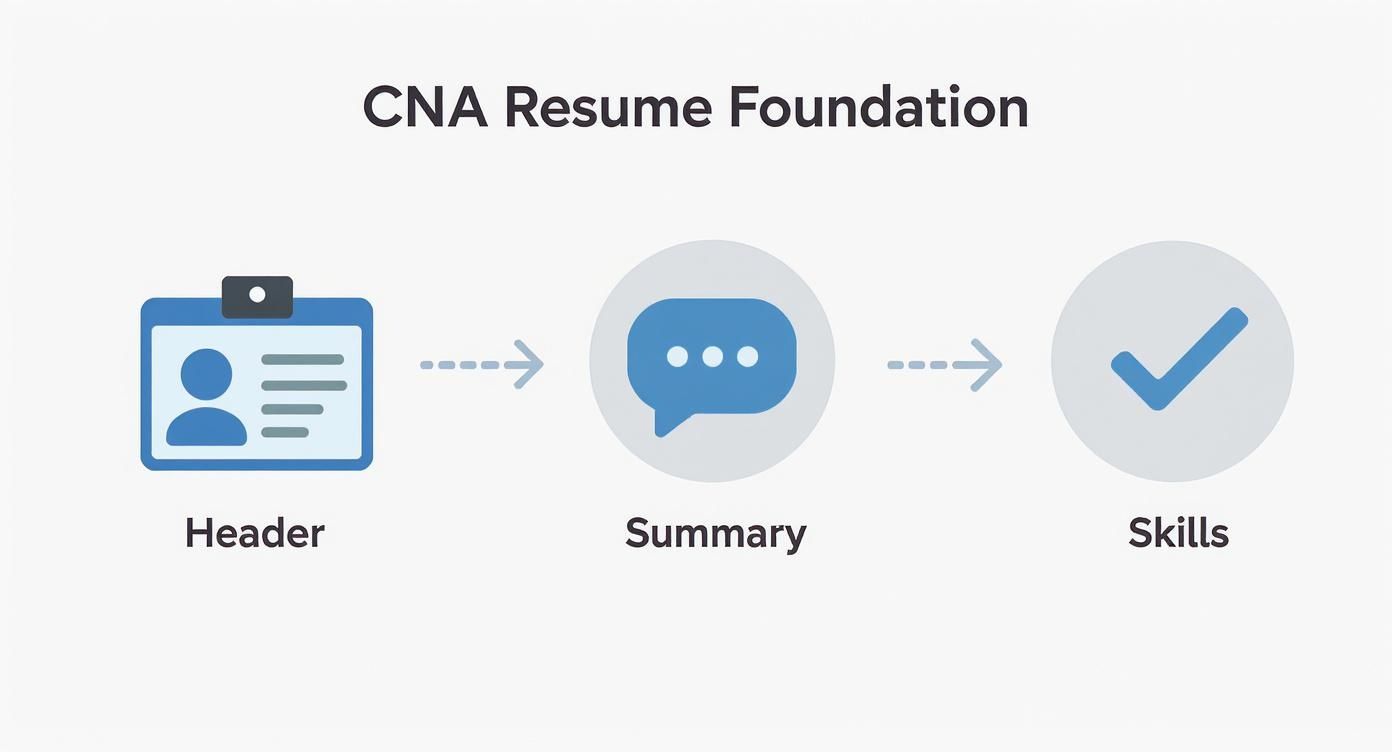
When your header, summary, and skills are already sharp and professional, the detailed accomplishments you list here become that much more believable.
Put Numbers to Your Work
Numbers are powerful. They catch the eye and offer solid proof of what you're capable of. Ditch the vague statements and use real data to show your competence and hard work.
Let’s look at a quick before-and-after:
- Before: Monitored patient vital signs.
- After: Accurately monitored and documented vital signs for 20+ patients per shift, promptly reporting any deviations to nursing staff to ensure timely interventions.
See the difference? The "after" version paints a clear picture of your workload, your attention to detail, and how you fit into the larger healthcare team. These details are exactly what employers are looking for, since a CNA job description covers a huge range of tasks that can be quantified.
Customize Your Experience for the Job
Your resume isn't one-size-fits-all. The most effective ones are tailored to the specific environment you're applying to. For example, a hospital CNA resume should highlight your experience with acute care and teamwork, while a home health resume should focus more on your compassion and ability to work independently.
Here’s how you can frame your accomplishments for different settings:
For a Long-Term Care Facility
- Weak: Assisted residents with ADLs.
- Strong: Improved the well-being for a 12-resident caseload by providing compassionate assistance with ADLs, contributing to a 15% increase in positive family feedback scores.
For a Hospital Setting
- Weak: Helped with patient mobility.
- Strong: Supported post-operative recovery on the orthopedic unit by safely assisting 8-10 patients daily with mobility exercises, directly contributing to reduced fall risks.
For Home Health Care
- Weak: Provided companionship and care.
- Strong: Ensured patient safety and comfort for an elderly client, maintaining 100% adherence to a complex medication and care schedule, which allowed them to remain safely in their own home.
Every single bullet point is a chance to sell yourself. When you focus on measurable results and kick things off with strong action verbs, you’re not just listing tasks—you’re telling a compelling story about a proactive and highly effective caregiver.
Showcasing Your Core CNA Skills and Certifications
Think of your skills and certifications section as the powerhouse of your resume. This is where you give a hiring manager—and the automated systems they use—a fast, clear look at what you bring to the table. Get this part right, and you instantly signal that you're a qualified, serious candidate.
To really make an impact, you need a smart mix of hard skills (the clinical tasks you're trained for) and soft skills (the personal traits that make you an amazing caregiver). Remember, Applicant Tracking Systems (ATS) are programmed to scan for specific keywords, so a well-built skills list is your ticket to getting your resume in front of human eyes.
Highlighting Essential Hard Skills
Hard skills are your bread and butter—the tangible, teachable abilities that are non-negotiable for any CNA role. These are the first things a recruiter looks for to confirm you can handle the job's core duties.
Make your list easy to scan and customize it for every job you apply to. If the description for a hospital position specifically mentions EHR systems, you absolutely need to have that on your resume.
Here are some of the must-have hard skills to include:
- Patient Care: Vital Signs Monitoring, Activities of Daily Living (ADLs) Support, Patient Mobility and Transfers, Catheter Care, Basic Wound Dressing
- Safety and Compliance: Infection Control Protocols, Patient Safety Procedures, HIPAA Compliance, Fall Prevention Strategies
- Medical and Technical: CPR/BLS Certification, Electronic Health Records (EHR) Charting, Blood Glucose Monitoring, Specimen Collection
Showcasing Crucial Soft Skills
If hard skills prove you can do the job, soft skills show how you'll do it. These interpersonal qualities are what separate a good CNA from a great one. They tell a story about your ability to connect with patients, work with a team, and handle the pressure of healthcare.
It's easy to just list "communication skills," but that doesn't really say much. Try to frame these skills in the context of your work. A strong soft skills section shows you have the emotional intelligence and professionalism to thrive in demanding situations.
Consider adding a few of these high-impact soft skills:
- Empathy and Compassion: Providing genuine emotional support to patients and their families.
- Communication: Clearly and concisely relaying patient status updates to nurses and physicians.
- Patience and Resilience: Maintaining a calm and professional demeanor during stressful or challenging events.
- Attention to Detail: Accurately documenting patient vitals and noticing subtle changes in their condition.
- Teamwork and Collaboration: Working seamlessly with nurses, therapists, and other staff to deliver cohesive care.
Placing Your Certifications for Maximum Impact
Your certifications are your proof of qualification, so they need to be front and center. I always recommend creating a dedicated "Licenses & Certifications" section so they're impossible to miss. This immediately tells a hiring manager you meet the baseline requirements.
Be specific. Always list the full name of the certification, who issued it, and your license or registry number. If you're looking to stand out even more, you can learn more about specialty certifications for CNAs that can give you a real edge.
Here’s a clean, professional way to list them:
- Certified Nursing Assistant (CNA), [Name of State Board of Nursing], Registry #1234567, Expires MM/YYYY
- Basic Life Support (BLS) for Healthcare Providers, American Heart Association, Expires MM/YYYY
Your Professional Summary and Education: Making a Strong First Impression
Think of your professional summary as your elevator pitch. It’s the very first thing a hiring manager sees, and you’ve got about two sentences to convince them you’re the right person for the job. It has to be sharp, confident, and answer one simple question: "Why you?"
This quick intro is your chance to frame your entire resume. If you’re a recent graduate, it's where you show off your fresh training and passion. For a veteran CNA, it's where you highlight your years of hands-on experience and specialized skills.
In a field with high turnover, this matters more than you’d think. There are over 750,000 CNAs, and the average person stays in a job for only one or two years. Because of this, facilities are always looking for signs of commitment and professionalism right from the get-go. You can dig into more of this data on CNA workforce dynamics from Zippia.
How to Write a Summary That Gets Noticed
Your mission here is to summarize your value—fast. Ditch the generic fluff like "hard-working team player" and get specific. The best way to do this is to read the job description, pick out the key phrases and skills they’re looking for, and mirror that language.
Let's look at how to tailor it based on your experience.
For the Experienced CNA
"Compassionate, state-certified CNA with 7+ years of experience in fast-paced geriatric and memory care settings. Proficient in EHR charting, patient mobility assistance, and fostering a safe, dignified environment for residents. Seeking to bring proven skills in patient-centered care to the team at [Facility Name]."
For the New CNA Graduate
"Dedicated and recently certified CNA with 120+ hours of hands-on clinical training in long-term care. Eager to apply skills in vital signs monitoring, ADL support, and infection control to provide exceptional patient care. Seeking an opportunity to contribute to the compassionate team at [Facility Name]."
See the difference? Both are specific, mention the type of environment they're targeting, and use strong, active language. They're customized, not generic.
Getting Your Education Section Right
Right after your summary, your education section provides the proof that you’re qualified. This part doesn’t need to be long-winded, but it absolutely must be clear and accurate.
Always list your most relevant qualification first: your CNA training. This immediately tells the recruiter you meet the basic requirements and they can keep reading.
Here’s a simple, clean format that works every time:
- [Name of CNA Program], City, State
- Certificate of Completion, Certified Nursing Assistant, [Year]
- [Name of High School or College], City, State
- High School Diploma or [Degree Name], [Year]
This approach is direct and easy to scan, helping your resume move forward in the hiring process without a hitch.
Polishing Your Resume's Format and Design
You've put in the hard work crafting the perfect content for your resume. Now it's time for the final, crucial step: making sure it looks as professional as it reads. A clean, easy-to-read design is your best friend here, helping both hiring managers and automated systems quickly spot why you're the right person for the job.
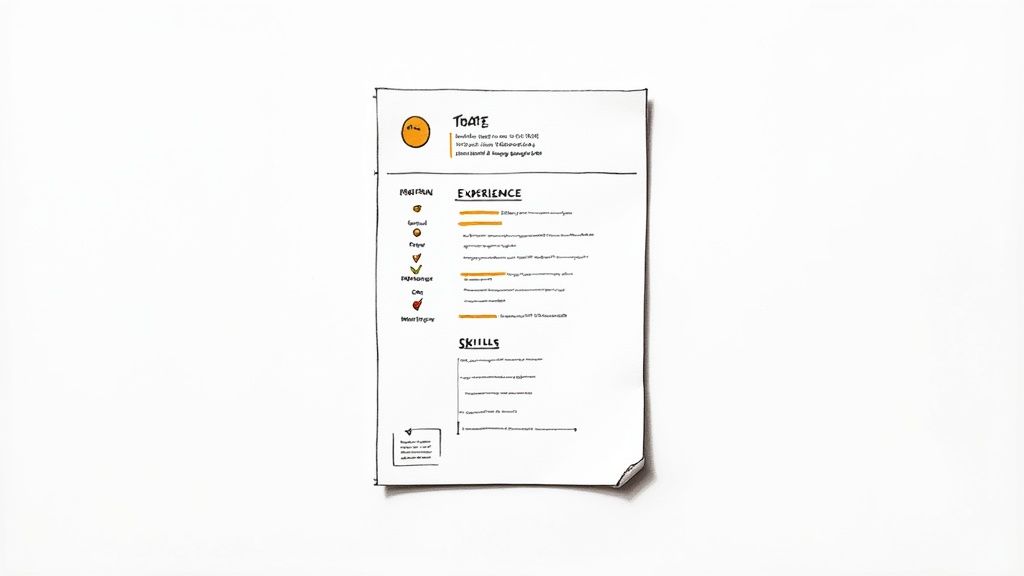
Think of the design as the supporting act—it shouldn't steal the show. Its only job is to guide the reader's eye to your most impressive qualifications. Simple choices about fonts, spacing, and file types make a bigger difference than you might think.
Choosing a Clean and Professional Layout
When it comes to your resume's layout, readability is everything. Both Applicant Tracking Systems (ATS) and human recruiters scan resumes incredibly fast, so a simple, straightforward format is non-negotiable. This is where a lot of great candidates get screened out before a person ever sees their application.
Here are a few formatting tips that always work:
- Pick the Right Font: Stick to the classics. Fonts like Calibri, Arial, or Georgia are professional and easy on the eyes. Keep the size between 10 and 12 points.
- Embrace White Space: A cramped resume is a nightmare to read. Give your content room to breathe with margins of at least 0.75 inches and add blank lines between each section.
- Stay Consistent: Make sure all your formatting choices are consistent from top to bottom. If one job title is bold, they all should be. If you use bullet points, keep the style the same throughout.
If you're feeling stuck or just want to make sure your resume is perfectly structured for the medical field, try using an online resume builder designed for healthcare professionals. These tools handle the ATS-friendly formatting for you, so you can focus entirely on the content.
Your Final Pre-Submission Checklist
Don't hit that "send" button just yet. Taking five extra minutes to run through a final checklist can be the difference between getting an interview and getting overlooked because of a simple mistake.
Your resume is the first impression a hiring manager has of you. A single typo or formatting glitch can unintentionally suggest a lack of attention to detail—a skill that’s absolutely critical for any CNA.
Go through these last-minute checks every single time:
- Proofread Like a Pro: First, read your resume out loud. This helps you catch any clunky sentences. Then, read it backward—word by word—to catch spelling errors your brain would normally autocorrect.
- Verify Your Contact Info: Is your phone number right? Is your email address professional? A single-digit typo here means an employer literally can't contact you for an interview.
- Save It as a PDF: Always, always save and send your resume as a PDF. This locks your formatting in place, so it looks exactly how you designed it, no matter what computer or software someone uses to open it.
- Name Your File Smartly: Don't just save it as "resume.pdf." A professional file name like "FirstName-LastName-CNA-Resume.pdf" shows you’re organized and detail-oriented from the get-go.
Common Questions About Writing a CNA Resume
Even with a solid plan, you're bound to run into a few tricky questions when you sit down to write your resume. It's totally normal. Getting the small details right can feel overwhelming, but it's those details that make your resume stand out.
Let's walk through some of the most common uncertainties I see from CNAs so you can feel confident your resume is polished, professional, and ready to land you that interview.
Should I Use a Resume Objective or a Summary?
This is a classic question, and the answer really comes down to where you are in your career.
If you’re an experienced CNA, go with a professional summary. It’s a powerful little snapshot at the top of your resume that lets you immediately show off your biggest wins and key skills. Think of it as your highlight reel.
But if you're a new graduate, an objective is your best bet. Since you don't have years of experience to summarize, an objective shifts the focus to your career goals, your passion for the field, and what you learned in your training.
- Summary Example (Experienced): "Dedicated CNA with 5+ years of experience in fast-paced hospital settings, proficient in EHR charting and patient mobility assistance."
- Objective Example (New Grad): "Compassionate CNA graduate seeking to apply clinical training in patient care and safety within a long-term care facility."
How Do I Make My Resume Strong With No Job Experience?
This is the number one worry for new grads, but don't panic. You have more experience than you think—it’s just a matter of framing it correctly. Your clinical rotations were your first job, and you need to treat them that way on your resume.
Start by moving your Education section right to the top, just below your contact information and objective. This immediately signals to the hiring manager that you've got the necessary credentials.
Your clinical hours are your proof of experience. Don’t just say you completed them—detail what you did during that time. Mentioning specific skills like infection control or assisting with ADLs shows you’re ready to contribute from day one.
Consider adding a "Clinical Rotations" section where you can use bullet points to describe your hands-on training. And don't forget about other jobs you've had! If you worked in retail or food service, highlight transferable skills like communication, time management, and customer service. These are all incredibly relevant to patient care.
Where Should I List My CNA License Number?
Your license number is non-negotiable. It’s the first thing a hiring manager looks for to verify you’re qualified, so you need to make it incredibly easy to find.
Here are the two best places to put it:
- In your contact header: Add it right next to your name at the very top (e.g., Jane Doe, CNA | Registry #: 12345).
- In a dedicated "Licenses & Certifications" section: Create a specific spot for all your credentials to live.
Honestly, I recommend doing both. It’s a simple trick that guarantees no one can miss it, whether they're just skimming your resume or reading it in detail.
What Are the Most Important Skills for a CNA Resume?
A great CNA resume shows you have both the technical know-how and the right personality for the job. You need a mix of hard skills (the clinical tasks) and soft skills (your people skills).
For your hard skills, you absolutely need to include keywords like Vital Signs Monitoring, Patient Safety, Infection Control, CPR/BLS, and Activities of Daily Living (ADLs) support.
For soft skills, think about what makes a CNA truly great at their job. Words like Compassion, Communication, Patience, and Teamwork are essential.
Here’s the most important tip I can give you: always, always read the job description carefully. Look for the specific skills they mention and make sure those exact words are on your resume. This simple step helps you get past automated filters and shows the hiring manager you're a perfect match.
At The CNA Guide, our mission is to provide you with clear, actionable resources for every step of your career journey. From finding the right training program to acing your interviews, we’re here to help you succeed. Explore more free guides and resources on our website.