A travel CNA is a certified nursing assistant who works on short-term assignments in different healthcare facilities, rather than staying put in one permanent job. Think of them as the skilled reinforcements who step in to fill critical staffing gaps, offering their expertise and support wherever it’s needed most.
What Does a Travelling CNA Actually Do?
Imagine being a healthcare specialist who gets to see the country. Instead of working for the same hospital or clinic year after year, a travel CNA takes on temporary contracts that can last anywhere from a few weeks to several months. This role is all about being adaptable and having a rock-solid set of skills you can apply anywhere.
Travel CNAs are the backbone of patient care, but they do it on the move. They provide the same essential, hands-on support as any other CNA, but their "office" changes with each assignment. This offers an incredible amount of flexibility in both where you work and the type of environment you work in.
This infographic paints a clear picture of the difference between the dynamic, on-the-go career of a travel CNA and the more stable, single-location role of a staff CNA.
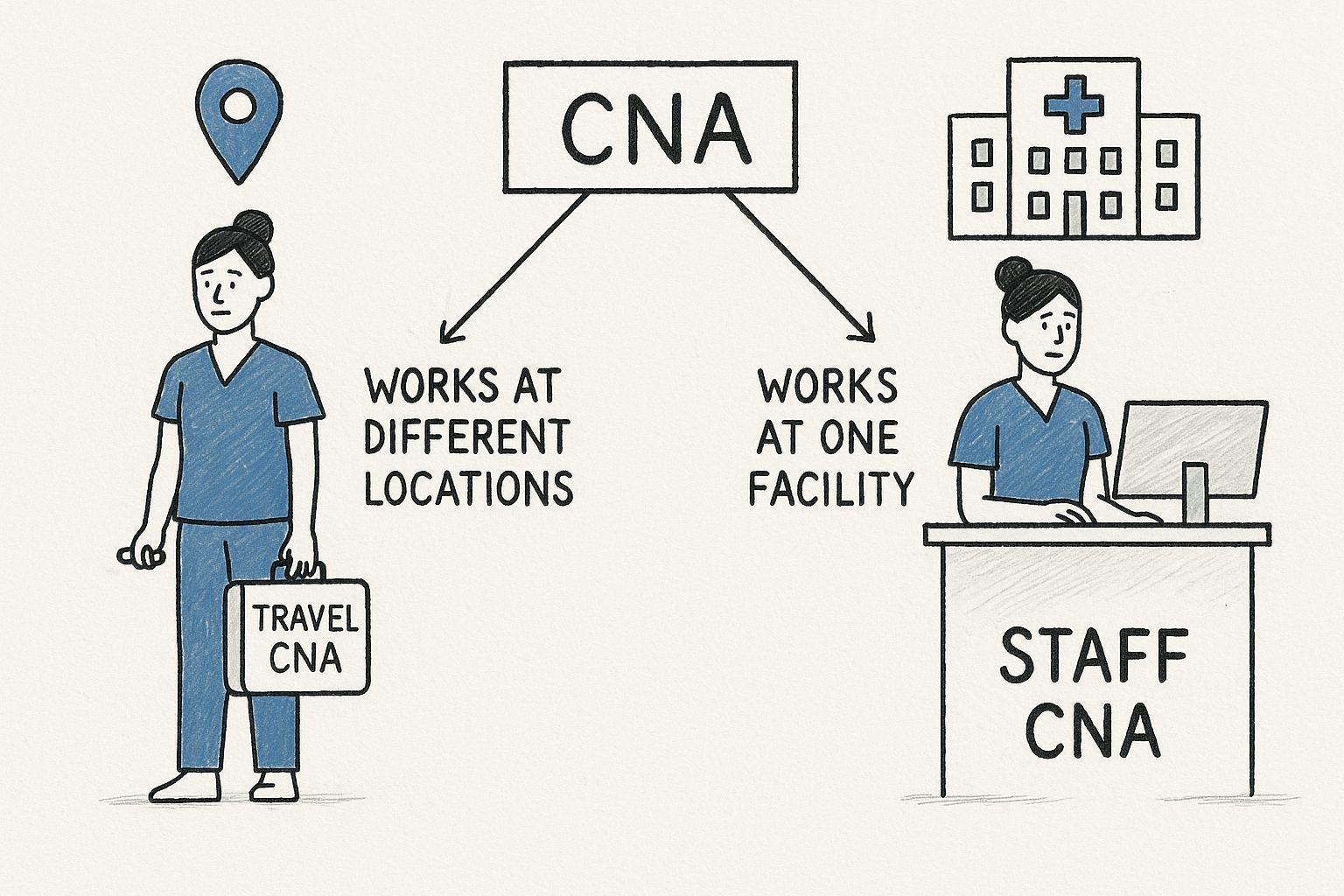
As you can see, while both paths center on patient care, the travel route is built for variety and movement. The staff path, on the other hand, offers consistency and a deep sense of familiarity with one workplace.
Travel CNA vs Staff CNA at a Glance
So, what really separates these two career paths? At the end of the day, the core duties of helping patients are identical. The real difference lies in the job's structure, lifestyle, and pay. Taking a closer look at CNA travel jobs can give you a better feel for which path fits your personal and professional goals.
To make it even clearer, let's break down the key distinctions side-by-side.
Travel CNA vs Staff CNA at a Glance
| Aspect | Travel CNA | Staff CNA |
|---|---|---|
| Work Environment | Always changing. You’re constantly adapting to new teams, facility policies, and locations with every contract. | Stable and consistent. You develop deep familiarity with one team, the facility’s layout, and its procedures. |
| Pay Structure | Typically includes a higher base pay plus non-taxed stipends to cover housing and meals. | A standard hourly wage or salary with predictable, regular paychecks and standard benefits. |
| Lifestyle | Dynamic and adventurous. It involves frequent travel, exploring new cities, and adapting on the fly. | Rooted in one community. This offers a predictable routine, a consistent schedule, and a stable home life. |
| Job Security | Relies on a series of short-term contracts. You'll need to line up your next assignment as one is ending. | Permanent employment offers long-term stability with a consistent schedule and job security. |
Ultimately, choosing between these two paths comes down to what you value most: the adventure and financial perks of travel or the stability and routine of a permanent role.
A Day in the Life of a Travel CNA

While the core tasks of a travel CNA look a lot like those of a permanent one, the day-to-day reality is worlds apart. It's less about a predictable routine and more about mastering the art of hitting the ground running. Every new assignment is a fresh start, forcing you to quickly get the lay of the land—from the facility's floor plan to the personalities on your team and their specific ways of doing things.
Those first 48 hours can feel like a blur of faces, names, and new rules. You’re not just learning the basics; you're also figuring out who to go to for what and, crucially, how to use their specific electronic health record (EHR) system. This is where your adaptability truly gets put to the test.
The ability to integrate seamlessly is what separates a good travel CNA from a great one. It’s about being a quick study, asking intelligent questions, and demonstrating competence and confidence from the moment you step onto the floor.
Navigating New Environments
Picture this: you're walking into a long-term care facility you've never seen before. Your morning still involves helping residents with their activities of daily living (ADLs) like bathing and dressing, but you're doing it while mentally mapping out where the clean linens are, learning the emergency codes, and picking up on how this particular team communicates during shift changes.
As your assignment progresses, your role subtly shifts. You're no longer the new person just trying to keep up. By the final week, a big part of your job is making sure the transition for the next person—whether that’s a permanent staff member or another traveler—is as smooth as possible.
Before you wrap up, you'll find yourself focused on a few key tasks:
- Detailed Charting: Leaving behind meticulous patient records is non-negotiable. You want to make sure the next caregiver has a crystal-clear picture of everything.
- Patient Handoffs: You'll give thorough reports to the permanent staff, pointing out any subtle changes in a patient's condition or specific needs you noticed during your time there.
- Organizing Your Station: A simple but vital step. You’ll leave your workspace clean and fully stocked so the next person can jump right in without any hassle.
Ultimately, a day in the life of a travel CNA is a masterclass in resilience. It's about delivering top-notch patient care while constantly adapting to the change that defines the job—and proving your worth with every contract you take.
Your Roadmap to Becoming a Travel CNA
Ready to turn your CNA skills into a ticket to see the country? It's an exciting thought, but launching a career as a travel CNA is more than just packing a suitcase. You need the right credentials and experience to make it happen.
Think of it as building a professional passport—one that proves you have the skills to work anywhere. Let's walk through the essential steps to get yours stamped and ready.
It all starts with a solid foundation. The very first step, and it's non-negotiable, is to complete a state-approved Certified Nursing Assistant program. This is where you'll get the fundamental knowledge and hands-on training that every other step builds on.
Once your training is done, you'll need to pass your state’s CNA competency exam. This certification is your official license to practice, proving you meet the high standards of care required in the field.
Gaining Essential Experience and Credentials
With your fresh certification in hand, it's time to get some real-world experience under your belt. Most staffing agencies and hospitals are looking for travel CNAs with at least one year of recent clinical experience.
This isn't just a number on a page. It shows them you can step into a new environment and confidently handle diverse patient needs without a lot of hand-holding.
From there, you’ll need to gather a few key credentials that are standard across the healthcare industry:
- Basic Life Support (BLS) Certification: This is a must-have for almost any role involving direct patient care. You'll typically get this from the American Heart Association or a similar group.
- State Licensure: You have to be licensed in the state where you want to work. Figuring out the different state requirements is a big part of being a traveler.
Understanding license reciprocity is crucial. Some states have a straightforward process for transferring your license. Others might be part of compacts that simplify things for nurses, but the rules for CNAs can vary. You'll always need to research the specific rules for any state you're considering.
Once you have your experience and credentials lined up, you're ready to connect with a staffing agency and start looking at assignments. For a deeper dive into each step of this process, our complete guide on how to become a traveling CNA has all the details you need to get started.
Following these steps will make you a qualified, sought-after candidate ready for the adventure that awaits.
Breaking Down the Travel CNA Pay Package
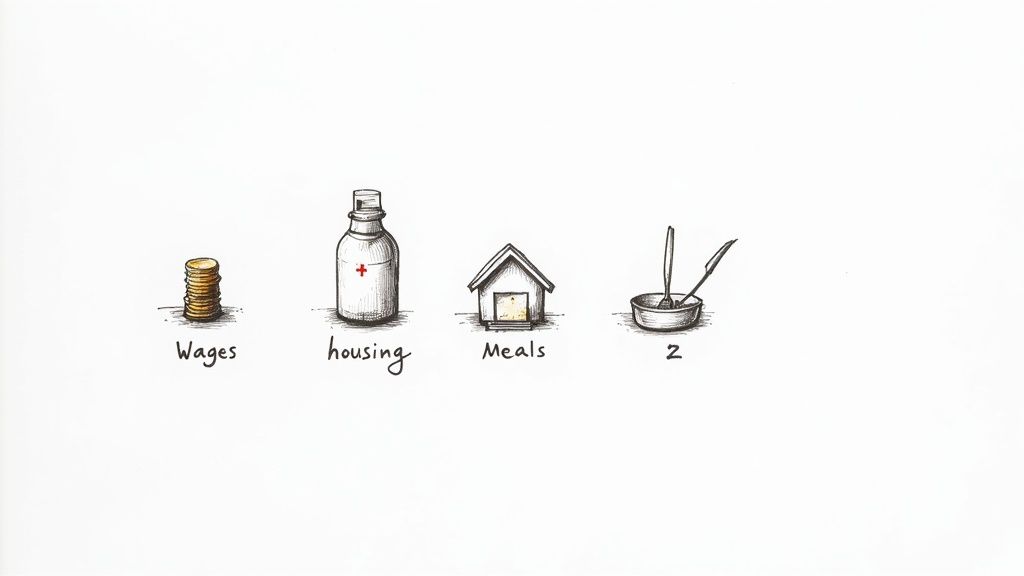
Let’s be honest: one of the biggest reasons CNAs look into travel assignments is the money. It's not a secret that travel gigs often pay significantly more than permanent staff positions, and it’s not just because the hourly rate is higher. The real magic is in how the pay is structured.
Most travel CNA jobs offer what’s called a "blended" pay package. It’s a combination of a standard hourly wage and tax-free reimbursements, and understanding this mix is crucial to seeing the full financial picture. This structure is designed to reward you for being flexible and willing to go where you’re needed most.
It’s about more than just the final number on your weekly paycheck; it’s about how that number is built.
Your Hourly Wage and Non-Taxed Stipends
First, you have your taxable hourly wage. This is pretty straightforward—it's the base rate you earn for every hour you put in, just like any other job. But for a traveler, this is often just the starting point.
The second, and often more impactful, part of your pay comes from non-taxed stipends. These are fixed amounts of money given to you each week or month to cover your living expenses while you’re away from home. This is where you really start to see the financial advantage.
Think of it this way: your taxable wage is what you earn for your skills. The stipends are your agency reimbursing you for the costs of living on the road—and because it’s a reimbursement, it’s not taxed as income.
These tax-free stipends are meant to cover the essentials:
- Housing: Money to pay for your temporary apartment, extended-stay hotel, or other lodging.
- Meals: A daily allowance (often called a per diem) to cover your food costs.
- Incidentals: A little extra to handle other small expenses that pop up when you're traveling.
So, how much can you actually make? The numbers can be pretty impressive, though they change a lot based on location, assignment urgency, and the agency you work with. Across the country, the average weekly pay for a travel CNA hovers around $1,011. But with high-demand assignments, some of the top-paying agencies offer contracts reaching up to $2,230 per week. For more detailed salary information, resources like Vivian Health provide up-to-date insights on travel CNA pay.
The Reality of the Travel CNA Lifestyle
The idea of being a travel CNA sounds like a dream, doesn't it? You get paid to explore new places, meet new people, and grow your skills. And while that's absolutely a huge part of it, it's not a permanent vacation.
To really thrive in this career, you need to see the whole picture—the incredible highs and the very real challenges. It’s a dynamic lifestyle that offers amazing opportunities, but it demands a certain kind of person to make it work.
The Major Advantages
Let's start with the good stuff, because there's a lot of it. The perks are what pull most people into this line of work, and they go way beyond just getting a new view outside your window.
- Higher Earning Potential: As we mentioned, travel CNAs often earn quite a bit more than staff CNAs. This is thanks to blended pay packages that include tax-free stipends for things like housing and food.
- Explore New Places: Every assignment is a new adventure. You get to live like a local in a different city for weeks or months at a time, and your job is footing the bill.
- Professional Growth: You’ll be constantly learning. Adapting to new teams, different charting systems, and diverse patient needs makes you an incredibly versatile and experienced caregiver, which really makes your resume pop.
The lifestyle of a travelling CNA is one of constant learning and adaptation. You're not just earning a living; you're investing in a uniquely broad set of experiences that can shape your entire career trajectory.
The Practical Challenges
Now, let's talk about the other side of the coin. The reality of the travel CNA lifestyle isn't always glamorous. It takes real resilience and solid planning to navigate the hurdles.
For starters, you're always on the move. Packing up your life every few months is a huge logistical task, from finding short-term housing to figuring out where your mail should go. Plus, different states have different rules. You'll need to get familiar with the ins and outs of CNA license reciprocity to make sure you can work legally and without delay.
On top of that, here are a few other things to be ready for:
- Potential Loneliness: It can get isolating being so far from family and friends. Those first few assignments, especially, can be tough while you’re still finding your footing.
- Instability: This isn't a 9-to-5 job with guaranteed long-term stability. You're working on contracts, which means as one assignment winds down, you're already hunting for the next one.
- Adaptation Fatigue: Imagine starting a new job every 13 weeks. Learning new facility rules, different EMR systems, and getting to know a whole new team over and over can be mentally exhausting.
Finding Your First Travel CNA Gig
Okay, so you've got your certifications and experience lined up. Now for the exciting part: actually finding a travel assignment. This isn't like applying for a regular staff job down the street. Your best friend in this process is going to be a good staffing agency.
Think of an agency recruiter as your personal agent in the healthcare world. They're not just a job board; they’re the ones who find gigs that fit your experience, fight for your contract terms, and often sort out the headaches of housing and travel. A solid recruiter is your guide, your advocate, and your lifeline when you're on the road.
Choosing the Right Agency to Work With
This is probably the single most important decision you'll make when starting out. The demand for traveling healthcare pros has absolutely exploded—we're talking a 430% jump in travel nurses and CNAs between 2018 and 2022. You can dig into the numbers in these recent travel nursing statistics. That boom means a lot of new agencies have popped up, so you need to be smart about who you partner with.
When you're checking out agencies, here's what to look for:
- Reputation and Real Reviews: What are other travelers saying? Hunt down reviews and see what people say about their support, how reliable they are, and the quality of the jobs they offer.
- The Benefits: Don't just look at the hourly rate. Compare their health insurance, check for a 401(k) or other retirement options, and see what they cover for reimbursements.
- Your Recruiter: This is huge. Do you actually click with the person on the phone? A good recruiter listens to you, is upfront about the good and the bad, and genuinely cares about what you want for your career.
Making Your Application Pop
Once you've found an agency you like, it's time to sell yourself. For a travel CNA, your resume needs to shout one thing loud and clear: adaptability.
Your resume is your highlight reel. It should scream 'I can hit the ground running.' Emphasize experience across different settings, your familiarity with various charting systems, and your ability to quickly integrate with new teams.
When it comes to the interview, remember it’s a two-way street. You're interviewing the facility just as much as they're interviewing you. Ask tough questions. Get the details on the facility, the specific unit you'd be on, typical patient ratios, and exactly what they'll expect from you. Asking smart, specific questions shows you're a pro who gets it. That confidence is what will land you a great first assignment and get your adventure started off right.
At The CNA Guide, we provide the resources you need to confidently plan your career, navigate credentialing, and find rewarding assignments nationwide. Explore our comprehensive guides and start your journey today at https://thecnaguide.com.